

Cointime

Download App
iOS & Android

Jimmy Song slams Bitcoin Core devs for 'fiat' mentality on OP_Return

Jimmy Song, a Bitcoin 

BTC$114,510developer and advocate, slammed the decision by Bitcoin Core developers to remove the OP_Return limit for non-monetary data embedded on the Bitcoin blockchain in the upcoming Bitcoin Core 30 upgrade, calling it “fiat” mentality.

Song accused the Core developers of deflecting user concerns about removing the OP_Return limit, which is currently 80 bytes in size, and ignoring the significant pushback from the Bitcoin community and node runners. He also said:

“The idea that spam is difficult to define, and because of this ambiguity, we shouldn't be making any distinctions at all in the software, is a time-wasting argument from fiat politics where you pretend not to know the obvious, so the actual debate can never get off the ground — the non-monetary uses of Bitcoin are spam.

You can argue whether that's something desirable or not, but saying you can't define it is a stalling tactic meant to avoid the real argument about actual impact — particularly, the long-term impact of this change,” Song continued.
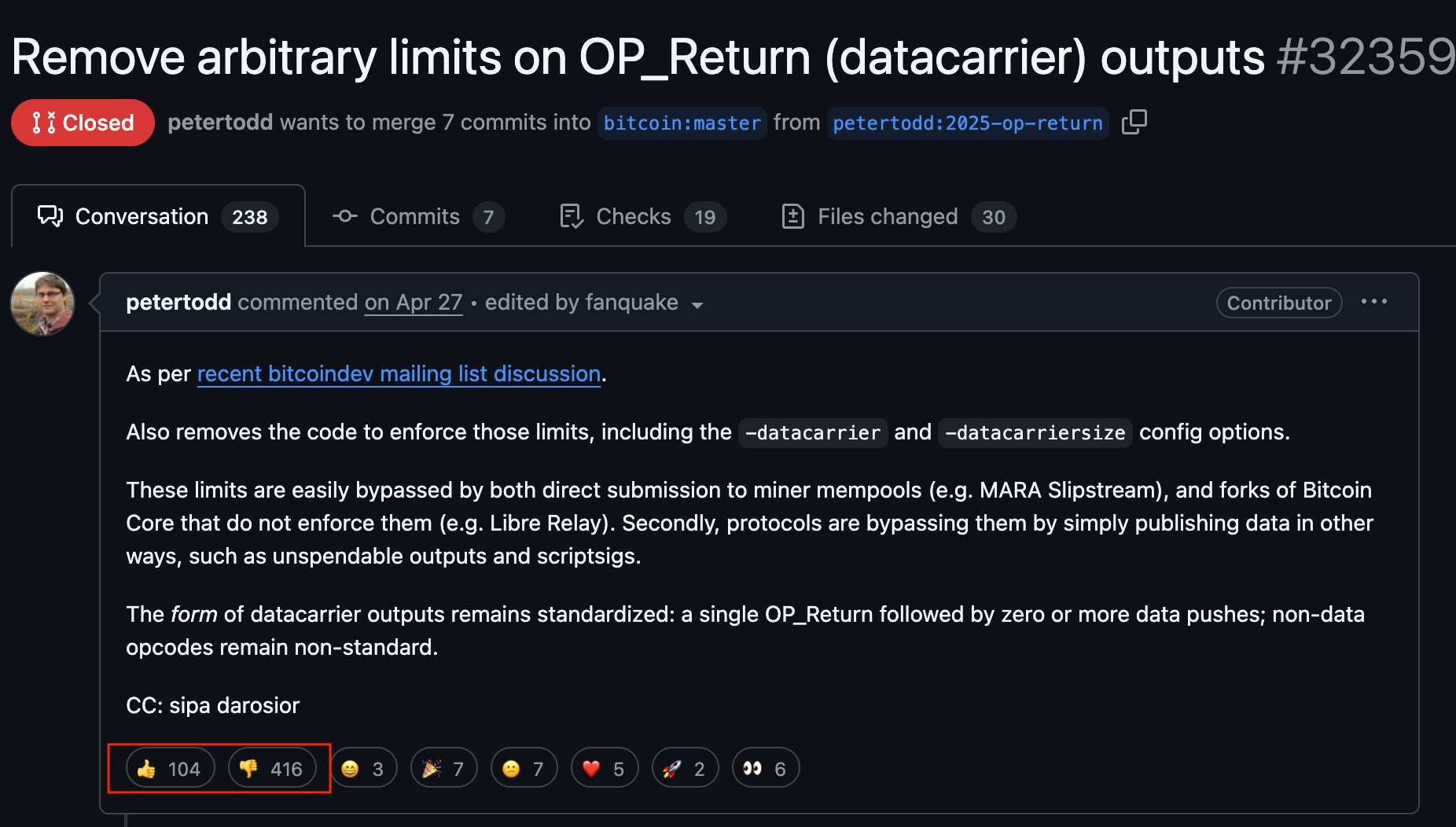
The pull request for removing the OP_Return limit was highly unpopular with the Bitcoin community, but was pushed through regardless. Source: GitHub

The OP_Return debate has raged on for nearly six months, and is reminiscent of the Bitcoin block size wars that took place between 2015 and 2017, which eventually resulted in a hard fork of the Bitcoin protocol that spawned Bitcoin Cash 

BCH$587.60, leading some in the Bitcoin community to speculate if the OP_Return wars will result in a similar split.

Node runners vote with their feet in historic exodus to Bitcoin Knots

The decision by Bitcoin Core devs to unilaterally blow open the OP_Return data limit has left the Bitcoin community divided and driven record numbers of Bitcoin node runners to Bitcoin Knots, an alternative implementation of the Bitcoin node software.

This surge in nodes running Bitcoin Knots, which now account for about 20% of the network, compared to about 1% in 2024, represents a near-vertical leap in just nine months.
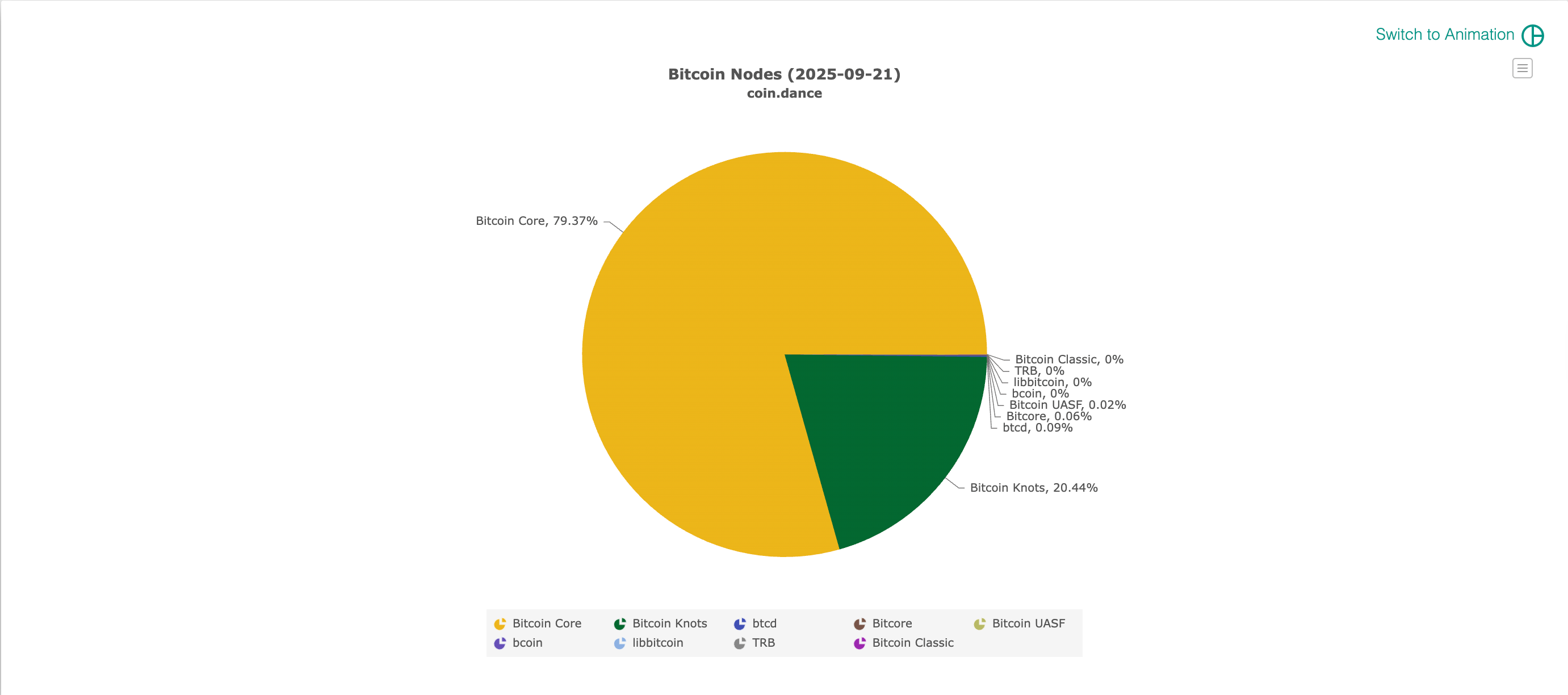
A breakdown of the different node software implementations on the Bitcoin network. Source: Coin Dance

Knots allows node runners to enforce strict data size limits, which proponents argue is necessary to preserve the decentralization of the Bitcoin protocol.

The Bitcoin ledger has generated about 680 gigabytes of data since the inception of the decentralized protocol in 2009, thanks to the simple architecture of Bitcoin and strict data limits.

Bitcoin’s low data storage requirements allow anyone to run a node on retail computer hardware for as little as $300, democratizing access and ensuring maximum decentralization.

For comparison, higher-throughput blockchain networks and smart contract platforms, which generate far more data, can cost tens of thousands of dollars to run and require specialized commercial hardware, meaning only wealthy investors and large corporations can run nodes and enforce the consensus rules of those protocols.

Robust hardware requirements translate into increased centralization of a blockchain protocol and a heightened risk that a few nodes can collude to alter the consensus rules or reverse transactions.


Comments

All Comments

Recommended for you

  • Zhipu Launches and Open Sources GLM-5.3-Flash

    On August 26, Zhipu launched and open-sourced GLM-5.3-Flash (320B-A18B), the first native multimodal model in the GLM-5 series. It features a total of 320 billion parameters and surpasses GLM-5.2, achieving a score of 57 on the globally recognized Artificial Analysis Intelligence Index (AA Comprehensive Intelligence Index), placing it among the leading models worldwide, on par with Anthropic's popular model Claude Opus 4.8. In the self-developed Z.ai Code Bench evaluation, its programming performance is comparable to that of Claude Opus 4.8. Additionally, GLM-5.3-Flash is priced at 1/10 of GLM-5.3, and during a limited-time discount, it is priced at 1/20 of GLM-5.3, which is 1/40 of Opus 4.8. The same intelligence at 1/40 the price, cutting-edge capabilities without the need to hold back.

  • Zhipu Launches and Open Sources GLM-5.3-Flash

    On August 26, Zhipu launched and open-sourced GLM-5.3-Flash (320B-A18B), the first native multimodal model in the GLM-5 series. It has a total of 320 billion parameters and surpasses GLM-5.2, achieving a score of 57 in the globally recognized Artificial Analysis Intelligence Index (AA Comprehensive Intelligence Index), placing it among the leading models worldwide, on par with Anthropic's popular model Claude Opus 4.8. In the self-developed Z.ai Code Bench evaluation, its programming performance is comparable to that of Claude Opus 4.8. Meanwhile, GLM-5.3-Flash is priced at 1/10 of GLM-5.3, and during a limited-time discount, it is available for 1/20 of GLM-5.3's price, which is 1/40 of Opus 4.8's price. The same intelligence, at 1/40 the cost, provides cutting-edge capabilities without the need to hold back.

  • Ethereum Developers Propose Restructuring Validator Staking Contract to Prepare for Quantum Attacks

    On August 26, Ethereum researchers proposed a draft to rebuild the validator deposit contract in preparation for the future introduction of quantum-resistant signature mechanisms, allowing for a gradual phase-out of the existing BLS signature format. This proposal enables the deposit contract to support keys of different sizes and public key types, assigning labels for each cryptographic scheme, with the current BLS signature labeled as 0 and potential future quantum-resistant schemes receiving new labels. Currently, approximately 42.4 million ETH, worth around $10.4 billion, are staked in Ethereum, all relying on BLS validator keys. This draft is still in its early stages and must be implemented alongside subsequent consensus layer upgrades, with the Ethereum Foundation's overall quantum resistance roadmap targeting around 2029.

  • Ethereum Developers Propose Restructuring Validator Staking Contract to Prepare for Quantum Attacks

    On August 26, Ethereum researchers proposed a draft to rebuild the validator deposit contract in preparation for the future introduction of quantum-resistant signature mechanisms, allowing for a gradual phase-out of the existing BLS signature format. This proposal enables the deposit contract to support keys of different sizes and public key types, assigning labels for each cryptographic scheme, with the current BLS signature labeled as 0, and future quantum-resistant schemes to be assigned additional labels. Currently, approximately 42.4 million ETH, valued at around $10.4 billion, are staked in Ethereum, all relying on BLS validator keys. The draft remains in its early stages and must be implemented alongside subsequent consensus layer upgrades, with the Ethereum Foundation's overall quantum resistance roadmap targeting around 2029.

  • Spot Gold Falls Below $4600/Ounce

    On August 26, spot gold fell below $4600 per ounce, declining by 1.30% during the day.

  • Spot Gold Falls Below $4600/Ounce

    On August 26, spot gold fell below $4600 per ounce, declining by 1.30% during the day.

  • SEC Submits New Crypto Custody Regulations Proposal to White House

    On August 26, Bloomberg reported that the U.S. Securities and Exchange Commission (SEC) has submitted a proposal to the Office of Management and Budget (OMB) regarding new regulations for investment advisors holding client digital assets. The rule aims to 'clarify the framework for investment advisors and investment companies to custody crypto assets,' addressing inquiries from institutions on how to comply with the custody of digital assets. It plans to eliminate certain existing custody requirements that are considered 'outdated' due to market evolution and current trading and custody practices. This proposal is seen as a step by financial regulators to advance the current administration's crypto agenda while relevant legislation remains stalled in the Senate. It will take effect after review by the OMB, a vote by SEC commissioners, and a public comment period.

  • BTC Falls Below $78,000

    Market data shows that BTC has fallen below $78,000, currently priced at $77,983.75, with a 24-hour decline of 1.03%. The market is experiencing significant volatility, so please ensure proper risk management.

  • BTC Falls Below $78,000

    Market data shows that BTC has fallen below $78,000, currently priced at $77,983.75, with a 24-hour decline of 1.03%. The market is experiencing significant volatility, so please ensure proper risk management.

  • Alibaba Qwen Releases Qwen 3.8-Flash Model

    On August 26, Alibaba Qwen launched the Qwen 3.8-Flash model, which is a multimodal MoE model and an early preview of the Qwen 4 architecture. The production version of Qwen 3.8-Flash will soon be available through the Qwen Cloud API, priced at just $0.16 per million input tokens and $0.47 per million output tokens. The model features 125 billion parameters plus 51 billion N-gram embedding parameters, but activates only 6 billion parameters per token, achieving high cost-effectiveness.