


Key takeaways
- The SEC has clarified that solo staking, delegated staking and custodial staking, when tied directly to a network’s consensus process, do not qualify as securities offerings.
- Post May 29 guideline, rewards earned from network validation are seen as compensation for services, not profits from the efforts of others, removing them from the Howey test classification.
- Validators, node operators and retail or institutional stakers can now participate without fear of regulatory uncertainty, encouraging wider adoption of PoS networks.
- Yield farming, ROI-guaranteed DeFi bundles and staking-disguised lending schemes remain outside legal bounds and may be treated as securities offerings.
On May 29, 2025, the US Securities and Exchange Commission issued new guidance regarding crypto staking to bring regulatory clarity. Before the guideline was issued, investors and service providers were unsure whether regulators would view staking rewards as securities or not, risking legal trouble.
The SEC’s latest move clearly outlines which types of staking are allowed and which are not. The guidance provides clear regulatory support for node operators, validators and individual stakers, recognizing protocol staking as a core network function rather than a speculative investment.
This article explains how regulators will treat crypto staking under the new rules, which activities are still not allowed, who will benefit, and what practices to avoid.
Whether you are a solo validator or using a staking service, understanding these updates is key to staying compliant in the US.
The SEC’s latest guidance on staking
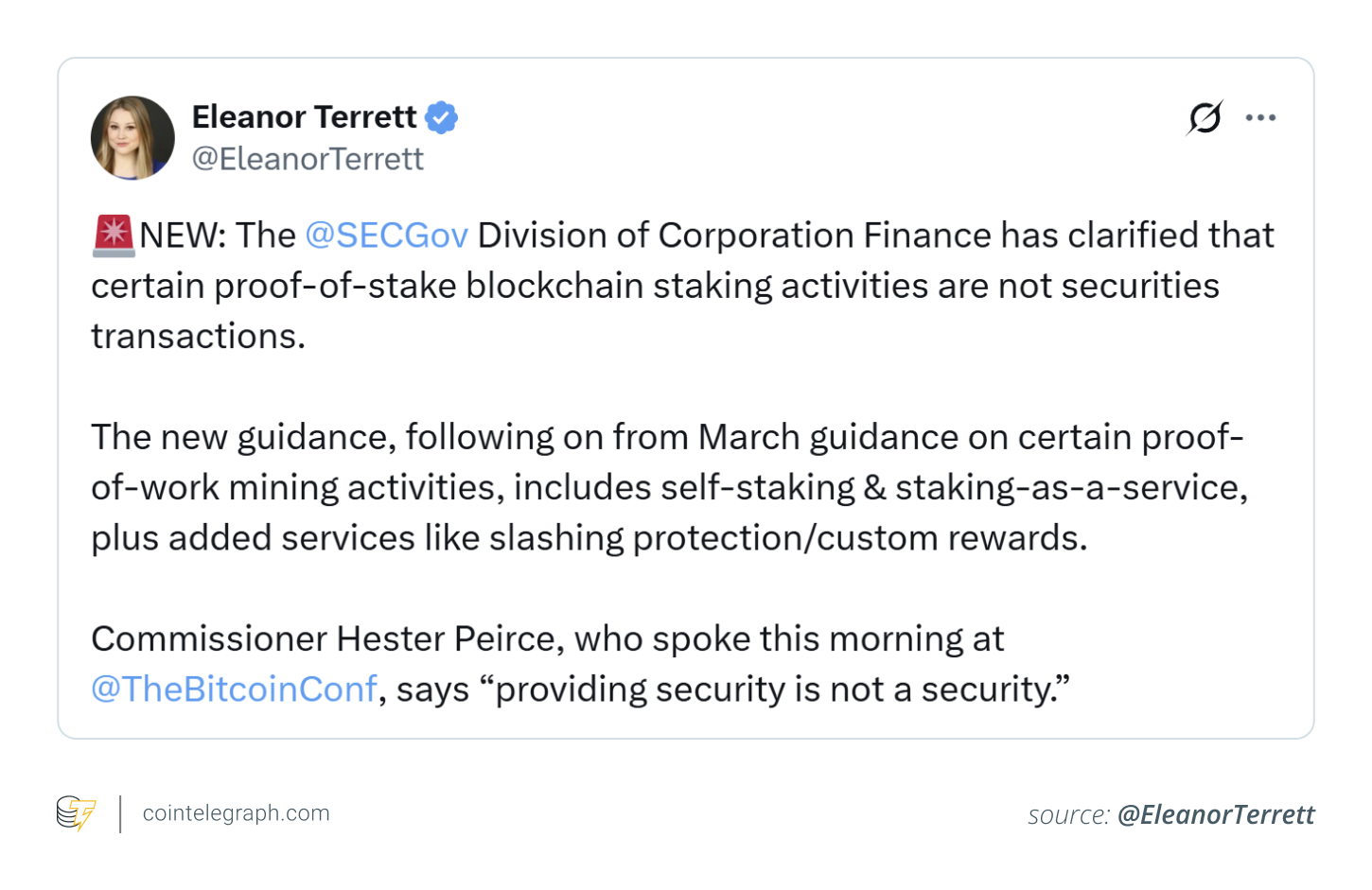
In 2025, the SEC’s Division of Corporation Finance released groundbreaking guidance stating the scenarios when the protocol staking on proof-of-stake (PoS) networks will not be considered a securities offering.
- This guidance applies to solo staking, delegating to third-party validators and custodial setups as long as these methods are directly linked to the network’s consensus process.
- The SEC clarified that these staking activities do not meet the criteria of an “investment contract” under the Howey test.
- The regulator also distinguished genuine protocol staking from schemes that promise profits from others’ efforts, like lending or speculative platforms.
- According to the guidance, staking rewards earned through direct participation in network activities, such as validating transactions or securing the blockchain, will not be viewed as investment returns.
Which staking activities are allowed under the new SEC rules?
The SEC’s Division of Corporation Finance has clarified that specific staking activities on PoS networks, when conducted as part of a network’s consensus process, do not constitute securities offerings. These protocol-staking activities are viewed as administrative, not investment contracts.
Here is what the guidelines explicitly permit:
- Solo staking: The new guidelines of the SEC allow individuals to stake who use their crypto assets using their resources and infrastructure. As long as they retain ownership and control of their assets and participate directly in network validation, their staking is not treated as a securities offering.
- Delegated staking (non-custodial): The SEC has allowed users to delegate their validation rights to third-party node operators while keeping control of their crypto assets and private keys. It remains compliant as this does not involve transferring ownership or expecting profits from others’ managerial efforts. Whether a node operator stakes its own crypto assets does not alter the Howey analysis of protocol staking.
- Custodial staking: Custodians like crypto exchanges can stake on behalf of users if assets are clearly held for the owner’s benefit, not used for other purposes, and the process is transparently disclosed to the owner before the activity.
- Running validator services: The guideline allows you to operate validator nodes and earn rewards directly from the network. These actions are viewed as providing technical services rather than investing in a third party’s business.
Did you know? Solo staking requires running your own node, often with high minimum token requirements, like 32 Ether for Ethereum. Staking pools let users combine smaller amounts, democratizing access.
SEC guideline on ancillary services in crypto staking
Service providers may offer “ancillary services” to owners of crypto assets. These services should be administrative or ministerial, not involving entrepreneurial or managerial efforts:
- Slashing coverage: Service providers may compensate owners for losses due to slashing, similar to protections in traditional business transactions, covering node operators’ errors.
- Early unbonding: Protocols may return assets to owners before the protocol’s unbonding period ends, shortening the wait for owners.
- Flexible rewards schedules: Projects may deliver staking rewards on a schedule or frequency that differs from the protocol’s without fixing or guaranteeing amounts beyond what the protocol provides.
- Asset aggregation: Protocols may combine owners’ assets to meet staking minimums, an administrative step in the validation process that supports staking without being entrepreneurial.
How the new SEC guidelines will benefit stakeholders in a PoS ecosystem
The SEC’s guidance on protocol staking supports various stakeholders in the PoS ecosystem.
The key benefits include the following:
- Validators and node operators: They can now stake assets and earn rewards without registering under securities laws. This clarity reduces legal risks for individual stakers and professional operators on networks like Ethereum, XDC and Cosmos.
- PoS network developers and protocol teams: The guidance confirms that protocol staking is not considered an investment contract, validating PoS network designs. This allows developers to grow their projects without altering token economics or compliance structures.
- Custodial service providers: Crypto exchanges and platforms offering custodial staking can operate legally by clearly disclosing terms and keeping assets in separate, non-speculative accounts.
- Retail investors and institutional participants: They can engage in solo or delegated staking with greater assurance. This clarity encourages compliance-focused institutions to join the PoS ecosystem.
These regulations will likely promote broader staking participation, strengthening PoS
blockchainsecurity and decentralization by increasing the number and diversity of validators.
Did you know? The concept of staking dates back to 2012 with Peercoin, the first PoS blockchain. Unlike mining, it lets users “stake” coins to validate transactions, inspiring modern networks like Ethereum Consensus Layer and Cardano to prioritize energy efficiency and broader participation.
Staking vs. securities: Where the SEC draws the line
While the SEC’s latest guidance facilitates protocol-based staking tied to network consensus, it draws a clear line between legitimate staking and activities that resemble investment contracts. The following practices still remain outside of the purview of the guideline:
- Yield farming or staking schemes not tied to consensus: Earning returns from depositing tokens into pools that don’t contribute to blockchain validation or network security still falls under securities laws.
- Bundled, opaque DeFi staking products promising ROI: Platforms that offer complex, aggregated products with unclear reward sources or profit guarantees remain at risk of regulatory scrutiny.
- Centralized platforms disguising lending as staking: Services that lend user funds or generate returns through third-party investments while labeling it “staking” do not qualify under the new guidance and could be treated as unregistered securities.
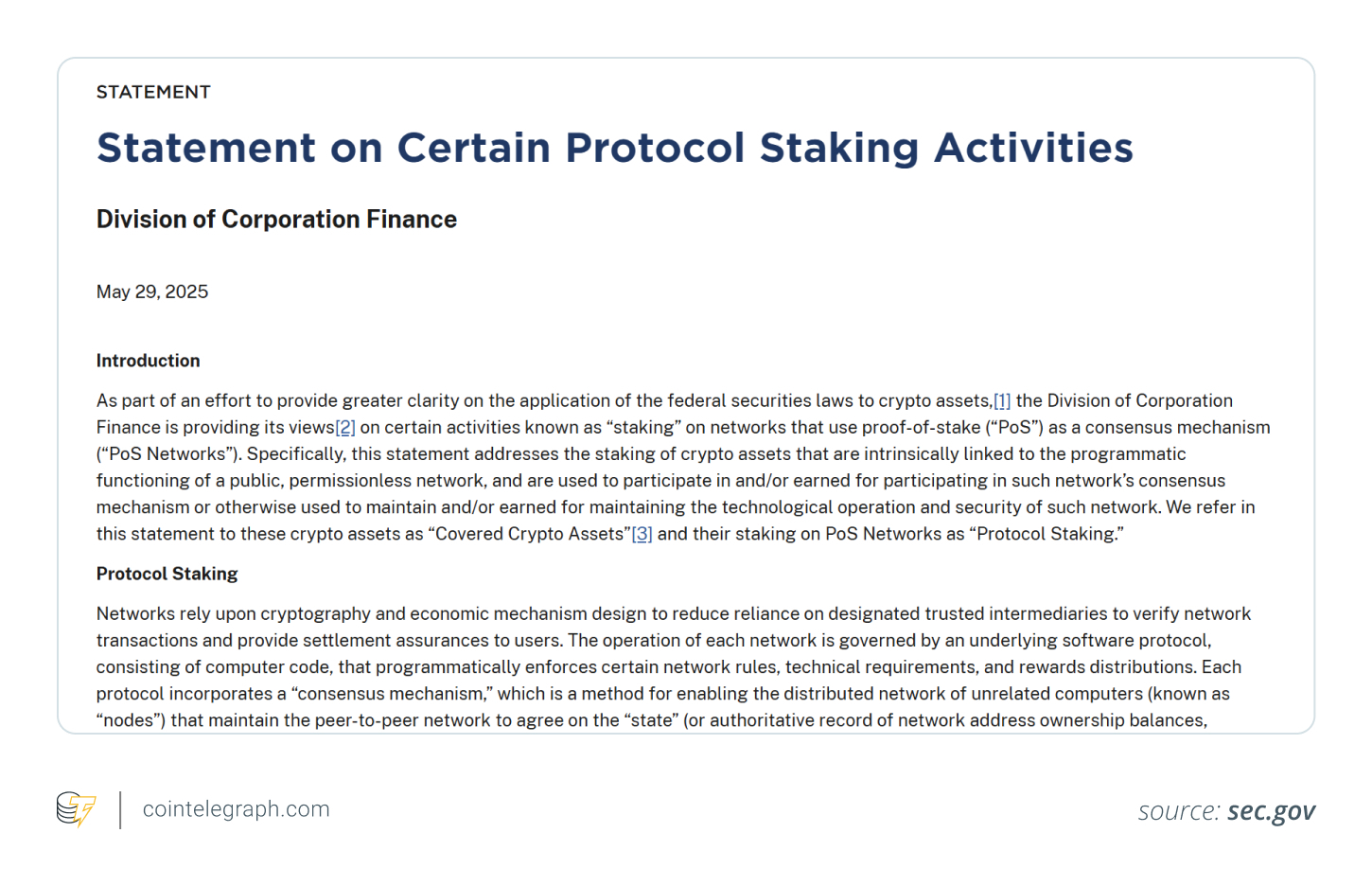
This statement addresses protocol staking generally rather than all of its variations. It doesn’t address all forms of staking, such as staking-as-a-service, liquid staking, restaking or liquid restaking. Node operators are generally free to share rewards or impose fees for their services in ways that differ from the protocol.
Best practices for legal crypto staking in 2025
As the SEC formally recognizes protocol staking as non‑securities activity, participants and service providers should adopt thoughtful compliance measures to stay within the safe zone. These practices ensure clarity, protect user rights, and reduce regulatory risk.
Here are the best practices for legal crypto staking in 2025, following the SEC’s guidance:
- Ensure that staking directly supports network consensus: Only stake assets in a way that they participate in blockchain validation. Your investments should earn rewards programmatically through the protocol, not via managerial or investment-like activity.
- Maintain transparent custodial arrangements: Custodians must clearly disclose asset ownership, avoid using deposited assets for crypto trading or lending, and act only as agents facilitating staking.
- Consult legal counsel before launching staking services: Seek legal advice to ensure staking services are of an administrative nature and comply with SEC guidance.
- Avoid offering fixed or guaranteed returns: The protocol should determine the earnings to prevent classification as an investment contract under the Howey test.
- Use clear, standardized disclosures and contracts: Provide clear documentation explaining user rights, asset use, fees and custody terms to avoid confusion.
Following these practices ensures staking activities are compliant, transparent and consistent with the SEC’s focus on consensus-based participation.
Did you know? Staking can yield 5%-20% annual returns on tokens like Cosmos or Tezos, offering crypto holders passive income. Unlike trading, it is low-effort — lock tokens, support the network and earn rewards — making it a popular choice for long-term investors.
Are 2025 SEC guidelines a turning point for crypto staking?
The SEC’s 2025 guideline is a significant step for crypto staking in the US, offering clear rules for staking in PoS protocols. The guideline separates protocol staking, which supports network consensus, from
yield-generating products classified as investment contracts.
The SEC confirmed that self-staking, self-custodial staking and specific custodial arrangements are not securities offerings, resolving a major legal uncertainty that has hindered participation.
This framework allows individual validators and users to delegate
tokensto third-party node operators to operate, as long as they maintain control or ownership of their assets. The SEC considers staking rewards as payment for services, not profits from managerial efforts, exempting them from the Howey test.
The guideline creates a stable foundation for compliant staking infrastructure, encouraging institutional adoption, innovation in staking services and greater retail participation.
By prioritizing transparency, self-custody and alignment with decentralized networks, the SEC’s approach could foster the growth of PoS ecosystems while discouraging risky or unclear staking practices. For the US crypto industry, this is a much-needed regulatory approval.


All Comments