


From reforgevc by Reforge

Framework Overview
Data as of 12 January 2025
- Latest Version/Release: v0.1.8+build.1 (12 January 2025)
- GitHub Repository: Eliza
- Licensing: Open-source MIT License
- Primary Language(s): Typescript
- Stats11.2k stars3.1k forks366 contributors
- 11.2k stars
- 3.1k forks
- 366 contributors
Introduction
Eliza is an open-source agent development framework that promises to make building AI agents simple, powerful, and extensible. But does it really live up to the hype? In this post, we break down what ElizaOS is great at, where it falls short, and what you need to know if you're considering using it.
What Eliza Claims to Be
- Framework Purpose: A toolkit for building personalized, multi-modal agents that can handle complex tasks.
- Primary Use Cases: AI assistants, social media personas, knowledge workers, and interactive characters
- Key Features:Modular runtime for registering actions and plugins.Cross-platform deployment support (e.g., X, Discord, Telegram, etc.)Character-driven customization using detailed persona filesMulti-media processing (e.g., text, video, images, etc.)Local and cloud-based inference functionalityAdvanced retrieval augmented generation (RAG) system for long-term memory and context awareness
- Modular runtime for registering actions and plugins.
- Cross-platform deployment support (e.g., X, Discord, Telegram, etc.)
- Character-driven customization using detailed persona files
- Multi-media processing (e.g., text, video, images, etc.)
- Local and cloud-based inference functionality
- Advanced retrieval augmented generation (RAG) system for long-term memory and context awareness
On paper, this sounds like a versatile system for building intelligent agents—but what does that look like in reality?
What Eliza Can Actually Do
- Persona Customization: The character system lets you create distinct agent personalities with unique tones, styles, and backstories.Eliza shines when building narrative-driven bots or maintaining consistent brand voices.Fields like
bio,lore,knowledge, andstylemake the customization process flexible and detailed. - Eliza shines when building narrative-driven bots or maintaining consistent brand voices.
- Fields like
bio,lore,knowledge, andstylemake the customization process flexible and detailed. - Cross-Platform Integration: Eliza connects seamlessly to Discord, Slack, Telegram, and other web platforms to make agents adaptable for community engagement.Social media bots and customer service agents can be’ deployed and coordinated across platforms.
- Social media bots and customer service agents can be’ deployed and coordinated across platforms.
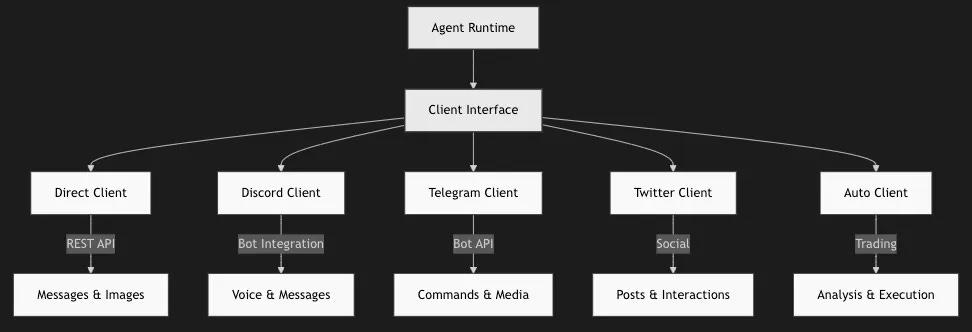
Client Packages Architecture Overview (Source: Eliza Docs)
- Extensible Plugin System: Add-ons for text-to-speech, image generation, and blockchain data retrieval make Eliza highly customizable.For example, these custom plugins are what allow market commentary bots to have extended functionality such as fetching real-time data and posting consistent, engaging content or insights.
- For example, these custom plugins are what allow market commentary bots to have extended functionality such as fetching real-time data and posting consistent, engaging content or insights.
- Retrieval-Augmented Generation (RAG): Eliza enables agents to ground their responses in external data sources and knowledge bases. For example, the market commentary bot will offer more reliable, context-aware answers with external document embeddings and caching to improve response speed and relevance.
- Trusted Execution Environment (TEE) Support: Eliza offers a security layer that provides agents with the functionality of handling sensitive workflows and operations.
Where Eliza Falls Short
1. Lack of adaptive learning
Static Persona Configurations: Character persona configurations are predefined and do not evolve based on user interactions or historical context. Agents can become repetitive because they don’t learn from conversations.
No Learning from Feedback: Eliza lacks mechanisms to learn from user corrections or adapt based on previous errors. Without adaptive learning, the system cannot refine its behavior, leading to recurring mistakes or misaligned responses.
2. No hierarchical planning
No sub-tasking capability: The framework doesn’t break down high-level objectives into smaller action steps. Agents can’t manage complex, multi-step workflows such as conducting research and summarizing multiple research papers and generating subsequent multi-part content. Hierarchical planning systems involve goal decomposition and sub-task assignment. Since Eliza doesn’t have any sub-task queuing or recursive task structures, developers need to integrate or build a task-planning library to extend this functionality.
3. Limited collaboration between agents
No Coordination Mechanisms: While Eliza supports multi-room and multi-participant environments there is no true inter-agent collaboration or shared memory. Agents cannot work together dynamically to share context, divide tasks, or resolve conflicting goals limiting.
4. Memory and context limitations
Basic Key-Value Memory Stores: The memory system stores data but lacks prioritization of recent or relevant context. Long conversations can cause agents to forget important details, making them seem disconnected.
No Memory Pruning: There is no built-in system for pruning outdated or irrelevant data from memory. Overloaded and bloated memory can lead to slower performance and irrelevant responses.
5. Minimal error handling
Basic API Error Handling: If an external service fails, the agent may return an error instead of switching to an alternative source. More robust error recovery mechanisms that gracefully handles failures by switching to secondary options would improve resilience.
6. Lack of True Multi-Modal Intelligence
Cross-Modality Gaps: While Eliza supports plugins for text-to-speech and image generation, it doesn’t combine inputs like text, images, and audio for unified reasoning. Interpreting visual data alongside text-based inputs is not possible for Eliza agents.
What Eliza is Best Suited For
- Market Intelligence Agents: Track sentiment trends, analyze social media chatter, and generate real-time, automated responses
- Content Generation Bots: Generate consistent posts and branded messaging across different social platforms.
- Customer Support Bots: Provide answers based on curated knowledge and respond to common questions. These bots function well as scripted, context-driven FAQ responders while having a custom character personality uniquely aligned with a brand’s ethos/culture.
The Bottom Line
Eliza provides an extensible and flexible structure for personality-driven agents, making it a strong choice for simple or scripted workflows. It’s a great tool for creating consistent, cross-platform personas, but falls short of being a true autonomous agent framework without learning or strategic planning capabilities.
If the goal is to build adaptive, autonomous agents that can collaborate or handle complex reasoning, teams will be doing a lot of heavy lifting to build additional functionality on top of it. The value in high-utility use cases would largely come from custom-built additions rather than the core framework.
Eliza should not be mistaken for a comprehensive agent framework like its web2 counterparts (e.g., Langchain, Autogen, Letta, etc.) at this point in time. Its real value lies in personality-driven automation and barely scratches the surface of unlocking genuine autonomous agent development.


All Comments