


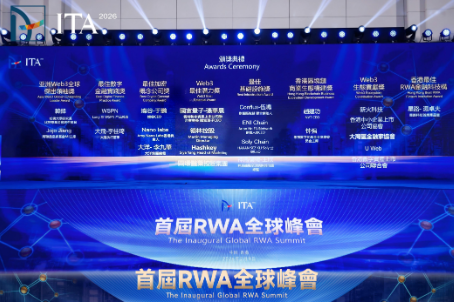
HONG KONG — The inaugural Global RWA Summit, co-hosted by Bauhinia Magazine and the RWA Global Federation, concluded today at the Hopewell Hotel in Hong Kong. Supported by relevant HKSAR government departments and policy think tanks, the summit drew over a thousand global leaders from the financial, technology, legal, and auditing sectors. ENI, the pioneering enterprise-grade public chain, was a key participant, with its Founder and CEO, Arion Ho, delivering a keynote address and participating in a high-level roundtable. For its breakthroughs in underlying architecture and commercial implementation, ENI was honored with the summit's prestigious "Best Infrastructure Award."
Moving Beyond the "Geek Playground": Overcoming the "Last Mile" of RWA Scaling
During the summit’s keynote session, Arion Ho delivered a speech titled "The Oracle of the Web3 Era: How ENI Defines the Commercial Bedrock for Trillion-Dollar RWA." He directly addressed the core obstacles to RWA (Real-World Asset) scaling, asserting that the industry’s bottleneck is not a lack of assets or capital, but rather the carrying capacity of current infrastructure.
"We must confront the undervalued 'trillion-dollar' deep-water zone," Ho stated. "With the enterprise blockchain market projected to exceed $1.4 trillion by 2030, these next five years represent a critical window for corporate positioning."
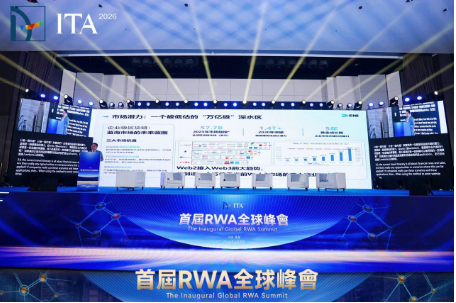
Ho analyzed that general-purpose public chains are often hindered by performance bottlenecks, a lack of compliance frameworks, and high costs, making them ill-suited for the high-frequency concurrency and regulatory isolation required by real-world business systems. ENI’s solution is to build the "Oracle" of the Web3 era—a definitive enterprise service layer. Through its "ENI Matrix" architecture—composed of a Mainnet, Hub, and AppChains—ENI achieves the physical isolation of business logic from regulatory requirements. "RWA is not merely about putting assets on-chain," Ho emphasized. "It is about migrating entire business systems to the blockchain."
Roundtable Insight: Shifting from "Legacy Finance Wrappers" to Infrastructure Upgrades
In the subsequent "RWA Ecosystem Collaboration" roundtable, Arion Ho engaged in a deep-dive discussion with experts from top-tier law firms, digital asset custodians, and ChainUp. Addressing the skepticism regarding whether RWA is merely a "wrapper" for traditional finance, Ho asserted that high-value RWA must fulfill three criteria: authentic underlying assets, clear legal title, and sustainable liquidity. He projected that by 2026, RWA liquidity will be driven by institutional allocation and corporate balance sheet management, rather than crypto-native speculative sentiment.
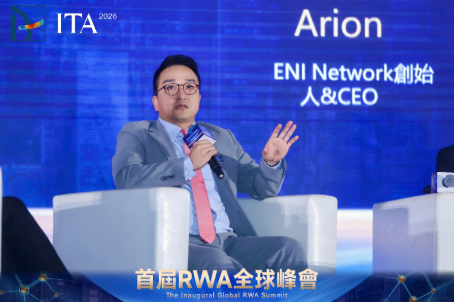
Regarding the adoption roadmap, Ho suggested that traditional institutions should first focus on "on-chain compliance," using blockchain as infrastructure for registration, clearing, and auditing. This would be followed by introducing qualified investors via permissioned mechanisms, and finally opening the market once regulatory boundaries are fully defined. Wendy Jiang, General Manager of [X] Digital Asset Custody, echoed this view, noting that the essence of RWA liquidity lies in on-chain title verification and re-hypothecation capabilities—a logic fundamentally different from that of native cryptocurrencies.
Building a Global Value Bedrock for Enterprise
Winning the "Best Infrastructure Award" marks a significant industry endorsement of ENI’s ability to solve the pain points of enterprise on-chain migration. Positioned as the "Chief Architect" for enterprise blockchain adoption, ENI utilizes its quantum-ready public chain attributes to enable regulatory logic isolation, allowing businesses to deploy bespoke AppChains under a unified governance framework.
Currently, ENI’s commercial ecosystem is in a phase of rapid expansion. From its strategic partnership with Japanese telecom giant NTT Digital to the launch of its "Top 100 Institutional Nodes" and "Top 100 Ecosystem Matrix," ENI has established a compliant gateway for traditional industries to enter Web3. Its global network of incubators further serves as the "capillary system" for RWA implementation.
Eliminating Barriers, Empowering Global Business
The success of the inaugural Global RWA Summit signals that asset tokenization is moving past the "conceptual phase" and into a new era of compliance and large-scale commercialization. As RWA evolves from a niche narrative into the default asset form for enterprises, the trillion-dollar blueprint constructed by ENI is set to become the indispensable bedrock for global digital migration. By dismantling commercial barriers, ENI is driving Web3 technology back to its essence: fueling real-world business growth and empowering every enterprise worldwide.


All Comments