


Bitcoin could be about to get a major change. A new proposal suggests some coins might have to be destroyed to protect the network from future quantum computer attacks.
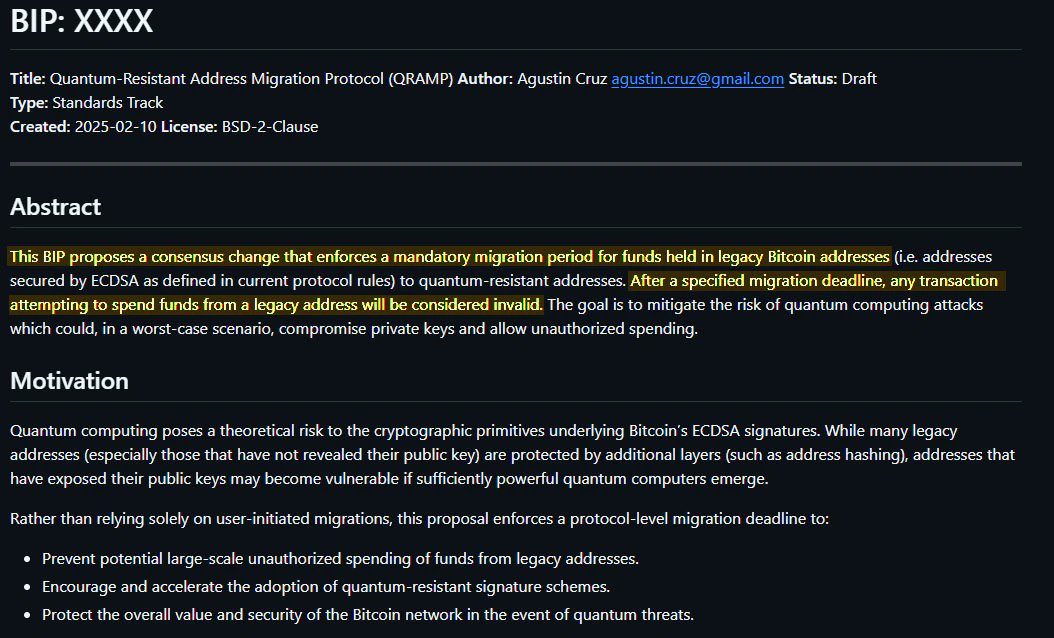
The proposal is called QRAMP, short for Quantum-Resistant Address Migration Protocol. It was put forward by Bitcoin developer Agustin Cruz and has caused quite a stir in the wider Bitcoin community.
Bitcoin’s security is based on ECDSA cryptographic system (Elliptic Curve Digital Signature Algorithm). That’s strong against regular computers but might be broken by quantum computers in the future.
Quantum computers use a new kind of processing procedure based on the laws of quantum physics. Instead of working with just ones and zeroes like regular computers, they use qubits which can exist in multiple states at once. That means they can do specific complex calculations much faster.
Cruz and other devs worry that one day a powerful quantum machine could crack Bitcoin’s security and allow hackers to steal coins from vulnerable wallets. Cruz said:
“Addresses that have exposed their public keys may now be vulnerable if sufficiently powerful quantum computers emerge.”
Cruz’s QRAMP proposal is a major update—a hard fork—to the Bitcoin network. A hard fork is a big software change that creates new rules for Bitcoin and essentially creates a new blockchain. Older versions of the software would no longer be compatible.
If QRAMP is adopted, all Bitcoin users will get a deadline. Before that deadline they would need to move their bitcoin from old, vulnerable addresses to quantum-resistant ones.
If they don’t do this in time, their coins will become unspendable.
The idea is to force users to secure their funds before quantum computers become a real threat. “It provides rightful owners with a clear, non-negotiable opportunity to secure their funds,” Cruz wrote in an email to Bitcoin Dev mailing list.
But there’s a big catch: any coins that remain in vulnerable wallets after the deadline would be effectively burned. This means the total supply of bitcoin could shrink — possibly by millions of coins.
The intense debate over this idea has really brought out the passion in Bitcoin supporters. Some see it as a smart way to safeguard the digital asset’s future.
They believe acting early—before a quantum disaster strikes—is better than waiting. It’s better to burn off some of those bitcoin now than risk losing them all, one supporter put it.
Others think that this plan goes too far. They say it undermines two of Bitcoin’s core principles: decentralization and immutability. That means no one can change Bitcoin’s history or rules.
Many people are worried about the coins locked away in dormant wallets. Those belong to users who’ve lost their private keys, passed away or simply haven’t accessed their funds in years.
Among those is Bitcoin’s creator Satoshi Nakamoto. Analysts estimate that Satoshi himself has over 1 million coins that he hasn’t touched in over 15 years.
If those people don’t migrate their coins, they’ll be lost forever.
History shows that not all dormant coins are forgotten or lost. There have been instances of old wallets activating after ten years.
“I admire the effort,” one Reddit user wrote , “But this will still leave everyone who doesn’t migrate’s coins vulnerable, including Satoshi’s coins.” That’s a pretty stark reminder of just how much is at stake.
QRAMP is just a draft proposal. It doesn’t have a BIP number and the Bitcoin community hasn’t reached consensus to move forward.
Implementing QRAMP would require a lot of work from users, wallet developers, miners, node operators and infrastructure providers. Everyone in the ecosystem would have to agree and update their software to support the change.
Microsoft’s recent announcement of their Majorana 1 quantum chip which can scale up to a million qubits might be why this discussion is happening now. Current machines don’t pose an immediate threat but the technology is advancing.
Other ideas have been proposed to protect Bitcoin from quantum threats.
One such idea from BTQ is a new kind of blockchain verification method using Coarse-Grained Boson Sampling — but that would require replacing existing mining hardware with quantum-compatible systems.


All Comments