

Cointime

Download App
iOS & Android

Crypto treasuries set for ‘bumpy ride’ as premiums narrow: NYDIG

The premiums of digital asset treasury (DAT) firms are falling and it’s likely to worsen in the near future unless they take action, says New York Digital Investment Group (NYDIG).

NYDIG global head of research Greg Cipolaro said on Friday that the gap between stock price and net asset values (NAV) of major Bitcoin 

BTC$111,058buying firms such as Metaplanet and Strategy “continue to compress” even as BTC has reached new highs.

“The forces behind this compression appear to be varied,” Cipolaro added. “Investor anxiety over forthcoming supply unlocks, changing corporate objectives from DAT management teams, tangible increases in share issuance, investor profit-taking, and limited differentiation across treasury strategies.”
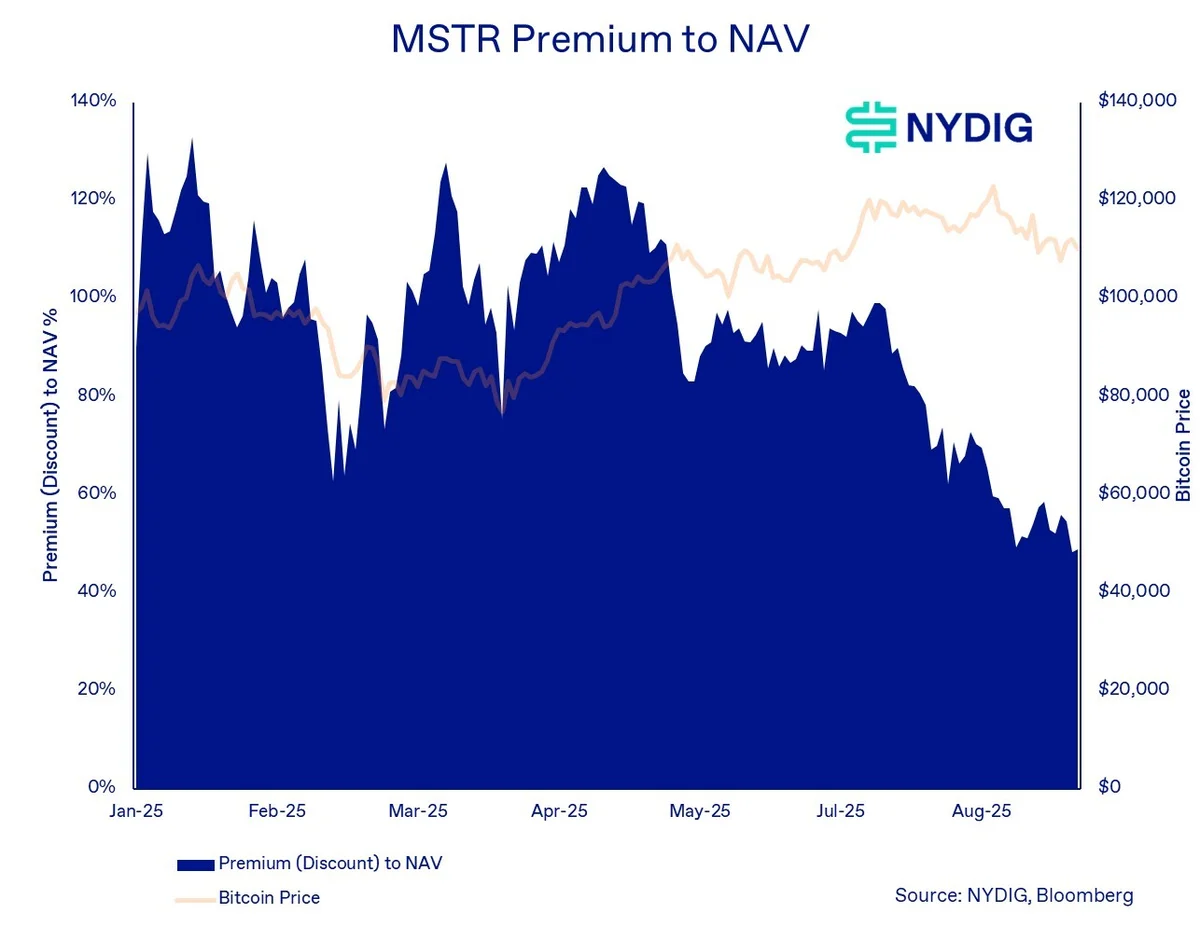
  Strategy’s premium to NAV (blue) has narrowed over the past few weeks as Bitcoin (orange) has risen. Source: NYDIG


Crypto treasury firms have become the latest fad on Wall Street and have garnered billions of dollars in the last year. Investors will typically compare share prices to the value of the assets they hold as a metric to assess their health.

Share buyback programs needed to boost health

Cipolaro said a “bumpy ride may be ahead” for crypto treasury firms as many are awaiting mergers or financing deals to go public, which could see a “substantial wave of selling” from existing shareholders.

He added many treasury companies, including KindlyMD and Twenty One Capital, are trading at or below the value of recent fundraises, and a share price drop “might exacerbate selling once shares are freely tradeable.”

If shares in a treasury company traded below its NAV, “the most straightforward course of action would be stock buybacks,” Cipolaro said, which aim to increase share prices by reducing supply.

“If we were to give one piece of advice to DATs, it’s to save some of the funds raised aside to support shares via buybacks.”

Company Bitcoin holdings hit peak, but buying slows

The holdings of Bitcoin buying companies have reached a peak high this year, at 840,000 BTC, with Strategy holding 76%, or 637,000, of the total, with the rest spread across 32 other firms, according to a CryptoQuant report on Friday.

The number of purchases per month is also up, but CryptoQuant said the total amount of Bitcoin bought by the companies slowed in August to below this year’s monthly average, and the firms are scooping up less Bitcoin per transaction.
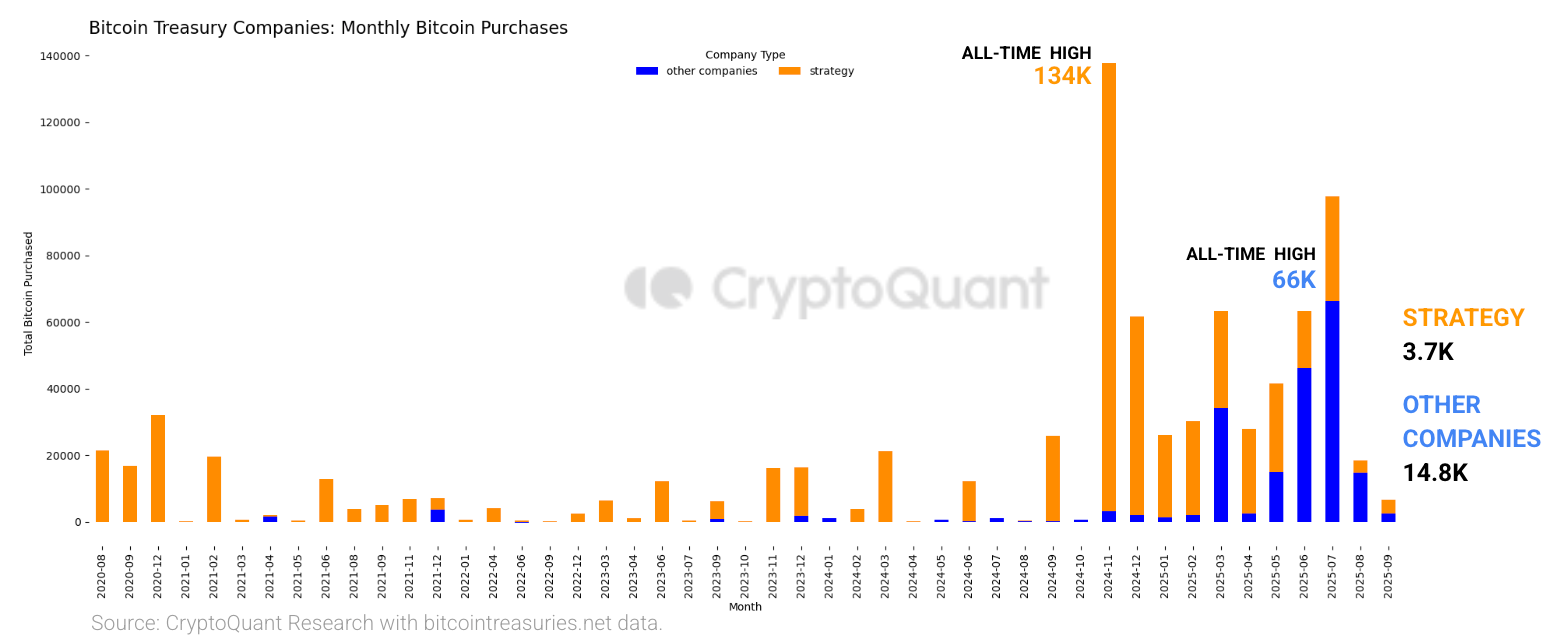
  Monthly Bitcoin purchases by Strategy (orange) and other treasury companies (blue). Source: CryptoQuant


For example, Strategy’s average purchase size fell to 1,200 BTC in August compared to its 2025 peak of 14,000 BTC, while other companies purchased 86% less Bitcoin compared to their 2025 high of 2,400 BTC in March.

That’s led to a sudden slowdown in the growth of Bitcoin treasury holdings, with Strategy’s monthly growth rate dropping to 5% last month, compared to 44% at the end of 2024, while other companies saw an 8% growth in August compared to 163% in March.

Bitcoin has traded flat in the last 24 hours at around $111,200, and has fallen 10.5% from its over $124,000 peak in mid-August, according to CoinGecko.

Comments

All Comments

Recommended for you

  • Amazon Shares Surge 15.2%, Biggest Gain Since 2012

    On July 31, Amazon shares surged 15.2% to $271.255 per share, marking their biggest gain since 2012, with a total market value of $2.92 trillion.

  • US Treasury Secretary Bessent Vows to Track Down Iranian Assets Globally for Terror Victims

    US Treasury Secretary Bessent said the US will actively track down Iranian assets worldwide to ensure compensation funds for victims of Iran-backed terrorist activities. Bessent stated that the US government's military and economic blockade measures against the Iranian regime will continue and will not be relaxed. (Jinshi)

  • Apple Plunges Nearly 10%, Q4 Revenue Guidance Misses Expectations

    On July 31, Apple (AAPL.US) plunged nearly 10% to $300.33, marking its biggest drop since April 2025. In terms of fundamentals, Apple's third-fiscal-quarter revenue rose approximately 16% year-over-year to $109.42 billion, slightly above analyst expectations. Among the details, product revenue came in at $78.68 billion, beating the expected $77.25 billion. However, services revenue—a key driver of its valuation re-rating in recent years—totaled $30.74 billion, missing the consensus estimate of $31.36 billion. Additionally, Greater China revenue reached $18.82 billion, with year-over-year growth slowing to 22%, also below analysts' forecast of $19.58 billion. During the earnings call, Apple guided fourth-fiscal-quarter revenue growth in the range of 9% to 11%, overall below the 12.1% analysts had expected. CFO Parekh noted that component supply constraints would impact iPhone, Mac, and iPad businesses in the fourth fiscal quarter, with currency fluctuations also constraining growth.

  • Three Fed Officials Back Rate Hike, Hawkish Pressure Builds

    On July 31, three Federal Reserve policymakers said that dissenting votes in favor of a rate hike this week stemmed from stubborn inflationary pressures, highlighting rising internal pressure on Fed Chair Warsh to act. In statements released Friday morning, Hammack and Kashkari said they worry that although the current round of price increases may stem from short-term factors such as President Trump's tariff policies and the Iran war, the inflation situation already warrants Fed action. Logan also joined in, saying that even if inflation cools, if the Fed does not raise rates, inflation is unlikely to fully fall back to the Fed's 2% target; without any policy constraints, inflation could continue to run above target until an unexpected shock occurs. Kashkari said that if inflation remains persistently stubborn, he might support a series of rate hikes, not just a single increase, to prevent inflation from becoming further entrenched. He said: "A series of small policy adjustments may be preferable to waiting for developments to unfold and ultimately having to take more forceful action." Hammack said that if the Fed does not tighten policy, price increases could continue to accelerate. She said: "Inflation has been stubbornly above 2% for more than five years, and I have no confidence that it will return to our target on its own." (Jin Shi)

  • US 10-Year Treasury Yield Rises to 4.7388%, Highest Since January 2025

    On July 31, the US 10-year Treasury yield rose to 4.7388%, the highest level since January 2025.

  • Spot Gold Intraday Decline Widens to 2%, at $4,021.08 per Ounce

    On July 31, spot gold's intraday decline widened to 2%, reported at $4,021.08 per ounce.

  • BTC Falls Below $63,000

    Market数据显示,BTC has fallen below $63,000, currently reported at $62,985.99, with a 24-hour decline of 2.99%. Market volatility is significant, please exercise risk control.

  • Fed's Logan: Leaning Toward 25 Basis Point Rate Hike

    On July 31, Federal Reserve Governor Logan said she leans toward a 25 basis point rate hike, believing inflation has not yet entered a sustainable path back to the Fed's 2% target. Logan stated that taking moderate action now would reduce the risk of needing more aggressive tightening in the future, while emphasizing that the Fed cannot rely on unexpected shocks to achieve its inflation target.

  • Fed's Logan: Taking Modest Actions Now Reduces Likelihood of Needing Stronger Action Later

    On July 31, Dallas Fed President Lorie Logan said that taking modest actions in the near term would reduce the likelihood of needing to take stronger action in the future.

  • Philadelphia Semiconductor Index Erases 5% Gain, Turns Lower

    On July 31, U.S. chip and semiconductor stocks rapidly weakened, with the Philadelphia Semiconductor Index wiping out a 5% gain and turning lower. Micron Technology, which had risen 6%, is now down 4.2%. SanDisk, which had gained nearly 10%, is now down over 6%. SK Hynix and Seagate Technology, which had risen over 8%, are now down 2%. TSMC, which had gained 4%, is now down nearly 1%.
