

Cointime

Download App
iOS & Android

Citigroup, JP Morgan, Goldman Sachs lead TradFi's blockchain charge: Ripple

Citigroup, JPMorgan Chase, Goldman Sachs and Japan’s SBI Group have emerged as the most active players in traditional finance backing blockchain startups, according to a new report by Ripple in partnership with CB Insights and the UK Centre for Blockchain Technologies.

Between 2020 and 2024, global banks participated in 345 investments in blockchain companies, most of them in early-stage funding rounds, per the report. Citigroup and Goldman Sachs led the pack with 18 deals each, while JP Morgan and Mitsubishi UFJ followed closely with 15 investments.

Mega-rounds, deals worth $100 million or more, were a key focus. Banks contributed to 33 such rounds during the four-year window, pouring capital into firms focused on trading infrastructure, tokenization, custody, and payment solutions.

Notable examples include CloudWalk in Brazil, which raised over $750 million across two rounds backed by Banco Itaú and others. Likewise, Solaris in Germany secured over $100 million from SBI Group and later became a majority acquisition target.

G-SIBs back blockchain with 100+ deals

Global Systemically Important Banks (G-SIBs), a group of financial institutions with such significant economic weight that their failure could trigger global financial instability, accounted for 106 deals, including 14 mega-rounds valued at over $100 million each.
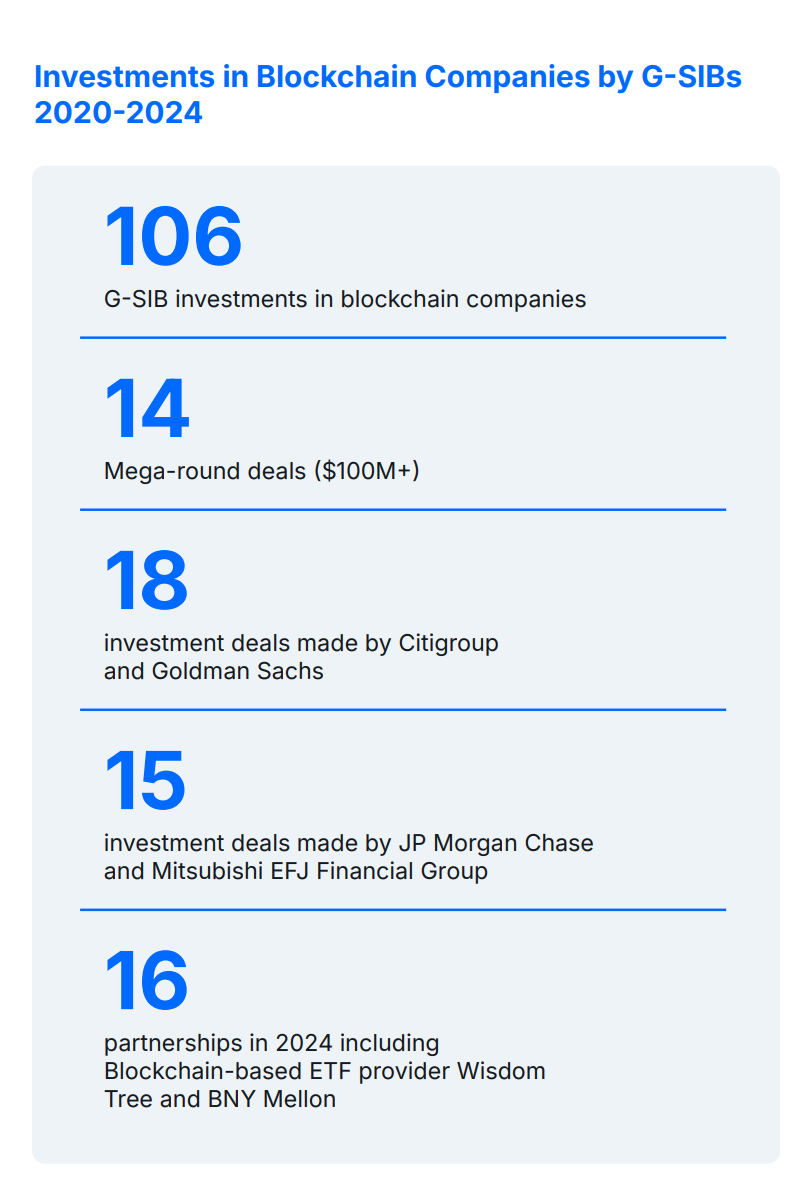
G-SIBs investments in blockchain companies. Source: Ripple

US and Japanese institutions led in deal volume, but Singapore, France, and the UK were also active. In total, over $100 billion was poured into blockchain startups between 2020 and 2024 across more than 10,000 deals globally.

Ripple’s survey of over 1,800 global finance leaders also found that 90% believe blockchain and digital assets will have a “significant or massive” impact on the industry within three years.

The momentum is also supported by regulatory developments, including the Guiding and Establishing National Innovation for US Stablecoins, or GENIUS Act, in the US and Markets in Crypto-Assets (MiCA) in the EU, both of which provide a clearer framework for digital asset operations.

Banks back stablecoins, tokenization next

Backing the investment trend is soaring demand for real-world blockchain applications. According to a Citi report, stablecoin volumes hit $650–$700 billion per month in Q1 2025, and more banks are launching their own stablecoins to offer programmable money without exposure to volatility.

Looking ahead, tokenization is expected to be a defining trend. Boston Consulting Group and Ripple estimate that tokenized real-world assets could exceed $18 trillion by 2033, with a compound annual growth rate of 53%.


Comments

All Comments

Recommended for you

  • Alberta Investment Management Corp Acquires 1.38 Million Shares of MSTR Worth $219 Million

    On April 30, Alberta Investment Management Corp (AIMC), a Canadian government-owned investment firm, disclosed that it has made its first purchase of 1.38 million shares of Bitcoin reserve company MicroStrategy (stock code: MSTR) valued at $219 million. This marks the first allocation to Bitcoin by one of Canada's largest institutional management firms.

  • Tether Mints 1 Billion USDT on Tron Network

    On April 30, at 15:45:00 Beijing time, Tether minted 1,000,000,000 USDT on the Tron network.

  • Brent Crude Oil Futures Rise to $126.09 per Barrel, Highest Since March 2022

    On April 30, according to Reuters quotes, Brent crude oil futures rose by more than $8 during the day to $126.09 per barrel, marking the highest level since March 2022. (Jinshi)

  • US Military Plans First Operational Deployment of Hypersonic Missiles Against Iran

    On April 30, Bloomberg reported that the US Central Command has submitted a request to deploy the 'Dark Eagle' hypersonic missiles to the Middle East. If approved, this would mark the first operational deployment of hypersonic missiles by the US, potentially aimed at striking ballistic missile launch systems deep within Iran.

  • US Treasury Secretary: America Seizes $450 Million in Iranian Crypto Assets

    On April 30, The Kobeissi Letter reported that US Treasury Secretary Scott Bessent stated that the United States has seized $450 million worth of Iranian crypto assets.

  • KKR Explores $10 Billion Sale of Flora Food Group

    On April 30, according to the Financial Times, private equity firm KKR is exploring a $10 billion sale of Flora Food Group.

  • U.S. Treasury Secretary: Kevin Warsh Will Bring a New Era to the Federal Reserve

    On April 30, Cointelegraph reported that U.S. Treasury Secretary Scott Basset stated, "Kevin Warsh will usher in a new chapter for the Federal Reserve, leading with accountability mechanisms, efficient governance, and sound policy-making at its core."

  • US Spot Bitcoin ETF Sees Net Outflow of $137.75 Million

    On April 30, according to monitoring by Trader T, the US spot Bitcoin ETF experienced a net outflow of $137.75 million yesterday.

  • US Spot Ethereum ETF Sees $87.72 Million Net Outflow

    On April 30, according to monitoring by Trader T, the US spot Ethereum ETF experienced a net outflow of $87.72 million yesterday.

  • Trump to Receive Briefing on New Military Plans Against Iran Including Strong Strikes and Control of Hormuz Strait

    On April 30, two informed sources stated that Trump plans to receive a briefing on Thursday from General Brad Cooper, the commander of U.S. Central Command, regarding new plans for potential military action against Iran. This briefing indicates that Trump is seriously considering the resumption of large-scale military operations to break the negotiation deadlock or deliver a decisive blow before ending the war. Three sources revealed that Central Command has prepared a plan for a 'short and powerful' strike against Iran, which may include targeting infrastructure. The expectation is that Iran would then show greater flexibility on nuclear issues and return to the negotiating table. Another plan expected to be presented to Trump involves controlling parts of the Strait of Hormuz to restore commercial shipping passage. One source indicated that such actions could involve ground troops. Another option that has been discussed in the past and may be presented in the briefing is to conduct special operations to ensure control over Iran's highly enriched uranium reserves. Cooper had previously briefed Trump on similar matters on February 26, and two days later, the U.S. and Israel launched a war against Iran. A person close to Trump stated that that briefing led to Trump's decision to go to war.