

Cointime

Download App
iOS & Android

Bitcoin, Ethereum, XRP: Prices Slide as Fed Maintains Interest Rates

Cointime Official

From financemagnates by Jared Kirui
Bitcoin's rally hit a roadblock as the U.S. Federal Reserve opted to keep interest rates unchanged in its first policy decision of 2025. The widely anticipated move sent Bitcoin sliding by $1,000 almost immediately after the announcement. With inflation still a concern and President Donald Trump pushing for lower rates, investors are left wondering when or if the Fed will shift its stance.

At the time of writing, the top three cryptocurrencies, Bitcoin, Ethereum, and XRP, had not changed much in the past day but remained down on the weekly chart. Bitcoin traded at $103k, representing a 0.86% and 1.29% decline in the past day and week, respectively.

Additionally, Ethereum changed hands for $3,114 on CoinMarketCap, representing a drop of 1.07% in the past day and 5% in the past week. XRP has also dropped more than 5% in the weekly chart.
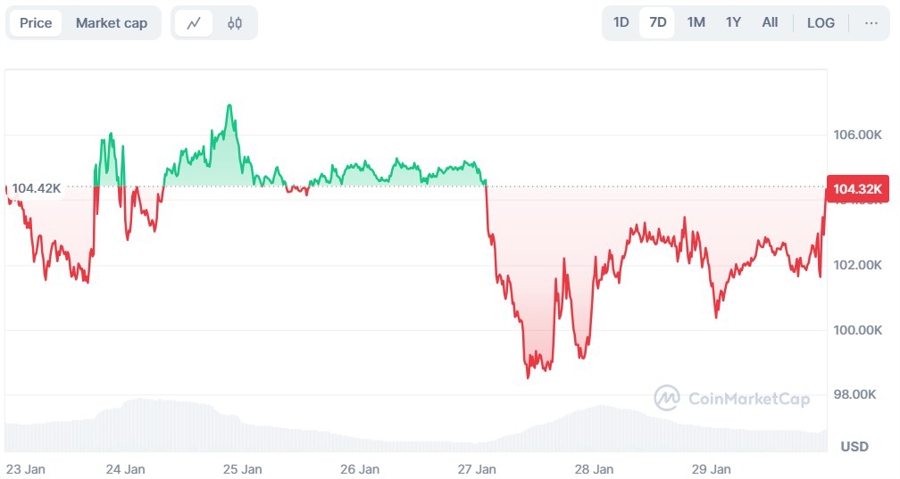
Bitcoin Price, Source: CoinMarketCap

Fed Holds Rates Amid Inflation

The Federal Reserve decided to maintain its benchmark interest rate at 4.25%—4.5%, citing inflation risks and economic uncertainty, Reuters reported. The move was expected, as the central bank had previously hinted at pausing rate cuts following a 25-basis-point reduction in late 2024.

However, the decision is likely to increase tensions between the Fed and the Trump administration, which has been vocal about the need for lower borrowing costs.

While last week's Consumer Price Index data suggested inflation was not as severe as anticipated, the Fed remained cautious. Officials omitted previous language about “progress” on inflation, signaling that concerns persist.

Fed Chair Jerome Powell and his team now face a complex economic landscape shaped by Trump's policy proposals, including potential tariffs and deregulation efforts.

Trump's Economic Policies Add Uncertainty

If the Fed remains hesitant to cut rates further, riskier investments could face more pressure. President Trump's return to the White House has brought new economic policy challenges.

His calls for aggressive tariffs, including a proposed 25% levy on imports from Mexico and Canada, could disrupt global trade and fuel inflation. At the same time, his push for tax cuts and deregulation aims to stimulate growth but could also complicate the Fed's ability to manage inflation.

The central bank previously modeled different tariff scenarios in 2018 and concluded that aggressive trade policies could lead to higher inflation, potentially justifying rate hikes rather than cuts.

Comments

All Comments

Recommended for you

  • Nexus Chain & Cointime to Host Industry AMA — Unpacking DeFi’s “Missing Layer”

    Nexus Chain will host a global AMA on December 27, 2025, at 20:00 (UTC+8) — “DeFi AMA|Unpacking the Missing Layer in Layer1.” The session will explore a key question facing the industry: as PoS evolves and liquidity remains fragmented, does DeFi still lack a foundational execution layer?

  • Japanese listed company ANAP Holdings increased its holdings of Bitcoin by 127.73.

    according to market sources, Japanese listed company ANAP Holdings has disclosed an increase in its Bitcoin holdings by 127.73 coins. As of now, the company's total Bitcoin holdings have reached 1,346.58 coins, valued at approximately 118 million USD.

  • Changpeng Zhao: Binance Wallet now supports identifying malicious addresses; you will receive a warning if you transfer funds to them.

    Zhao Changpeng posted on Binance Plaza stating, "The cryptocurrency industry should be able to completely eradicate address poisoning attacks and protect users. All wallets should simply check whether the receiving address is a poisoned address and block the user.This is a blockchain query. Wallets should not even display these junk transactions anywhere. If the value of the transaction is very small, filter it out. Security alliances in the industry should maintain a real-time blacklist of these addresses so that wallets can check before sending transactions. Binance Wallet is already doing this. If a user tries to send to a malicious address, they will receive a warning.

  • Bitcoin spot ETFs saw a total net outflow of $189 million yesterday, marking the fourth consecutive day of net outflows.

     according to SoSoValue data, the total net outflow of Bitcoin spot ETFs is 189 million USD.The Bitcoin spot ETF with the largest single-day net outflow yesterday was Blackrock's ETF IBIT, with a single-day net outflow of 157 million USD. Currently, IBIT's total historical net inflow has reached 62.34 billion USD. The second is Fidelity's ETF FBTC, with a single-day net outflow of 15.2979 million USD. Currently, FBTC's total historical net inflow has reached 12.189 billion USD. As of the time of writing, the total net asset value of Bitcoin spot ETFs is 114.289 billion USD, with the ETF net asset ratio (market value as a proportion of Bitcoin's total market value) reaching 6.53%, and the cumulative historical net inflow has reached 57.076 billion USD.

  • BTC falls below $88,000

     market shows BTC fell below $88,000, currently at $87,997.85, 24-hour decline reaches 0.88%, market volatility is significant, please manage your risk accordingly.

  • The U.S. spot Ethereum ETF saw net inflows of $84.59 million yesterday.

     according to Trader T monitoring, the US spot Ethereum ETF had a net inflow of 84.59 million USD yesterday.

  • ETH breaks $3,000

     the market shows ETH breaking through $3000, currently at $3000.08, with a 24-hour decline of 0.38%. The market is highly volatile, please manage your risk accordingly.

  • Binance Wallet launches "secure auto-signature" service

     according to the official announcement, Binance Wallet has launched the "Secure Auto Sign" (SAS) service: it now supports mnemonic/private key wallets to trade on Binance Wallet (web version).
