


From beincrypto by Lockridge Okoth

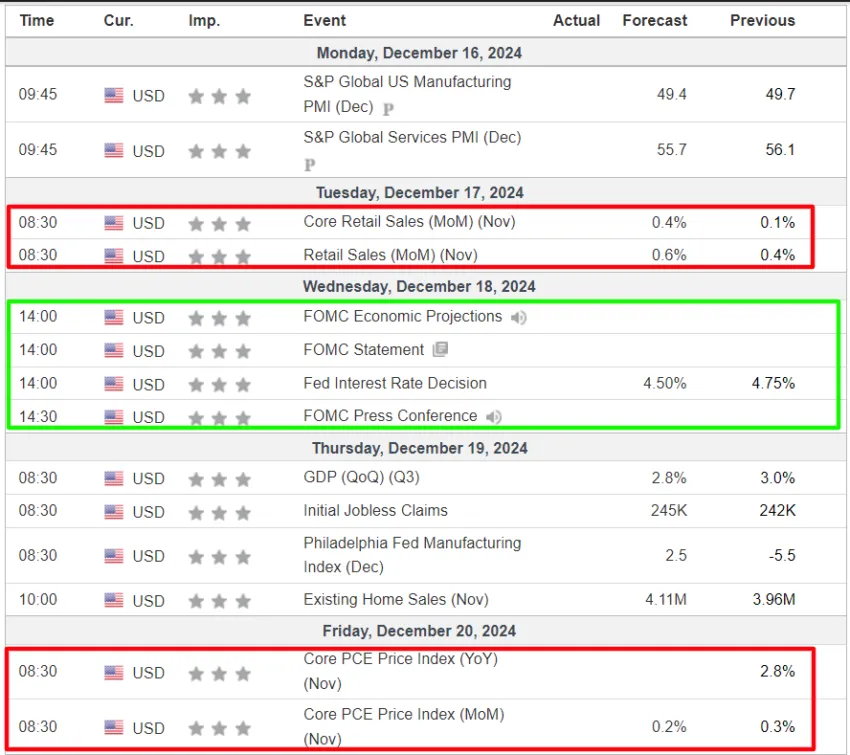
This week is packed with key economic events that could significantly influence the crypto market. These macroeconomic data come as market participants gear up for the run into the year-end holiday.
Meanwhile, Bitcoin (BTC) continues to hold above the $100,000 mark, with traders and investors anticipating further upside in the supposed Christmas rally.
US Macroeconomic Data That Could Influence Bitcoin Sentiment This Week
Crypto market participants, traders, and investors alike will be watching the following US economic data this week for price implications.
S&P Flash Services and Manufacturing PMI Data
The week begins with the release of the S&P Flash Services and Manufacturing Purchasing Managers’ Indices (PMI) on Monday. PMI data, derived from monthly business surveys, serve as key indicators of economic health, often used to predict market trends and assess business conditions.
The services PMI for November stood at 56.1, with December’s consensus forecast slightly lower at 55.3. Meanwhile, the manufacturing PMI, which was 49.7 in November, is expected to dip marginally to 49.6 in December. A PMI above 50 indicates economic expansion, while a reading below 50 signals contraction.
If the data shows strength in the services and manufacturing sectors, it may bolster overall economic confidence. This optimism could increase investor appetite for riskier assets, including cryptocurrencies. However, economists remain cautious as concerns about the broader economic outlook persist.
“The US Economy is in complete SHAMBLES right now. We have had an inverted yield curve and ISM Manufacturing PMI under 50 for almost a year now. The inversion in yield curves has predicted the last 7 recessions successfully. Before the COVID and 2008 Crash ISM Manufacturing PMI was under 50,” a popular user on X shared.
Retail Sales Data
Another US economic data that will interest crypto market participants this week is the retail sales data. After the 0.4% reading in October, economists forecast a November reading of 0.6%. The retail sales data will provide insights into consumer spending patterns and overall consumer confidence.
If retail sales are strong, indicating that consumers are spending more, it could be seen as a positive sign for the economy. This could lead to increased investor confidence in traditional financial markets, which may spill over into the crypto market as well.
Retail sales data can also influence inflation expectations. If retail sales are strong, it could signal increasing demand and potentially higher inflation down the line. Cryptocurrencies like Bitcoin are often viewed as a hedge against inflation, so any signs of rising inflation could drive investors toward cryptocurrencies.
“Strong sales = bullish markets, weak = risk-off,” popular analyst Mark Cullen said.
Fed Interest Rate Decision (FOMC)
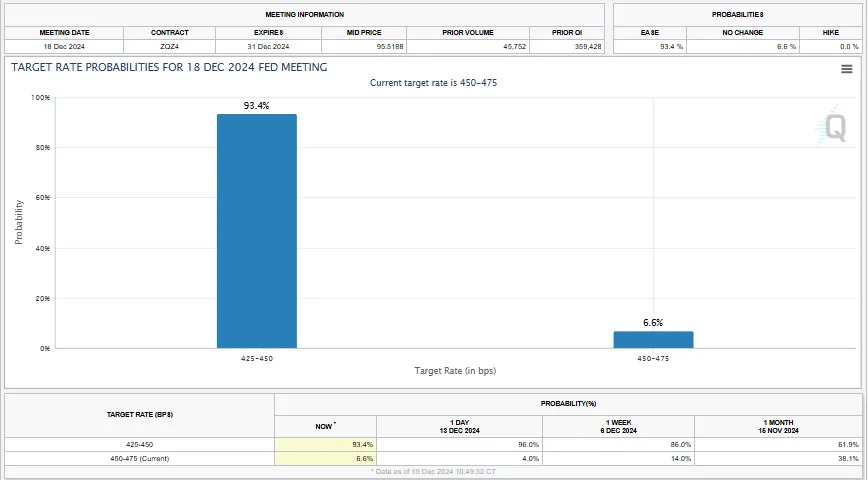
However, the height of this week’s US macroeconomic data will be the Federal Reserve’s (Fed) interest rate decision on Wednesday. Crypto markets brace for market swings amid anticipation of whether the Fed will hike or cut rates.
According to the CME FedWatch Tool, markets are anticipating a 25 basis points (0.25% bps) rate cut on Wednesday. This is against a 6.6% probability of the Fed cutting rates by 50 basis points (0.5%).

Sponsored
This suggests an expectation that the Fed will adopt a more cautious stance on cutting interest rates next year amid signs that the progress in lowering inflation toward the 2% target has stalled. Against this backdrop, investors will also monitor the Fed’s dot plot to gauge if the median interest rate projections show a hawkish shift in the Fed’s outlook.
Shortly after the FOMC, Fed chair Jerome Powell will hold his press conference, marking another interesting watch for crypto market participants.
“Markets are closely watching for any signs of future tightening or dovish comments. A surprise here could trigger significant moves across the board, especially in interest rate-sensitive sectors,” a popular user on X (Twitter) remarked.
The US Consumer Price Index (CPI) and the Producer Price Index (PPI) released last week reinforced expectations that the Fed will slow the pace of its rate-cutting cycle next year. Specifically, CPI increased again, while Core CPI refused to decrease. Meanwhile, the unemployment rate is gradually increasing.
Given this situation, the FED is likely to continue reducing interest rates by another 0.25%. However, this stance may be based on the hope that this is only a temporary situation and that inflation and the unemployment rate will continue to decrease in the coming time.
Q3 2024 GDP Data
On Thursday, the US Bureau of Economic Analysis (BEA) will release the second revision of third quarter (Q3) GDP data. This data will offer insight into the health of the economy as we approach the end of the year.
Of note is that this is one of the primary gauges of the US economy’s health, with a median forecast of 2.9% after the previous 2.8%. This means that the US GDP grew at an annual rate of 2.8% in Q3 2024, and markets will watch to see whether the trend continues.
PCE Inflation Data
To close out the week, the November Personal Consumption Expenditure (PCE) inflation data will be released on Friday. It is a measure of consumer spending and includes all goods and services bought by US households. This makes it a critical measure for the Fed, meaning any surprises here could have a direct impact on the Fed’s future policy decisions and market sentiment.
According to The Kobeissi Letter, a popular commentary on the global capital markets, the one-month annualized core PCE inflation is now at 3.5%+ as traders await November’s data at the end of the week. Meanwhile, the one-month, three-month, and six-month annualized core PCE inflation are all back on the rise here.
Similarly, the one-month annualized Supercore PCE inflation is now nearing a whopping 5%. On the other hand, headline Supercore PCE inflation is above 3.5% and back on the rise. Taken together, these data show that consumers are back under pressure of severe inflation in many categories.
Based on the above, the week may be wild, with possible heightened volatility around these events. At the time of writing, BTC was trading for $104,991, a modest 2% rise since Monday’s session opened.


All Comments