


In most trading systems, “profit” is often presented as a final outcome rather than a process. Users may see increasing balances, but they rarely understand where those profits come from, whether they are sustainable, or if they can persist across different market conditions. This lack of transparency creates a gap in trust, where even strong performance metrics fail to fully convince users of a system’s reliability.
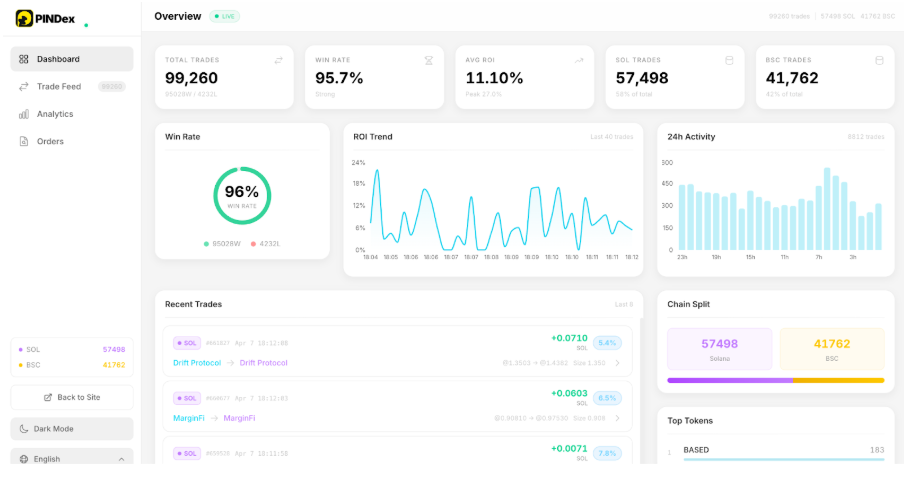
The PINDex dashboard system addresses this issue by fundamentally restructuring how profitability is presented. Rather than simply visualizing results, it decomposes arbitrage activity into observable, understandable, and verifiable components. Users are no longer faced with isolated numbers, but with a complete framework that explains how profits are generated. This transition from “result display” to “process transparency” forms the foundation of its core value.
Making System Performance Instantly Perceptible
The Dashboard serves as the user’s first point of interaction, but its role extends far beyond displaying daily data. It provides an immediate and intuitive understanding of the system’s operational state. Metrics such as total trades, win rate, average ROI, and multi-chain activity are not standalone figures; together, they form a comprehensive snapshot of system performance.
Through these indicators, users can quickly determine whether the system is actively running, consistently profitable, and operating within stable parameters. The profit curve further enhances this understanding by introducing a time dimension, allowing users to observe how returns evolve throughout the day. Profit is no longer perceived as a static result, but as an ongoing process unfolding in real time. This design reduces cognitive complexity, transforming sophisticated arbitrage behavior into an intuitive visual experience.
From Short-Term Results to Long-Term Validation
While real-time data answers the question of whether the system is currently profitable, the Analytics module addresses a deeper concern: whether this profitability is sustainable over time. By aggregating historical transaction data, the system constructs a structured representation of long-term performance.
In this context, individual metrics become less important than the relationships between them. The alignment between win rate and average ROI, the ratio of profitable to losing trades, and the distribution of returns all contribute to a broader understanding of system stability. These interdependencies allow users to assess whether current performance is repeatable or merely coincidental.
Visualization tools such as distribution charts and scatter plots further reinforce this analysis. They translate abstract concepts like stability into tangible patterns that users can directly observe. When returns cluster within reasonable ranges and extreme losses remain minimal, both the effectiveness of the strategy and the robustness of risk control become evident. This data-driven validation replaces subjective judgment with objective insight.
Revealing the True Source of Profit
A common limitation in many arbitrage systems is the lack of clarity around profit origins. PINDex addresses this by breaking down not only how much is earned, but where those earnings come from.
Through multi-chain comparisons and arbitrage path analysis, the system reconstructs the execution logic behind each trade. It highlights performance differences across chains, identifies the most frequently used trading paths, and shows which market combinations contribute the most to overall profits. This level of transparency exposes the system’s fundamental capability: identifying and exploiting price discrepancies across markets.
By revealing this underlying logic, PINDex transforms user perception from passive observation to active understanding. Profit is no longer a black-box output, but a traceable result of specific, repeatable strategies.
Strengthening Perception of Continuous Profitability Through Real-Time Data
The Trade Feed elevates system visibility from static observation to dynamic awareness. Each completed arbitrage transaction is recorded and displayed in real time, providing continuous insight into ongoing activity.
This stream of data does more than update information—it reshapes perception. Users begin to recognize that profitability is not derived from isolated opportunities, but from the repeated execution of a consistent strategy. The system’s ability to generate returns becomes evident through its continuous operation.
By transforming profit from a static outcome into a sequence of ongoing actions, the Trade Feed reinforces both trust and confidence in the system’s stability.
Bridging System Performance and Individual Earnings
Ultimately, users are most concerned with their own returns. The Orders module addresses this by linking system-wide performance directly to individual accounts through wallet-based queries.
This functionality does more than provide access to personal data; it completes the conceptual loop between system output and user benefit. Instead of merely observing overall performance, users can clearly identify their share of the generated profits. This direct mapping from macro-level data to individual outcomes ensures that the system’s value is both tangible and personally relevant.
Reconstructing Trust Through On-Chain Verification
At the highest level, PINDex’s most defining advantage lies in its verifiability. Every transaction recorded within the system can be independently confirmed on-chain. This ensures that all displayed profits correspond to real, executed trades rather than internally generated figures.
This mechanism fundamentally changes how trust is established. Instead of relying on platform credibility or narrative, users can verify performance through publicly accessible blockchain data. Trust shifts from being institution-based to data-driven.
When profitability can be independently validated, the system achieves a level of transparency and reliability that traditional trading platforms struggle to match.
Transforming Profitability into a Structured, Understandable System
In essence, the true value of the PINDex dashboard system lies not in the breadth of its features, but in its ability to redefine how profitability is understood. It converts what is typically opaque and difficult to verify into a structured, logical, and data-driven framework.
By integrating real-time monitoring, historical analysis, live transaction tracking, and on-chain verification, the system enables users to understand not just how much is earned, but how and why it is earned. This multidimensional perspective enhances transparency while lowering the barrier to comprehension.
In a market defined by uncertainty, the rarest asset is not opportunity, but the ability to consistently capture it. PINDex does not merely present profits—it articulates the underlying capability to generate them. This shift from result presentation to capability expression is what ultimately defines its significance.


All Comments