


1. What exactly does PayStill do?
PayStill is the first payment value aggregator in the FUSN × DrixPay ecosystem, transforming real-world payment transactions into a cross-ecosystem value flow interface. Through dual-asset combined computing power, on-chain consumption value-added mechanisms, and multi-ecosystem value aggregation, it makes each payment transaction a value anchor connecting the Web3 ecosystem.
It has designed a comprehensive mechanism to ensure that participants receive due rewards for their contributions. It relies on:
Real-World Utility: Powered by "U-cards" (crypto cards) and an on-chain marketplace, ensuring every payment is backed by actual goods and services.
Finance-Grade Infrastructure: Built on the FUSN Mainnet, supporting advanced features like credit terms, clearing, and settlements.
Institutional Backing: DrixPay is backed by Prime Intelligence Solutions Group Limited (08379.HK), a Hong Kong-listed company, providing a high level of transparency and authority.
Aggressive Deflation: A "burn-on-use" mechanism designed to counteract market volatility.
You may not trust anyone, but you have to admit one fact: rules written into a contract plus real-world consumption scenarios are more reliable than any promise.
Let's look at some key data from this project:
| index | Introduction |
| Total Token Supply | 210,000,000 |
| Ultimate deflation goal | 21,000,000 |
| Mining machine production mechanism | The gold standard yields 0.05% per day; different mining machines offer hashrate bonuses, and profits are decoupled from the cryptocurrency price. |
| Deflation triggering methods | Earnings will be automatically destroyed upon receipt. |
| underlying public chain | FUSN |
The total supply of ecosystem tokens increased from 210 million to 21 million, representing a 90% deflation rate. This was achieved gradually by automatically burning 10% of the tokens with each revenue claim. Once this rule is written into the blockchain, no one can change it.
This is PayStill's fulcrum. By relying on real consumption and on-chain rules, it allows everyone to leverage returns.

II. The underlying logic of PayStill: Making Web3 practically valuable through PayFi
Many people immediately ask: "How much can the price of this coin rise? When will it be listed on exchanges?"
Instead, I'd like to ask a more fundamental question: how many cryptocurrencies have you seen used in real-world scenarios? Paystill emerged precisely to break several deadlocks in the traditional payments and web3 fields.
The collapse of trust in the points systemTraditional points are issued unilaterally by the platform, with opaque rules and devaluation at any time. Many accumulated points across numerous global platforms have never been used. When a platform collapses, the points instantly become zero.
Web3 lacks real-world application scenarios.On the other hand, many Web3 projects are still stuck in the "white paper promise" stage, lacking real-world applications and actual product circulation, ultimately becoming pure financial games. Once new user growth stagnates and liquidity dries up, the projects die.
PayStill's mission is clear: to give tokens value through real-world consumption scenarios and ensure the system's continued operation.
III. PayStill's Value Loop: Consumption is not the end, but the beginning.
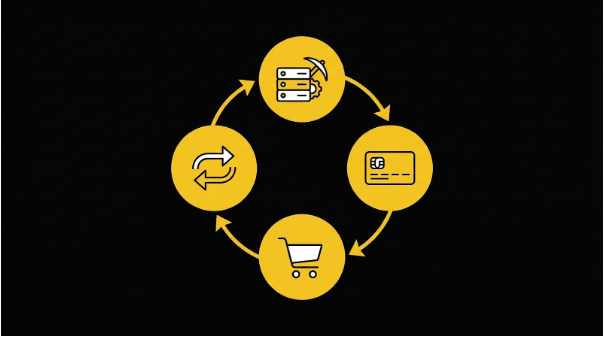
Traditional consumption pattern: You spend 100 yuan on coffee → Wallet balance -100 yuan → End of value
PayStill's consumption model: You spend 100 USDT → mining power → producing PAYS → spending to earn FUSN cloud computing power → continuously producing public chain tokens → value cycle.
First layer: Mining with mining machines (stable output under the gold standard)
mechanismCombine 50% TET and 50% USDT to create a mining machine and obtain computing power.Core FeaturesGold standard output and currency price fluctuationsComplete unhooking
| Mining machine type | Input costs | Computing power multiplier | Obtain computing power | Daily output |
| Experience mining machines | 100 USDT | 2.0x | 200T | 1 USDT equivalent (PAYS) |
| Small mining machine | 1,000 USDT | 2.1x | 2,100T | 10.5 USDT equivalent (PAYS) |
| medium-sized mining machines | 2,000 USDT | 2.2x | 4,400T | 22 USDT equivalent (PAYS) |
| Large mining machines | 5,000 USDT | 2.3x | 11,500T | 57.5 USDT equivalent (PAYS) |
| Super Mining Machine | 10,000 USDT | 2.4x | 24,000T | 120 USDT equivalent (PAYS) |
One advantage of using the gold standard for returns is that if the price of the coin rises, you receive fewer but more valuable PAYS; if the price falls, you receive more but the value of your PAYS remains stable. In any case, your USDT equivalent returns are locked, making the returns real and predictable.
Second layer: U-card global payments (making the tokens actually usable).
Pays allows you to top up your global physical USB card for cross-border offline spending. It works in dining, shopping, travel—anywhere that accepts bank cards. This bridges the gap between the crypto world and real life.
Third layer: On-chain e-commerce for value-added consumption (core innovation)
mechanismShopping at partner stores using PAYS → Merchant discount amount × 5 = FUSN cloud computing power → Consumers receive 50% of the computing power share → Computing power generates FUSN native currency daily.
Consumption is no longer the end point of value, but the starting point. Every penny you spend is accumulating public blockchain assets for you.
Fourth layer: Ecosystem Swap Trading (Completing the liquidity loop)
PayS and FUSN can be freely exchanged on decentralized exchanges, forming a complete closed loop of value circulation. The value of traditional crypto projects can only be realized through "selling tokens," while PayStill's value can be continuously accumulated through "use."
IV. PayStill's Mechanism Innovation
(1) Extreme deflation mechanism: use and destroy.
Triggering methodEach time a user withdraws earnings, the system automatically charges a 20% handling fee.
Allocation rules:
- 10% → Directly destroyed
- 5% → Foundation Reserves
- 5% → Dividends for Genesis Shareholders
Value FlywheelEcosystem growth → Increased users → Increased consumption → Increased revenue collection → Accelerated token burning → Token scarcity → Increased value → Attracting more users → Accelerated cycle
Traditional points systems are issued indefinitely, leading to a continuous depreciation of their value. In contrast, PayStill's tokens are burned faster the more active the user is, allowing early participants to automatically enjoy scarcity benefits and achieve value growth through its mechanism.
(2) Symbiotic Promotion System: Saying Goodbye to Zero-Sum Game
The fatal flaw of traditional multi-level marketing is the conflict of interest between superiors and subordinates. The better the subordinates perform, the more the superiors worry about being surpassed and losing profits.
PayStill's innovative mechanism:
Equal-level awardWhen your directly referred users advance to the same level as you, you will still enjoy a 10% share of their mining machine output.
Beyond AwardEven if your directly referred users surpass you in level, you will still permanently enjoy a 10% commission.
The traditional model involves suppressing subordinates to maintain hierarchical advantage; the PayStill model, on the other hand, involves fully supporting subordinates because the more successful they are, the more I benefit. This truly achieves a win-win situation for all parties.
V. PayStill's Ecological Expansion: Not an Isolated Island, but an Ecological Hub
PayStill is not an isolated project; it is the value anchor of the FUSN × DrixPay ecosystem.
The FUSN public blockchain offers financial-grade execution capabilities, ensuring long-term stable operation. DrixPay provides global payment infrastructure, integrating wallet, fiat currency account, and crypto account into a single system, and converts user behavior into public blockchain assets based on cloud computing power mechanisms.
PayStill is responsible for connecting public blockchain technology with real-world consumption scenarios, validating the feasibility of the PayFi business model, and providing stable value accumulation for the ecosystem.
At the same time, PayStill's dual-asset access model also validates that the project can serve as an ecosystem interface, enabling various projects to seamlessly integrate into the ecosystem in a standardized manner, reducing technical barriers and integration costs, while simultaneously achieving mutual empowerment between the public chain value and ecosystem projects, forming a symbiotic and mutually beneficial value network.
VI. The Value Gains from Participating in PayStill
Short-term: Start with as little as 100 USDT. Benefit from stable, predictable daily USD-pegged returns.
Medium-term: Compound your gains. Use your PAYS for shopping to trigger FUSN cloud mining rewards and benefit from the referral structure.
Long-term: Capitalize on ecosystem growth. With DrixPay’s connection to a HK-listed company and FUSN’s roadmap toward a Pre-IPO, early participants stand to gain the most from the 90% token supply reduction.
VII. Witness the value of PayStill together
PayStill aims to prove that in real-world consumption scenarios, value can be verified, accumulated, and realized over the long term.
In the world of PayStill:
● Consumption is not an expenditure, but an accumulation of assets.● Time is not a cost, but a compounding engine.● Participation is not speculation, but rather the use of protocols.● Consensus is not just a slogan, but a continuous action.
PayStill uses clear rules to transform every transaction into sustainable value; and uses defined mechanisms to amplify long-term contributions.
PayStill doesn't rely on human nature; it operates solely based on scenarios and rules. When consumption becomes an asset, time becomes an eternal engine of compound interest.


All Comments