


Chapter 1: The End of Safe Havens — Why Physical Hoarding Became the “Gallows” of Assets
From the late night of January 31, 2026, to the early hours of February 1, 2026, global financial history recorded an extraordinarily brutal episode. For countless investors pinning their hopes on physical assets as a safe haven, it was an inescapable nightmare.
1. Midnight “Bloodbath”: The Shattered Myth of Safety
According to real-time market monitoring, spot silver prices experienced an “epic” collapse within a short period, plunging as much as 36% intraday — the largest single-day drop in history. Meanwhile, spot gold was not spared, falling over 12% at one point and dipping below $4,700 per ounce intraday, marking the largest single-day decline in 40 years.

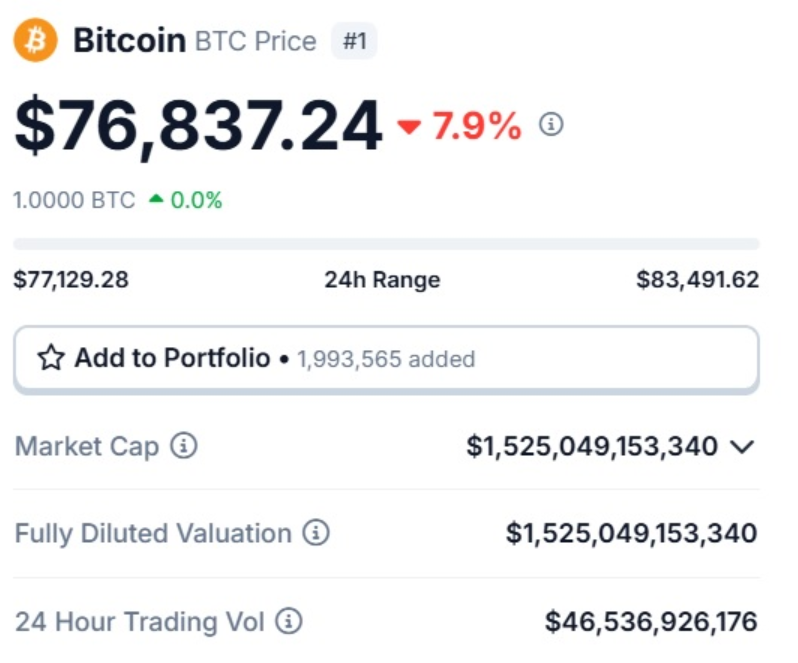
While traditional commodities were in widespread turmoil, the crypto market was also severely affected. Bitcoin fell below $80,000 in the early hours of February 1, and the total crypto market capitalization lost approximately $111 billion within 24 hours. Statistics show that over 400,000 investors were liquidated in this wave, with around $2.5 billion in assets wiped out instantly.
2. The Disillusionment of “Hoarding Gold and Silver”: Lonely Vigil at the Summit
In the past few months, amid macroeconomic uncertainty, many retail investors blindly poured into physical gold and silver, believing that holding tangible assets meant safety. However, this midnight “bloodbath” revealed a harsh truth: blind accumulation without trading fundamentals or risk management is essentially an asymmetric game against top global institutions.
- Liquidity depletion and excessive premiums: Physical asset investors often paid extremely high premiums when entering, but faced near-zero liquidity when the market plunged and cashing out became urgent.
- The cost of strategic vacuum: When the US Dollar Index rebounded strongly by around 0.9% due to policy expectations (e.g., the Fed chair nomination), holders of physical assets could only watch their portfolios shrink helplessly. Entering the market based on intuition left countless investors trapped at peak asset cycles.
3. Deep Drivers Behind Gold, Silver, and BTC Collapse
- Paradigm shift in hawkish policy: The US officially nominated the “extremely hawkish” Kevin Walsh as the next Fed chair. This was not just a change of position, but a signal of the return to a “long-term high interest rate” era, shattering rate-cut fantasies.
- The “liquidity black hole” of the dollar: The nomination news caused the US Dollar Index to surge, generating a terrifying siphon effect. Gold, silver, and BTC were forced into liquidation to allow institutions to reclaim cash.
- Irrational stampede: Excessive prior gains in gold and silver accumulated massive profit-taking positions. When prices broke key psychological levels, forced liquidations triggered cascading sales, leaving blind hoarders stranded at the summit.
Despite BTC often being called “digital gold,” its safe-haven properties failed completely in this crisis:
- Liquidity “blood bag” effect: When institutions suffered huge floating losses on gold and silver positions, they had to sell highly liquid BTC to meet margin requirements, triggering synchronized declines.
- Extreme risk aversion: In panic, funds did not flow into crypto but returned to USD and cash. Spot ETFs continued to bleed, showing institutional confidence in BTC asset allocation plummeted.
- Leverage liquidation cascades: The selling pressure from 400,000 liquidations created a market without buyers, and retail interest collapsed to minimal levels.
4. The Defeat of Emotional Trading
It is clear that conventional financial logic and intuition were failing. Financial markets do not pity tears. Behind 400,000 liquidations lies the tragedy of emotion defeating reason, intuition replacing algorithms. Without systematic governance, individuals overleveraged in greed and capitulated in fear. Such irrational volatility is precisely the opportunity for top-tier algorithms to capture profit.
Chapter 2: Nivex — The Strongest “Counter-Mover” Against Crashes
When traditional safe-haven assets fail and markets collapse from emotion, there is an urgent need for a solution that can traverse bull and bear cycles and counter volatility through mathematical certainty. This is the mission behind Nivex.
1. Brand Leap: From Exchange to Intelligent Financial Terminal
Nivex has completed the transition from a compliant Web3 exchange to a globally leading AI-driven crypto financial terminal. Our goal is not merely to provide a trading venue, but to build the next-generation “financial operating system.”
At the core of Nivex’s logic, AI is not a decoration but the engine of trading. We aim to achieve a leap from “experience-based trading” to “system-empowered execution.” This allows investors to delegate complex risk control and execution to tireless algorithms, remaining calm amid market turbulence.
2. Institutional-Level Performance and Global Compliance Safe Harbor
A platform handling global capital must possess ultimate resilience and transparency.
- Performance benchmark: Nivex’s institutional-grade trading engine rivals top global platforms, supporting over a hundred major assets with millisecond-level matching. Even during extreme conditions on February 1, peak daily trading volume exceeded 730 million USDT, yet the system ensured smooth execution, unaffected by liquidity shocks.
- Compliance cornerstone: Trust is the foundation of finance. Nivex has successfully obtained US FinCEN MSB registration and Nigeria CAC certification, and is actively pursuing licenses from UAE VARA and Singapore MAS. In a world of tightening regulation, Nivex provides a legally protected long-term safe harbor for users.
3. Intelligent Trading Hub: Alpha Strategies and Dynamic Risk Boundaries
Nivex’s Alpha strategy hub supports custom leverage and drawdown control, precisely fitting investors with varying risk appetites. More importantly, the platform’s AI detection mechanism automatically executes protection logic during market anomalies. This mathematically deterministic asset protection is a technological moat beyond physical hoarding or manual trading.
Chapter 3: In-Depth Analysis of Nivex Institutional Copy Trading — Replicating Top Algorithms’ Path to Success
Amid the ruins of trapped traditional assets and crypto liquidations, Nivex’s institutional copy-trading system demonstrated high profit certainty and stability. The system democratizes top institutional algorithmic sovereignty at the core level.
1. Algorithmic Sovereignty: Making 85%–95% Win Rates the Norm
Nivex institutional copy-trading is a premium product offering real-time signals from professional quant teams. Users can bind funds with one click to fully replicate top institutional operations. According to historical strategy data, core strategies maintain a long-term win rate of 85%–95%.
2. Nivex Institutional Strategies: Practical Performance of Diversified Allocations
In recent extreme market conditions, Nivex’s core institutional strategies displayed strong defense and explosive potential:
| Product Name | Total Return | Cumulative Profit (U) | Strategy Type |
| X-Hunter | 378.90%+ | 1,020,859.69 | Aggressive, capturing alpha during extreme volatility |
| AITrade | 326.51%+ | 2,892,104.04 | High-frequency, smoothing returns through dense arbitrage |
| Fidelity | 236.41%+ | 921,394.56 | Steady, focusing on long-term asset appreciation |
| Alpha10 | 157.54%+ | 6,983,801.04 | Trend-following, capturing large wave profits via macro modeling |
These strategies cover 45 major strategies including arbitrage, trend, and swing trading, with outstanding Sharpe ratios, delivering stable cross-cycle returns.
3. Transparent and Efficient Fee Economics
Nivex’s fee structure maximizes room for investors’ long-term growth:
- Highly competitive fees: Single-trade fee of 0.05%.
- Professional hedging model: Dual-direction hedging (long/short, close long/short) ensures flexibility across market conditions.
- Cost calculation: A full round involves 4 fees, resulting in a total effective rate of ~0.2%. This low-cost, high-frequency operation is unattainable for retail traders on conventional platforms.
4. Capital Efficiency: Why Large Funds Prefer Institutional Copy Trading
In Nivex’s model, capital size is a key driver of returns. While small accounts can profit through high-frequency trading, large accounts achieve higher capital efficiency.
- Data comparison: A 20,000 U conservative user, despite lower trading frequency, generates fee contribution and compounding 15x that of small accounts. Concentrating capital in institutional strategies reduces single-point risk while enabling exponential asset growth via algorithmic discipline.
Conclusion: From the Aftermath of Chaos to the Eternal Order Defined by Algorithms
The 2026 global “financial deep freeze” liquidated not only 400,000 leveraged investors but also blind faith in traditional safe-haven assets. When gold and silver dimmed under the hawkish shadow of Kevin Walsh, and BTC fell into liquidity black holes, we realized: in this hyper-connected, rapidly changing smart finance era, the costliest mistake is no longer trading fees, but arrogance toward “order” and ignorance of “volatility.”
Do not become an echo of the old era, vainly watching from the summit. True moats are no longer metal weight but algorithmic logic. The purpose of Nivex institutional copy trading is to let mathematical rigor dispel human warmth and weakness. Here, AI is not a cold machine, but the crystallization of top financial civilization, constructing an “unsinkable fortress” around your assets with millisecond risk control.
In this chaotic game where everyone is a player, you are either devoured by volatility or become a creator of rules.
Join Nivex, and let the wisdom of civilization replace primal instinct. We do not promise absolute calm, but we promise the strictest discipline. Let algorithms navigate silently, giving your wealth a soul that flows upstream through storms.
Nivex: In the Name of Algorithms, Guarding Every Inch of Order.


All Comments