

It’s that time again — when your friends and family members who know you’re into Bitcoin text asking if now is the time to buy.
A time that signifies we’re at another peak in bitcoin’s price.
I know, I know. How bah-humbug of me.
But the truth is, if you’re thinking about buying bitcoin right now, it might not be the best time to make a sizable purchase — despite the fact that we might see spot bitcoin ETFs (exchange-traded funds) approved in the near future (possibly as early as January).
Why?
Let’s start by looking at bitcoin’s price action during periods leading up to the last two Bitcoin halvings. (The next is due in late-April, when block 840,000 is expected to be mined.)
Trends from previous Bitcoin cycles
Bitcoin halving cycles last about four years (210,000 blocks produced at approximately 10 minutes per block). At the commencement of each cycle, the block subsidy reward that Bitcoin miners receive is cut in half, which triggers a bitcoin supply shock.
Historically, bitcoin’s price has risen dramatically during the year and a half that follows the halving. The price then tanks and trades in a range for the cycle’s other two and a half years.
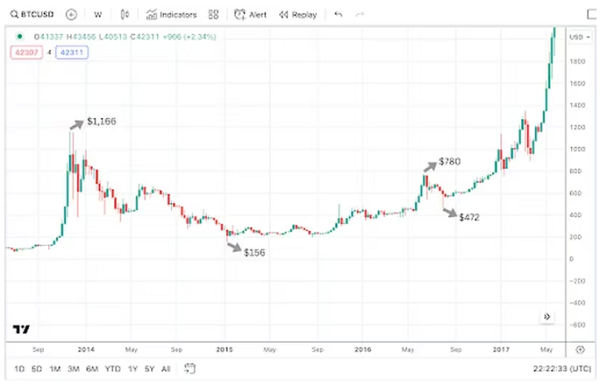
From late-2013 until mid-2016, when the second halving occurred, bitcoin’s price fell from $1,166 to $156. It then rebounded to $780 — 67% of the previous all-time high — before falling 40% to $472 in August 2016.
The $472 price point marked a local bottom just one month after the second halving took place.
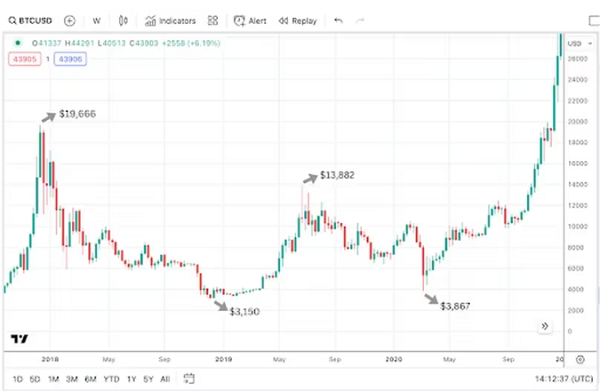
From late 2017 to late 2018, bitcoin’s price fell from $19,666 to $3,150 before rebounding to $13,882 — 70% of the previous all-time high. By March 2020, its price had fallen 72% to $3,867.
$3,867 marked a local bottom two months before the third Bitcoin halving, which occurred in May 2020.
Another two-and-a-half-year period that precedes a Bitcoin halving is coming to an end. This period began in late 2021 and will end in April 2024, when the fourth halving is scheduled to occur.
During this period thus far, bitcoin’s price has fallen from $69,000 to $15,522 before rebounding to $44,759 — 65% of the previous all-time high.
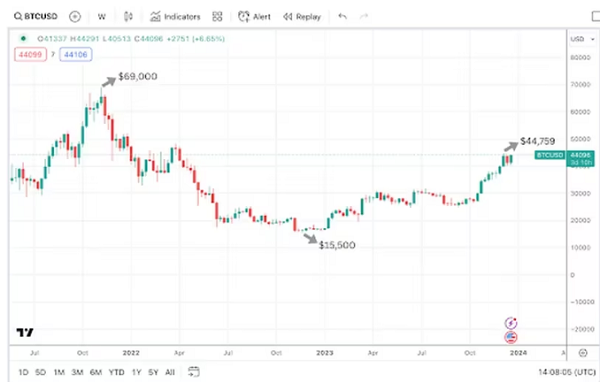
This 65% rebound — the current one — is awfully close to the 67% and 70% rebounds we saw in the two previous cycles.
And so the big question now is: Will bitcoin’s price retrace significantly leading up to the next halving as it has leading up to the two previous halvings?
If bitcoin’s price were to fall 40% from these current levels — as it did in 2015-2016 — we’d see bitcoin’s price at $26,855. (As of writing, it is approaching $44,000).
If it were to fall 72% — as in 2019-2020 — we’d see bitcoin’s price at $12,532.
I’ve seen very few people mention such numbers in the wake of the euphoria bitcoin investors are currently experiencing.
So, will this time be different?
Aren’t we waiting for billions of dollars to flow into bitcoin almost immediately after the spot bitcoin ETF is approved?
Maybe.
The spot bitcoin ETF
No one knows whether an approval of a spot bitcoin ETF is priced into the bitcoin market yet.
Some believe it is and that the announcement of a spot bitcoin ETF will be a “buy the rumor, sell the news” event — a situation in which bitcoin’s price rises in anticipation of a spot bitcoin ETF announcement, as it has been, but then sells off once the ETF is announced.
Others say it’s a “buy the rumor, buy the news” event — a situation in which bitcoin’s price rises in anticipation of a spot bitcoin ETF and rises again once the ETF is announced.
The truth is that no one knows what will happen in the wake of a spot bitcoin ETF being approved and coming to market.
And with Bloomberg analysts predicting a 90% chance of approval by January 10, 2024, hardly anyone seems to be asking the following question: What happens to bitcoin’s price if the spot bitcoin ETF isn’t approved? (Though CoinDesk did.)
This scenario could easily be grounds for a significant drawdown in bitcoin’s price. The drawdown might not be as severe as the previous two, but it would likely be notable.
Also, what happens to bitcoin’s price in the event of a hard landing?
What if we don’t get a soft landing?
While the powers that be and major institutions will have you believe that we’re on our way to a soft landing or, at worst, a mild recession, those of us who remember hearing the exact same rhetoric in 2008 aren’t so convinced.
A number of reputable outlets have stated that we may be amid a “melt-up” — a situation in which asset prices rise parabolically before crashing catastrophically.
This isn’t hard to believe given that the Dow Jones Industrial Average is at an all-time high, while the S&P 500 and the Nasdaq are almost there, as well — all while we’re still in an environment in which investors can earn over 5% risk-free in money market mutual funds.
If a melt-up is currently taking place and bitcoin’s price is going along for the ride, then there are two more questions we have to ask: How high does bitcoin’s price rise before it comes crashing down, and what sort of investing strategy is best to employ if this is the case?
While the first question is difficult to answer, the second isn’t as challenging.
A BTC investment strategy for this point in the Bitcoin cycle
By all means, continue to HODL your BTC and DCA (dollar-cost average) into the asset, as these investment strategies have proven fruitful for anyone who has held BTC for more than four years.
The one thing you might want to avoid amid this euphoria is aping into a large position at these levels — especially with any sort of leverage. (To quote the Founder & CEO of Custodia Bank, Caitlin Long, “A fool and their leveraged bitcoin are soon parted.”)
If we see a massive drawdown in bitcoin’s price, you’ll want to have some cash on the sidelines to buy, not find yourself bitcoin-less and cash-strapped due to acting like an overzealous gambler.
As always, we don’t know where bitcoin’s price will go from here. Maybe it actually will move up only both into and beyond the halving.


All Comments