

Cointime

Download App
iOS & Android

Mark Zuckerberg is building an AI agent to help run Meta

Meta CEO and co-founder Mark Zuckerberg is reportedly building an AI agent to help handle his work in managing the company amid a company-wide push for employees to adopt agentic tech.

​According to a report from The Wall Street Journal on Sunday, citing sources close to the matter, Zuckerberg’s AI agent is still in development but already being used to help the CEO speed up information retrieval.

Instead of going through multiple layers of people or teams to get the required information, the agent has been retrieving the information directly.  

​The move is part of a broader goal within the company to accelerate employee productivity and reduce layers of friction within its 78,000-strong employee base. The report adds that Meta is pushing to compete with AI-native startups that have much smaller teams.

​Zuckerberg has previously alluded to this push, noting in an earnings call in late January that 2026 is going to be the year that “AI starts to dramatically change the way” Meta works, while also indicating there may be changes to the firm’s organizational structure moving forward.

​“As we navigate this, our north star is building the best place for individuals to make a massive impact. So to do this, we're investing in AI-native tooling so individuals at Meta can get more done, we’re elevating individual contributors, and flattening teams.”

The WSJ report highlights that Meta employees have been utilizing agentic tools such as MyClaw, which has been giving them access to work files and chat logs, while also enabling them to talk with colleagues or their AI agent counterparts.

Meta employees have also been said to be using Second Brain, another AI tool built on top of Anthropic’s Claude infrastructure to help speed up work on projects, which has been described internally as something akin to an “AI chief of staff,” according to the sources.

Reports suggest Meta may plan further layoffs

A recent report from Reuters claimed that the firm may be finalizing plans for another wave of layoffs to offset its expenditures and capitalize on AI efficiency gains.

In an article on March 14, Reuters cited three sources familiar with the matter who claimed that Meta could be planning layoffs that may impact up to 20% of the company.

The sources claimed that no date has been set yet and that the scale of the layoffs hasn’t been finalized.

In a statement to Cointelegraph, Meta declined to comment on the WSJ article; however, a spokesperson responded to the Reuters reporting by saying that it was a “speculative report about theoretical approaches.”

The crypto sector has been hit by a wave of layoffs in 2026, with several firms outlining a renewed focus on AI.

Last week, blockchain data provider Messari announced a shuffling of executives and employee layoffs to make way for the company’s “next phase” of becoming an AI-first company.

Meanwhile, exchange Crypto.com also announced a 12% reduction in its workforce amid its own AI push.
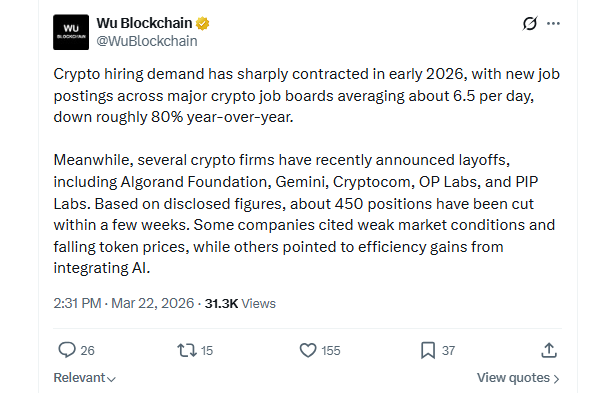
  Source: Wu Blockchain
Comments

All Comments

Recommended for you

  • Russian Foreign Minister Lavrov: Meeting with U.S. Secretary of State Rubio Scheduled for Tomorrow

    On July 22, Russian Foreign Minister Lavrov stated that the meeting with U.S. Secretary of State Rubio has been scheduled for tomorrow.

  • Supermicro Surges Over 14% Pre-Market as Q4 Gross Margin Doubles Guidance, New Orders Exceed $60 Billion

    On July 22, AI server manufacturer Supermicro (SMCI.US) surged over 14% in pre-market trading to $29.17. On the news, the company released preliminary results for the fourth fiscal quarter ended June 30. The company's GAAP and non-GAAP gross margins are expected to be between 15% and 17%, nearly double the previously guided range of 8.2% to 8.4%. Management attributed this better-than-expected performance to favorable customer structure and product mix. Meanwhile, the company's total new orders for the quarter exceeded $60 billion, a record high.

  • US Optical Communication Stocks Fall in Pre-market, Marvell Down Over 2%

    On July 22, US optical communication concept stocks fell collectively in pre-market trading, with Astera Labs, Coherent, Credo Technology, Ciena, AXT Inc, and MaxLinear falling more than 3%, and Fabrinet, Lumentum, Corning, Applied Optoelectronics, Tower Semiconductor, Marvell Technology, POET Technologies, and GlobalFoundries falling more than 2%.

  • US AI chip stocks fall pre-market, Intel down 3%

    On July 22, US stock market AI chip stocks generally fell before the market open, with Intel down 3%, TSMC, AMD, and Qualcomm down over 2%, Broadcom down nearly 2%, and NXP and Nvidia down over 2%.

  • Russia Develops 150nm Lithography Machine, Performance Comparable to Pentium 4 from 20 Years Ago

    On July 22, according to Fast Technology, Russia's Green City Nanotechnology Center (ZNTC) has successfully developed a prototype of an electron beam lithography machine (ELL) with a design standard of 150nm. The project is a key research and development task under the framework of Russia's national plan for scientific and technological development, codenamed Progress ELL 150. This device is mainly used for manufacturing photomasks, and can also directly draw circuit patterns on substrates without using masks. The 150nm process roughly corresponds to the performance level of Intel's Pentium 4 from 20 years ago. In 2025, ZNTC demonstrated a similar device with 350nm resolution, and has now advanced to 90nm and 130nm technology nodes. Industry experts point out that such equipment is only suitable for small batch production of specialized chips in fields such as aerospace and defense.

  • Beijing State-owned Capital: Nearly 10 Billion Yuan Allocated to Stock Market from Own Funds

    On July 22, Beijing State-owned Capital Operation and Management Co., Ltd. announced that, as of now, it has allocated nearly 10 billion yuan from its own funds to invest in the stock market. Going forward, the company will continue to support listed company stocks using its own funds and through its subsidiaries, including securities firms and public funds, while also backing the development of the Beijing Stock Exchange. Rooted in its functional role as a state-owned capital operator, the firm is committed to safeguarding the strategic value of core assets of listed companies and contributing to the stable and healthy growth of the capital market through concrete actions, as a state-owned enterprise based in Beijing. (Beijing State-owned Capital)

  • U.S. Stock Futures Fall, Major Indices Decline

    U.S. stock futures are lower, with Nasdaq 100 futures down 1%, S&P 500 futures down 0.4%, and Dow futures down 0.3%.

  • Japan's Two-Year Government Bond Yield Rises to 1.47%, First Time Since 1995

    Japan's two-year government bond yield rose to 1.47%, the first time since 1995.

  • WTI and Brent Crude Surge Over 4%

    On July 22, international oil prices surged rapidly. WTI crude oil futures rose over 4% to $87.77 per barrel; Brent crude oil futures rose over 4% to $94.71 per barrel.
