

Cointime

Download App
iOS & Android

Dormant Coins Targeted in Proposed Quantum-Resistant Bitcoin Fork

Validated Project

Bitcoin could be about to get a major change. A new proposal suggests some coins might have to be destroyed to protect the network from future quantum computer attacks.

The proposal is called QRAMP, short for Quantum-Resistant Address Migration Protocol. It was put forward by Bitcoin developer Agustin Cruz and has caused quite a stir in the wider Bitcoin community.
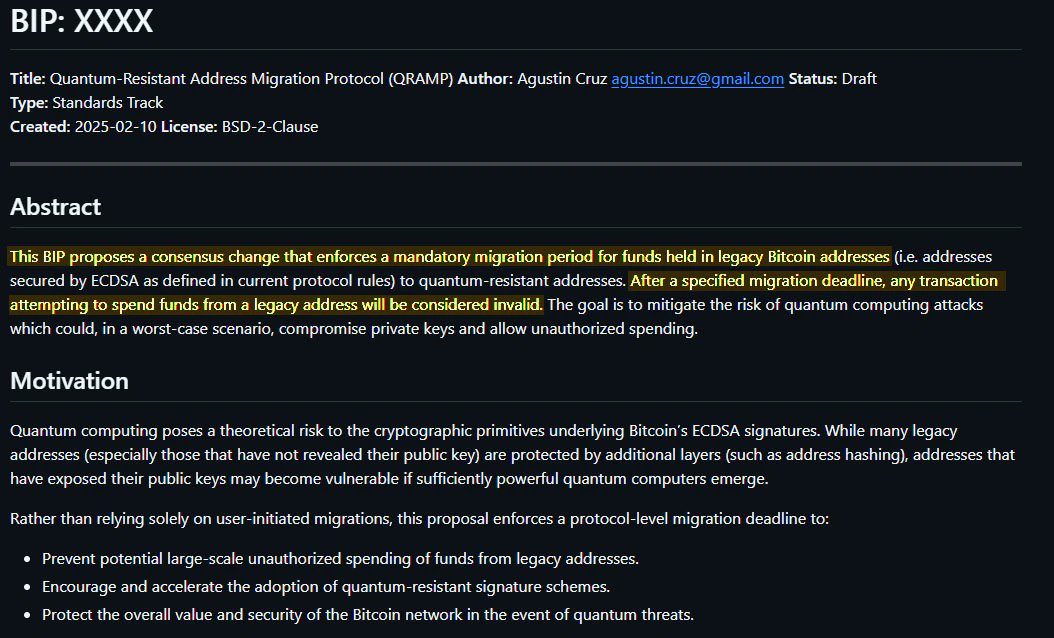
The proposed Bitcoin QRAMP BIP sets a mandatory migration period

Bitcoin’s security is based on ECDSA cryptographic system (Elliptic Curve Digital Signature Algorithm). That’s strong against regular computers but might be broken by quantum computers in the future.

Quantum computers use a new kind of processing procedure based on the laws of quantum physics. Instead of working with just ones and zeroes like regular computers, they use qubits which can exist in multiple states at once. That means they can do specific complex calculations much faster.

Cruz and other devs worry that one day a powerful quantum machine could crack Bitcoin’s security and allow hackers to steal coins from vulnerable wallets. Cruz said:

“Addresses that have exposed their public keys may now be vulnerable if sufficiently powerful quantum computers emerge.”

Cruz’s QRAMP proposal is a major update—a hard fork—to the Bitcoin network. A hard fork is a big software change that creates new rules for Bitcoin and essentially creates a new blockchain. Older versions of the software would no longer be compatible.

If QRAMP is adopted, all Bitcoin users will get a deadline. Before that deadline they would need to move their bitcoin from old, vulnerable addresses to quantum-resistant ones.

If they don’t do this in time, their coins will become unspendable.

The idea is to force users to secure their funds before quantum computers become a real threat. “It provides rightful owners with a clear, non-negotiable opportunity to secure their funds,” Cruz wrote in an email to Bitcoin Dev mailing list.

But there’s a big catch: any coins that remain in vulnerable wallets after the deadline would be effectively burned. This means the total supply of bitcoin could shrink — possibly by millions of coins.

The intense debate over this idea has really brought out the passion in Bitcoin supporters. Some see it as a smart way to safeguard the digital asset’s future.

They believe acting early—before a quantum disaster strikes—is better than waiting. It’s better to burn off some of those bitcoin now than risk losing them all, one supporter put it.

Others think that this plan goes too far. They say it undermines two of Bitcoin’s core principles: decentralization and immutability. That means no one can change Bitcoin’s history or rules.

Many people are worried about the coins locked away in dormant wallets. Those belong to users who’ve lost their private keys, passed away or simply haven’t accessed their funds in years.

Among those is Bitcoin’s creator Satoshi Nakamoto. Analysts estimate that Satoshi himself has over 1 million coins that he hasn’t touched in over 15 years.

If those people don’t migrate their coins, they’ll be lost forever.

History shows that not all dormant coins are forgotten or lost. There have been instances of old wallets activating after ten years.

“I admire the effort,” one Reddit user wrote , “But this will still leave everyone who doesn’t migrate’s coins vulnerable, including Satoshi’s coins.” That’s a pretty stark reminder of just how much is at stake.

QRAMP is just a draft proposal. It doesn’t have a BIP number and the Bitcoin community hasn’t reached consensus to move forward.

Implementing QRAMP would require a lot of work from users, wallet developers, miners, node operators and infrastructure providers. Everyone in the ecosystem would have to agree and update their software to support the change.

Microsoft’s recent announcement of their Majorana 1 quantum chip which can scale up to a million qubits might be why this discussion is happening now. Current machines don’t pose an immediate threat but the technology is advancing.

Other ideas have been proposed to protect Bitcoin from quantum threats.

One such idea from BTQ is a new kind of blockchain verification method using Coarse-Grained Boson Sampling — but that would require replacing existing mining hardware with quantum-compatible systems.


Comments

All Comments

Recommended for you

  • Blockchain.com Seeks Approval for Prediction Markets and Cryptocurrency Derivatives Trading

    On October 9, the crypto asset platform Blockchain.com submitted an application to the U.S. Commodity Futures Trading Commission (CFTC) seeking to obtain licenses for a designated contract market (DCM) and a futures commission merchant (FCM) to offer event contracts (prediction markets) and cryptocurrency derivatives trading services to U.S. users.

  • US May Seize Approximately $1 Billion in Cryptocurrency Related to Iran This Week

    U.S. Treasury Secretary Bencet stated at the NPolicy Summit held by Newsmax in Washington on Thursday that we may seize $1 billion in cryptocurrency this week, adding, "We know where it is, and we are isolating them." Bencet noted that the Trump administration's approach to Iran has shifted from 'maximum pressure' to 'absolute isolation,' with measures including maritime blockades, restrictions on air travel, and the cutting off of land routes. The UAE and Oman are cooperating with the U.S., which is also working with Pakistan and Turkey to cut off all land routes in and out of Iran.

  • Zcash Development Team Plans to Introduce Quantum-Resistant Signatures in January

    The development team of the privacy cryptocurrency Zcash (ZEC) plans to introduce post-quantum signature opcodes to the network in January next year, supporting hash-based signature technology to defend against potential quantum computing attacks. This solution primarily targets the transparent (public) payment pool, where approximately 70% of ZEC is currently stored. Although the developers have set January as the target deadline, the specific network activation time has not yet been finalized. This upgrade aims to prevent attackers from using existing public keys to reverse-engineer private keys and forge payment authorizations. Additionally, the Zcash node validator Zakura has launched a wallet tool based on Private Information Retrieval (PIR), allowing users to query balances across multiple addresses without revealing the correlation between those addresses to the server. Previously, Ethereum researcher Justin Drake warned that artificial intelligence could accelerate the cracking of traditional encryption algorithms and urged cryptocurrency holders to prepare for potential security threats.

  • BTC Surpasses $83,000

    Market data shows that BTC has surpassed $83,000, currently priced at $83,017.3, with a 24-hour increase of 0.66%. The market is highly volatile, so please ensure proper risk management.

  • Central Committee and State Council: Comprehensive Implementation of 'AI+' Initiative

    On October 9, the Central Committee of the Communist Party of China and the State Council issued the 'Opinions on Developing New Quality Productive Forces.' The opinions mention the comprehensive implementation of the 'AI+' initiative. This includes promoting the transformation of traditional industries through artificial intelligence, accelerating the development of new-generation intelligent terminal applications such as smart connected new energy vehicles, AI smartphones and computers, and humanoid robots. It aims to speed up innovation in digital intelligence technologies like artificial intelligence, break through foundational theories and core technologies, and strengthen the efficient supply of computing power, algorithms, and data. The strategy involves tailored approaches based on local conditions and industry-specific policies to layout national pilot bases for AI industry applications and high-value application scenarios, vigorously promoting the application of AI across various sectors. Additionally, it emphasizes the establishment of a technology monitoring, risk warning, and emergency response system to ensure that artificial intelligence is safe, reliable, and controllable.

  • U.S. Government-Related Wallet Deposits 17,733 BTC and 750 WBTC to Coinbase Prime

    On October 9, according to monitoring by Lookonchain, wallets associated with the U.S. government have deposited 17,733 BTC (worth $1.48 billion) and 750 WBTC (worth $62 million) into Coinbase Prime over the past three days. According to tagging data from Arkham, these wallets currently hold cryptocurrency assets valued at $25.4 billion, with Bitcoin alone valued at $25.3 billion.

  • ETH Falls Below $2500

    Market data shows that ETH has fallen below $2500, currently priced at $2499.87, with a 24-hour decline of 2.55%. The market is experiencing significant volatility, so please ensure proper risk management.

  • ETH Surpasses $2500

    Market data shows that ETH has surpassed $2500, currently priced at $2500.13, with a 24-hour decline of 2.21%. The market is experiencing significant volatility, so please ensure proper risk management.

  • BTC Surpasses $82,000

    Market data shows that BTC has surpassed $82,000, currently priced at $82,002.01, with a 24-hour decline of 1.47%. The market is highly volatile, so please ensure proper risk management.

  • Fed's Musalem: Further Tightening of Monetary Policy Needed to Bring Inflation Back to Target; Rates Should Be Raised in Next 6 to 9 Months

    On October 9, Fed's Musalem stated that further tightening of monetary policy is necessary to bring inflation back to target, and interest rates should be raised in the next 6 to 9 months. The economy is currently quite strong, and the best thing the Fed can do is to lower inflation; market inflation expectations remain stable, and there has been no indication of a loss of credibility for the Fed.