

Cointime

Download App
iOS & Android

US appeals court upholds preventing New Jersey enforcement against Kalshi

A US appellate court has ruled against New Jersey gaming authorities for bringing an enforcement action against prediction market platform Kalshi over sports event contracts. 

In a Monday-issued opinion, a panel of judges in the US Court of Appeals for the Third Circuit ruled 2-1 in favor of Kalshi’s argument that the company had a ”reasonable chance of success” claiming that the Commodity Exchange Act preempted state law, setting the stage for a potential battle over gaming laws in the US Supreme Court.

"This is a big win for the industry and millions of users," Kalshi CEO Tarek Mansour said in a social media post on X.

The appellate court’s opinion affirmed a lower court ruling, in which Kalshi argued that the US Commodity Futures Trading Commission (CFTC) had “exclusive jurisdiction” in regulating sports-related event contracts as swaps that fall under its purview.

“Allowing New Jersey to enforce its gambling laws and state constitution would create an obstacle to executing the Act because such state enforcement would prohibit Kalshi, which operates a licensed [designated contract market] under the exclusive jurisdiction of the CFTC, from offering its sports-related event contracts in New Jersey,” wrote Circuit Judge David J. Porter. “This state regulation is exactly the patchwork that Congress replaced wholecloth by creating the CFTC.”
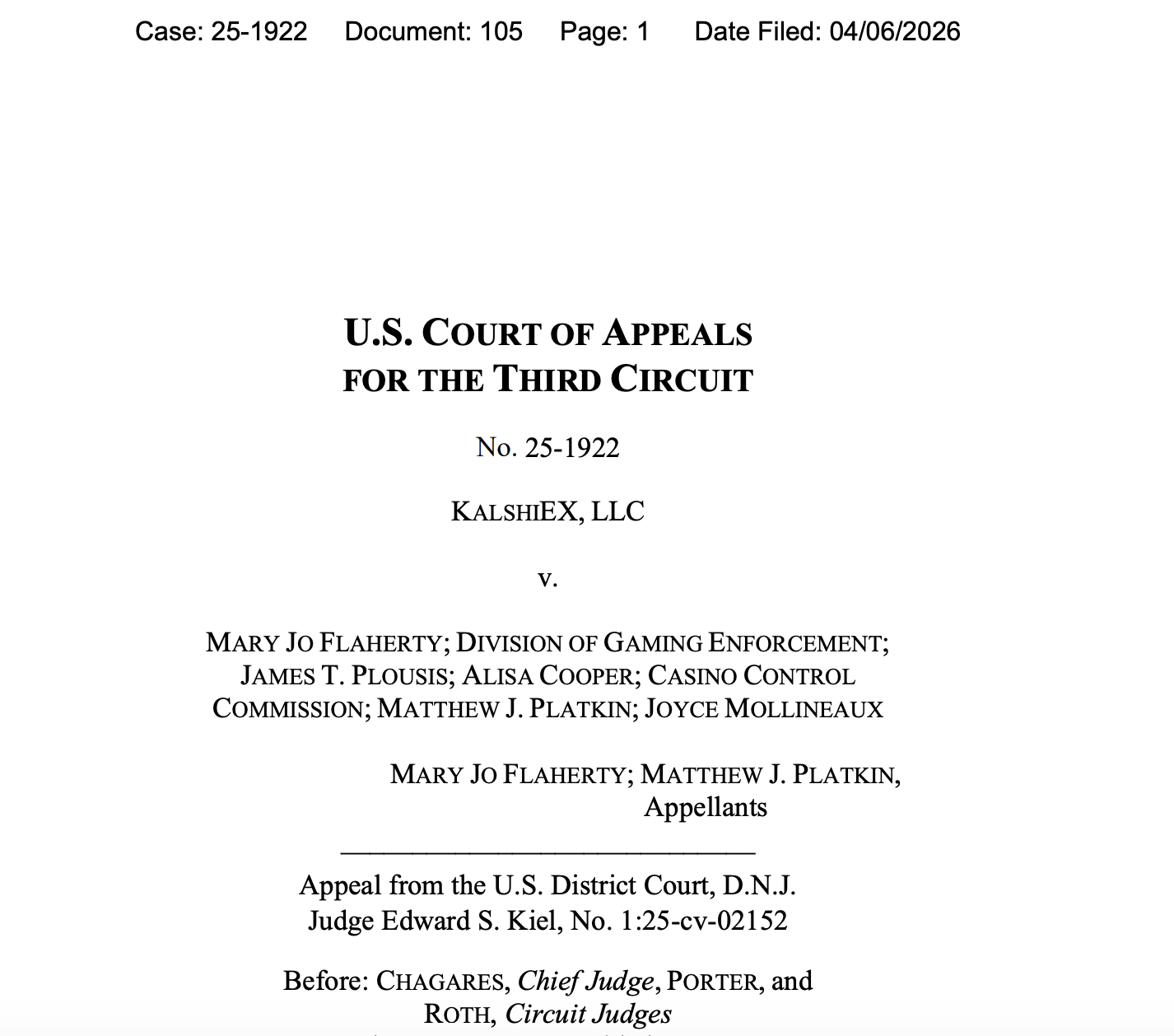
Monday’s Third Circuit opinion affirming lower court ruling. Source: PACER


The circuit court ruling came just days after a Nevada judge extended a ban on Kalshi offering event-based contracts, following several other state authorities cracking down on sports betting on prediction markets. The patchwork of state-level rulings could lead to the US Supreme Court taking up one of the cases, potentially changing its 2018 decision giving states the authority to regulate sports gambling.

In her dissent, Circuit Judge Jane Roth said the prediction markets platform’s actions were a “performative sleight meant to obscure the reality that Kalshi’s products are sports gambling,” adding that the company’s event contracts were “virtually indistinguishable” from those on betting websites:

“[T]he question of whether sports-event contracts are swaps is a thorny issue with the potential to radically upend the legal landscape governing the gambling industry, and I am not convinced the Majority’s analysis does this issue justice.”

CFTC chair reiterates agency’s position on prediction markets

CFTC Chair Michael Selig, the sole commissioner at the financial agency following the departure of acting chair Caroline Pham in December, has made prediction markets one of the commission’s central issues since taking office. In the last four months, Selig has claimed that the CFTC has “exclusive jurisdiction” in regulating event contracts on prediction markets, opened a proposed rule to public comment and filed an amicus brief supporting its position in the Ninth Circuit Court of Appeals in a case involving Nevada’s gaming authorities.

The regulator last week sued Arizona, Connecticut and Illinois to block them from pursuing what it said were unlawful efforts to regulate prediction markets.

“Our definition of commodity and statute is very broad,” Selig said at the Digital Assets and Emerging Tech Policy Summit at Vanderbilt University on Monday. “It includes events on sports, it includes events in politics, it includes corn and grains and all sorts of things. It doesn't really distinguish between if you're offering an event contract on grains, you're regulating that differently than an event contract on sports.”

The CFTC chair added that there were exceptions for event contracts that were “readily susceptible to manipulation.”


Comments

All Comments

Recommended for you

  • Whale Transfers 1,133 BTC to Coinbase Prime, Valued at $71.48 Million

    According to Onchain Lens monitoring, a whale transferred 1,133 BTC from Coinbase to Coinbase Prime through an intermediary wallet, valued at $71.48 million.

  • U.S. AI Chip Stocks Decline Before Market Open, Intel Falls Over 3%

    On July 7, U.S. AI chip stocks experienced widespread declines before the market opened. Intel dropped over 3%, while AMD, Qualcomm, and NXP fell more than 2%. TSMC, Broadcom, and Tesla decreased by over 1%, and NVIDIA declined by 0.7%.

  • China's Central Bank Increases Gold Reserves for the 20th Consecutive Month

    As of the end of June, China's gold reserves stood at 75.44 million ounces (approximately 2,346.446 tons), an increase of 480,000 ounces (about 14.93 tons) from the end of May, which reported 74.96 million ounces (approximately 2,331.52 tons). This marks the 20th consecutive month of gold accumulation.

  • China's Foreign Exchange Reserves in June at $341.6262 Billion

    On July 7, China's foreign exchange reserves for June stood at $341.6262 billion, a decrease of $26 billion from the end of May, representing a decline of 0.75%, with expectations set at $343.2 billion.

  • U.S. Storage Stocks Drop Pre-Market, SanDisk and Micron Down Over 4%

    On July 7, U.S. storage concept stocks collectively fell in pre-market trading. Western Digital dropped over 5%, SanDisk and Micron Technology fell over 4%, Seagate Technology declined over 3%, Rambus fell over 2%, and SMI fell over 1%.

  • U.S. Stocks in Optical Communication Sector Drop Pre-Market

    On July 7, stocks in the optical communication sector of the U.S. market collectively fell pre-market. Astera Labs dropped over 4%, while Marvell Technology, Credo Technology, and AXT Inc. fell more than 3%. Tower Semiconductor, MaxLinear, Corning, Applied Optoelectronics, GlobalFoundries, Lumentum, and Qorvo all declined by more than 2%. Coherent, Nokia, Amphenol, and Broadcom dropped over 1%.

  • Pre-market Decline in U.S. Storage Stocks

    In pre-market trading, U.S. storage concept stocks experienced a widespread decline, with Micron Technology falling by 4.8%, SanDisk dropping over 4%, Corning down more than 2%, and Intel decreasing by over 3%.

  • Two Departments: Support for Reinsurance Institutions to Increase Capital and Issue Supplementary Capital Tools

    On July 7, the National Financial Supervision and Administration Bureau and the Shanghai Municipal Government released several measures to accelerate the construction of the Shanghai International Reinsurance Center. Among these measures, they proposed to enhance the quality and efficiency of the reinsurance industry, support reinsurance institutions in increasing capital and expanding shares, and issuing supplementary capital tools to improve the capacity for internal capital accumulation and external capital supplementation, thereby strengthening the reinsurance industry's capabilities. The initiative aims to guide the insurance industry to focus on major national projects, strategic emerging industries, and livelihood security, consolidating insurance and reinsurance underwriting capabilities to enhance risk protection levels. It also supports reinsurance institutions in leveraging their professional technical advantages to assist the insurance industry in reducing risk.

  • Sources: Saudi Arabia Plans to Expand Oil Pipeline to Red Sea, Increasing Capacity by 2 Million Barrels Daily to Bypass Strait of Hormuz

    On July 7, five informed sources revealed that Saudi Arabia is considering expanding the crude oil pipeline capacity to its western coast on the Red Sea, allowing Saudi Arabia and its neighbors to transport more oil without passing through the Strait of Hormuz. This east-west pipeline, built in the early 1980s, has gained strategic importance since the outbreak of the Iran war in February and the disruption of shipping in the Strait of Hormuz. The pipeline can deliver up to 7 million barrels of crude oil per day to the Red Sea port. The CEO of Saudi Aramco stated in May that approximately 2 million barrels are supplied to west coast refineries, while about 5 million barrels are for export. Sources indicate that Saudi Arabia is in preliminary discussions with some neighboring countries regarding the pipeline expansion, aiming to add about 2 million barrels of pipeline capacity per day. It remains unclear whether Aramco's planned expansion involves upgrading existing infrastructure or constructing new pipelines. One source mentioned that the expansion plan also includes a smaller refined oil pipeline. Two sources indicated that the expansion scale could range from 1 million to 2 million barrels per day, with refined oil also being considered. Another source stated that the project would take several years and cost billions of dollars, requiring adjustments to Saudi crude pricing mechanisms.