

Cointime

Download App
iOS & Android

Ethereum Foundation makes post quantum security a top priority as new team forms

What to know:

  • The Ethereum Foundation has elevated post-quantum security to a top strategic priority, forming a dedicated Post Quantum team led by Thomas Coratger with support from leanVM cryptographer Emile.
  • Researcher Justin Drake said Ethereum is shifting from background research to active engineering, including biweekly developer sessions on post-quantum transactions and multi-client post-quantum consensus test networks.
  • The foundation is backing new cryptography with funding and outreach, launching two $1 million prizes, planning post-quantum community events and education, and stressing that blockchains must prepare early for quantum threats despite their long-term nature.

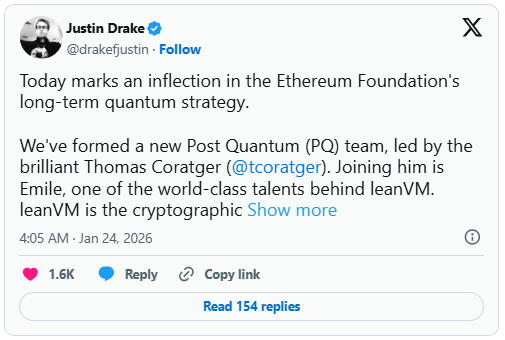
The Ethereum Foundation (EF), a nonprofit organization that supports Ethereum’s development, is turning its long running post quantum research into a public engineering push, forming a dedicated Post Quantum team and calling the effort a top strategic priority for the network.

EF researcher Justin Drake said the new group will be led by Thomas Coratger, with support from Emile, who Drake described as a key talent behind "leanVM."

Drake framed leanVM as a core part of Ethereum’s broader approach to post quantum security, arguing that timelines are accelerating and that Ethereum should move into a build phase rather than keep work in the background.
The announcement comes as crypto markets have become more sensitive to quantum risk headlines, even if the practical threat remains a longer dated problem.

Quantum computing uses new types of processors that could one day break today’s encryption much faster than normal computers. Blockchain developers worry it could eventually expose wallet keys, forcing networks to upgrade cryptography well before that risk becomes real.

The bigger issue for large networks is not a single breakthrough moment but the time it takes to ship a safe transition, update wallets and move users onto new formats without breaking daily usage.

Drake outlined several near term steps. A bi weekly developer session focused on post quantum transactions is expected to start next month, led by Antonio Sanso. The agenda is aimed at user facing defenses, including dedicated cryptographic tools inside the protocol, account abstraction paths and longer term work on aggregating transaction signatures using leanVM.

EF is also putting money behind cryptography research. Drake said it is announcing a $1 million Poseidon Prize to harden the Poseidon hash function and pointed to another $1 million post quantum initiative called the Proximity Prize.

On the engineering side, Drake said multi client post quantum consensus dev networks are already running, with multiple teams participating and weekly interoperability calls to coordinate.

Ethereum plans more community work as well. Drake said the EF will host a post quantum event in October and a post quantum day in late March ahead of EthCC, alongside education efforts that include a video series and enterprise focused materials.

Others in the ecosystem echoed the urgency. Pantera Capital XX Franklin Bi argued that traditional finance could take years to upgrade systems, while blockchains may be able to coordinate a full stack software transition faster.


Comments

All Comments

Recommended for you

  • Senate Banking Committee Chair: CLARITY Act Fails to Advance Due to Democratic Opposition, SEC and CFTC Should Establish Digital Asset Rules

    On September 16, Tim Scott, Chairman of the Senate Banking Committee, stated that today, nearly all Senate Republican members voted in favor of advancing the CLARITY Act, but the motion ultimately failed to secure enough votes due to opposition from Senate Democrats. We have taken a step forward. Now, before Congress completes legislation, it is up to the SEC and CFTC to establish clear regulatory rules for digital assets. I remain focused on single mothers and Americans living in poverty, as I grew up in similar circumstances. I will continue to work to protect their hard-earned money and ensure the future of the financial industry remains in the United States.

  • Galaxy CEO: CLARITY Act Fails Due to Bipartisan Ethical Disagreements, SEC and CFTC to Continue Regulatory Efforts

    On September 16, Galaxy CEO Mike Novogratz stated, "The government seems to be paralyzed. Our industry has worked with both Democrats and Republicans for 18 months, yet the CLARITY Act has faltered just five yards from the finish line. All disputes, except for one issue, were resolved through hard negotiations. That issue is ethics. Both sides have held firm to their positions on ethics, ultimately deeming their stance more important than the long-term interests of a significant industry and the opportunity for the U.S. to lead in this sector. Republicans are concerned about imposing real restrictions on the President's ability to profit from digital assets; Democrats have decided to use this industry as a battleground in their fight against corruption. They worry about any actions that could be interpreted as showing a "soft stance" towards the President. Previously, there was a bipartisan proposal that could have resolved this issue, but it ultimately got caught up in political maneuvering. I am very disappointed that neither side was able to find a way across this divide. I know that with only seven weeks until the election, this has largely driven both parties' actions. However, what is truly perplexing is that I do not believe cryptocurrency and this bill will be among the top ten issues in this election. In 2024, yes, but this year's focus will be on war, inflation, cost of living, artificial intelligence, immigration, and which party can provide better solutions to these issues. Nonetheless, I still believe that the SEC and CFTC will continue to advance the development of regulatory rules for digital assets. I hope that over time, Congress will eventually find a way to formally legislate these rules, allowing market participants to build longer-term confidence in how digital assets will be regulated in the U.S. Perhaps Mitch McConnell returning to Congress in a wheelchair after a 90-day break is itself a rather ironic signal, further highlighting the predicament Congress is currently in. Tomorrow we continue to work. We keep building.

  • BTC Falls Below $76,000

    Market data shows that BTC has fallen below $76,000, currently priced at $75,944.3, with a 24-hour decline of 4.09%. The market is experiencing significant volatility, so please ensure proper risk management.

  • BTC Surpasses $77,000

    Market data shows that BTC has surpassed $77,000, currently priced at $77,007.69, with a 24-hour decline narrowing to 2.2%. The market is experiencing significant volatility, so please ensure proper risk management.

  • Becerra: We Can Start Paying Off Debt When Deficit Reaches 3% of GDP

    U.S. Treasury Secretary Becerra: We can start paying off debt when the deficit reaches 3% of GDP.

  • WTI Crude Oil Surpasses $100 per Barrel, Up 2.04% Intraday

    WTI crude oil has surpassed $100 per barrel, rising 2.04% intraday.

  • ETH Falls Below $2400

    Market data shows that ETH has fallen below $2400, currently priced at $2397.9, with a 24-hour decline of 4.42%. The market is experiencing significant volatility, so please ensure proper risk management.

  • Brent Crude Oil Increases by 2.00% to $105.21 per Barrel

    Brent crude oil has increased by 2.00% today, currently priced at $105.21 per barrel. According to Reuters, shipping sources have reported that oil loading operations at Saudi Arabia's largest port in the Red Sea, Yanbu, have been suspended following attacks on east-west oil pipelines.

  • OpenAI Collaborates with Anthropic and Google on AI Safety Initiatives

    OpenAI is currently collaborating with Anthropic and Google to work on artificial intelligence safety initiatives.

  • U.S. Stock Indices Decline, Dow Jones Falls by 1%

    U.S. stock indices declined, with the Dow Jones falling by 1%.