


2023.06.26–2023.07.02
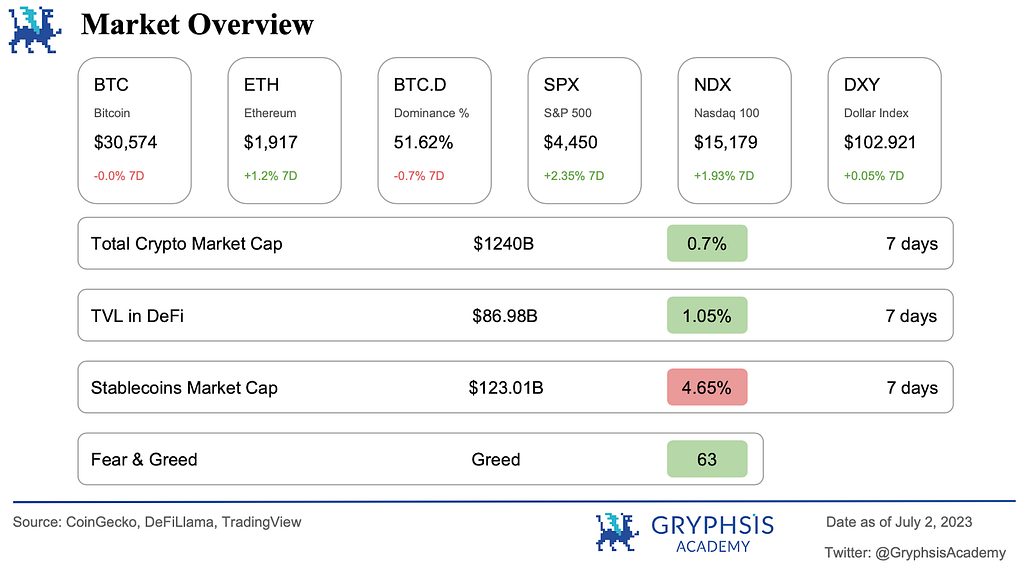
Market and Sector Snapshot:
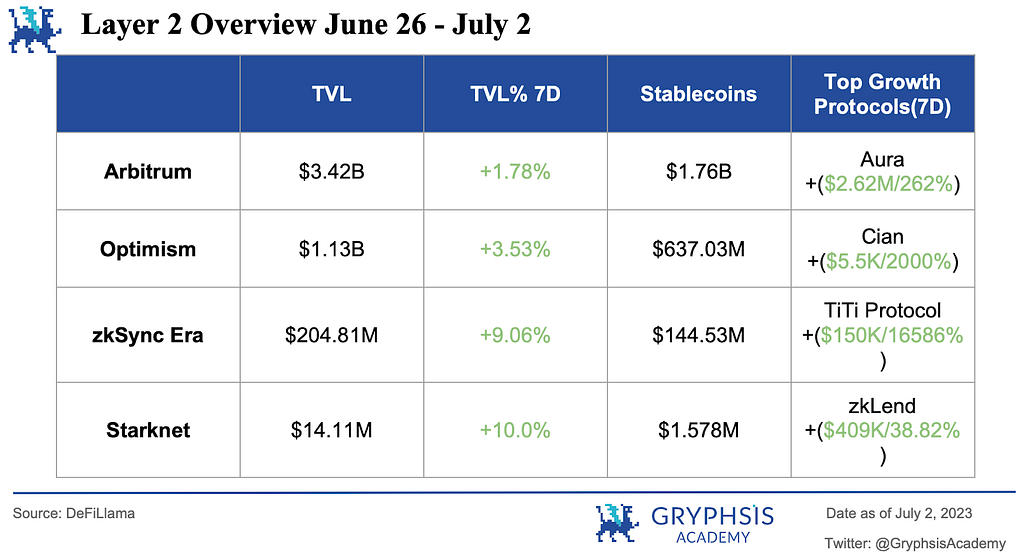
Layer 2:
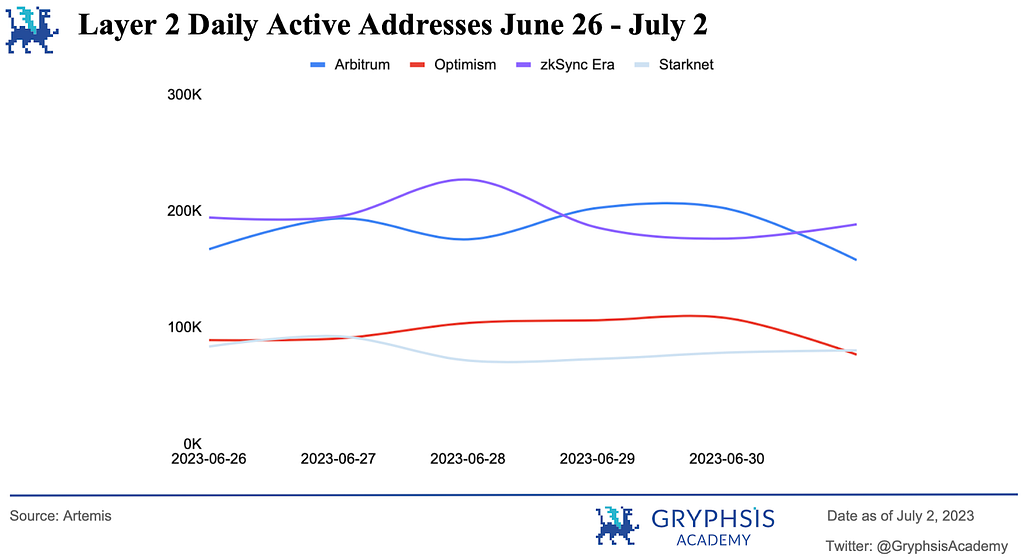
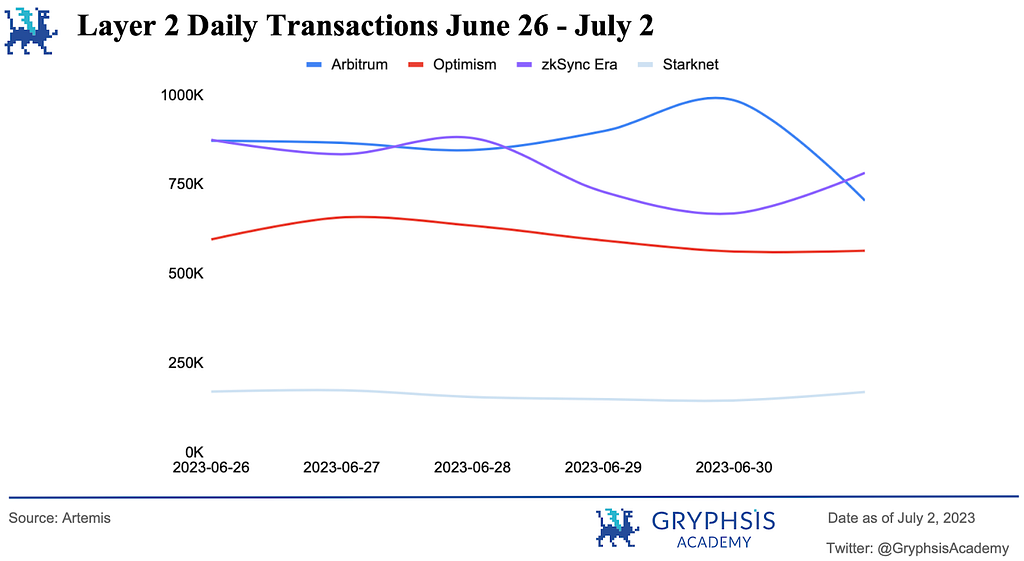
This week saw all four Layer-2 solutions exhibit modest growth in TVL, led by zkSync, which recorded a growth of 9%. Individual protocols such as Cian, Aura, TiTi, and zkLend distinguished themselves, boasting the most substantial TVL growth over the past week. Additionally, both Arbitrum and zkSync experienced a slight uptick in their daily active addresses compared to the previous week. As a result, Arbitrum and zkSync Era continue to be at the forefront of Layer-2 solutions.
LSD:
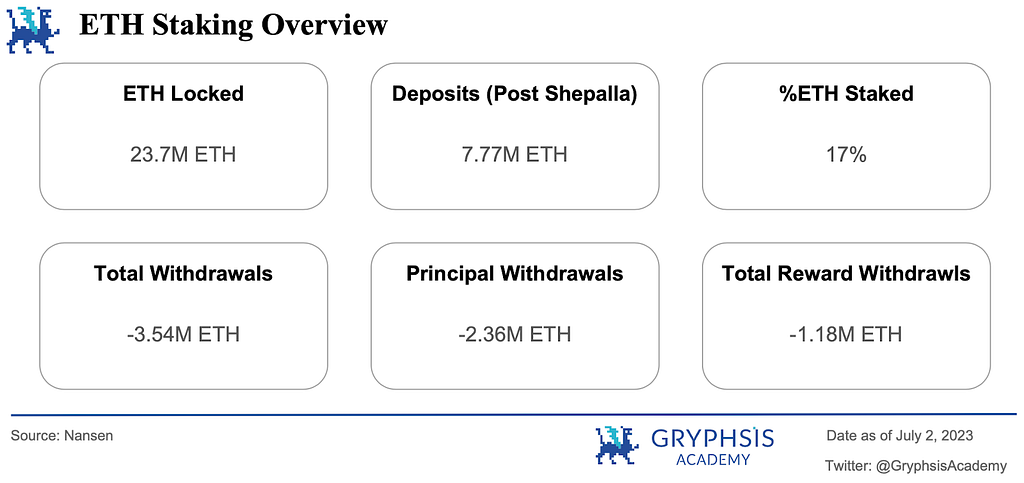
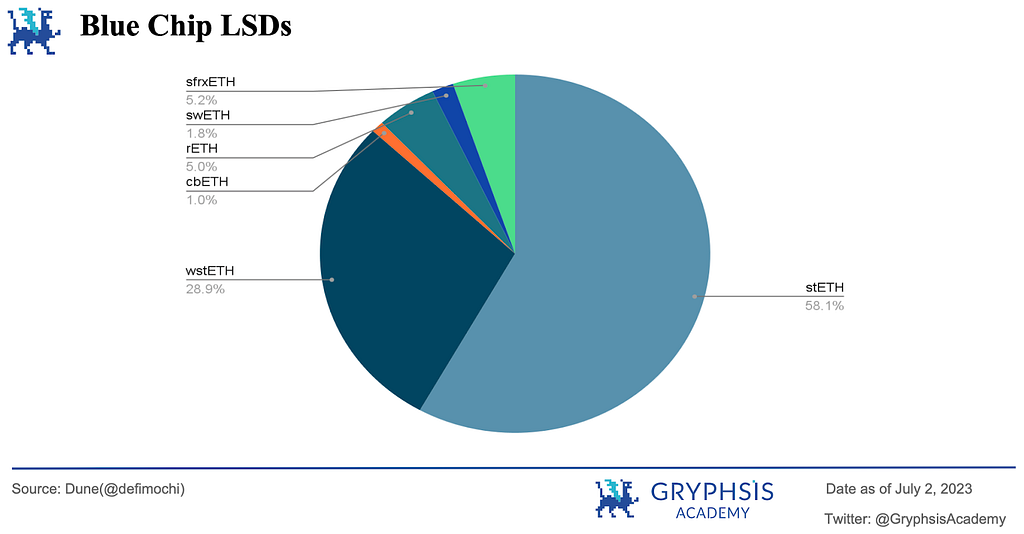
The LSD sector has continued to display consistent growth this week. Notably, deposit volumes have experienced a slight increase, adding to the overall expansion of the sector. The percentage of ETH staked has remained stable at 17%, identical to last week’s figure.
AI:
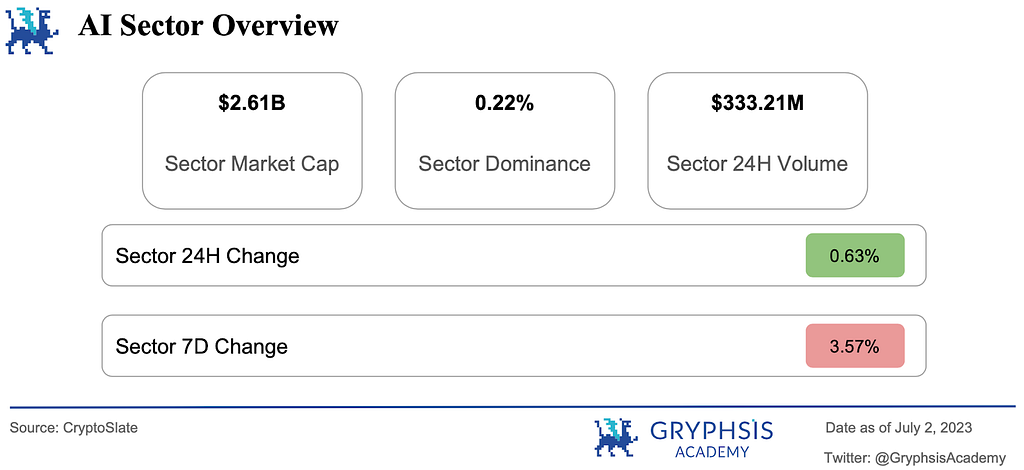
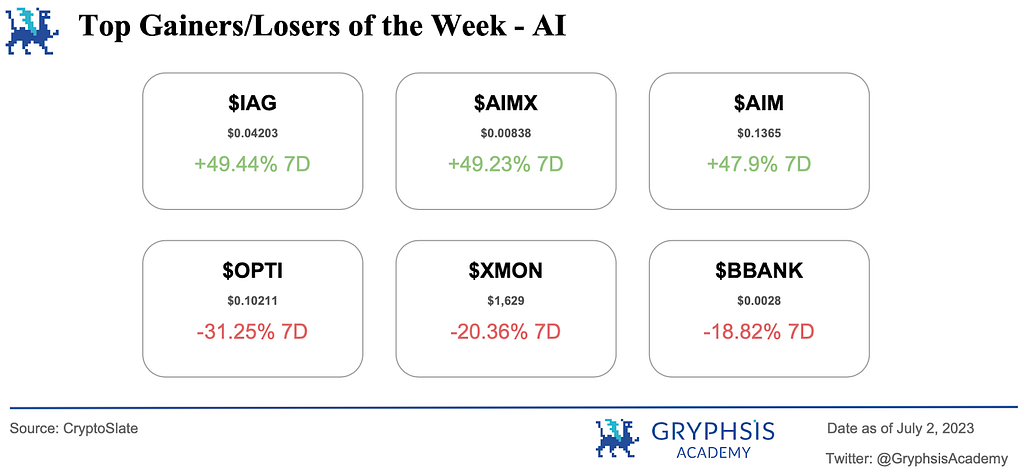
The AI sector has faced a bit of a downturn this week, with the sector’s total market capitalization witnessing a dip of approximately 3.5%. In a surprising twist of fate, $OPTI, one of last week’s standout performers, found itself among the top losers this week with a significant drop in its price by around 30%. However, not all was gloom and doom in the sector, as $IAG shone brightly. For the second week running, $IAG held its position as one of the top gainers in the AI sector, surging by almost six-fold over the past fortnight.
Main Topics
Macro Overview:
- US Stock V.S. Crypto
Big Story:
- Azuki’s Elementals
Protocol Spotlight:
- Dolomite
Gryphsis Research(Radiant Capital):
- In-depth Analysis of the Omnichain Liquidity Solution
VC Funding Highlight:
- One Trading ($33M)
Macro Overview
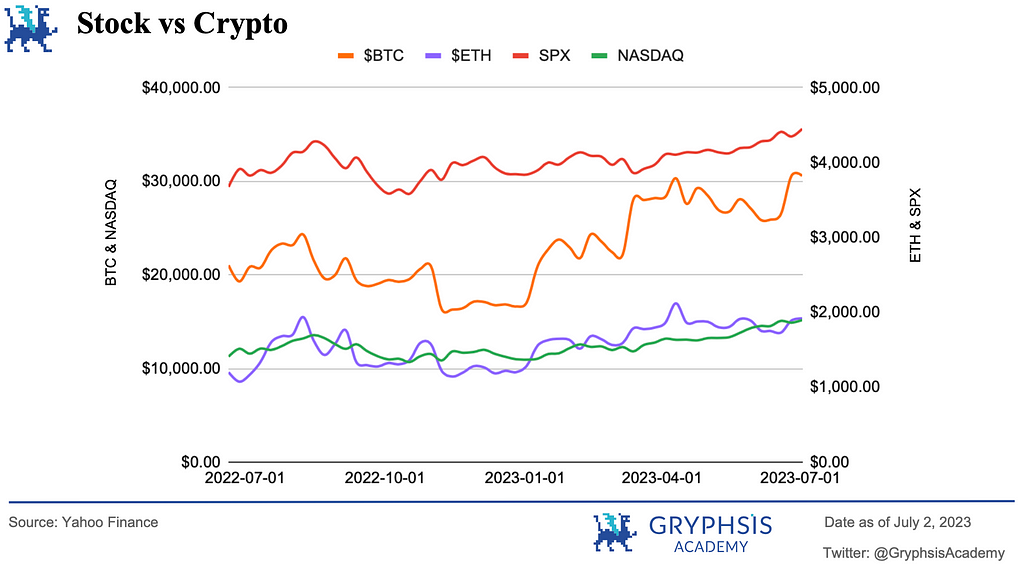
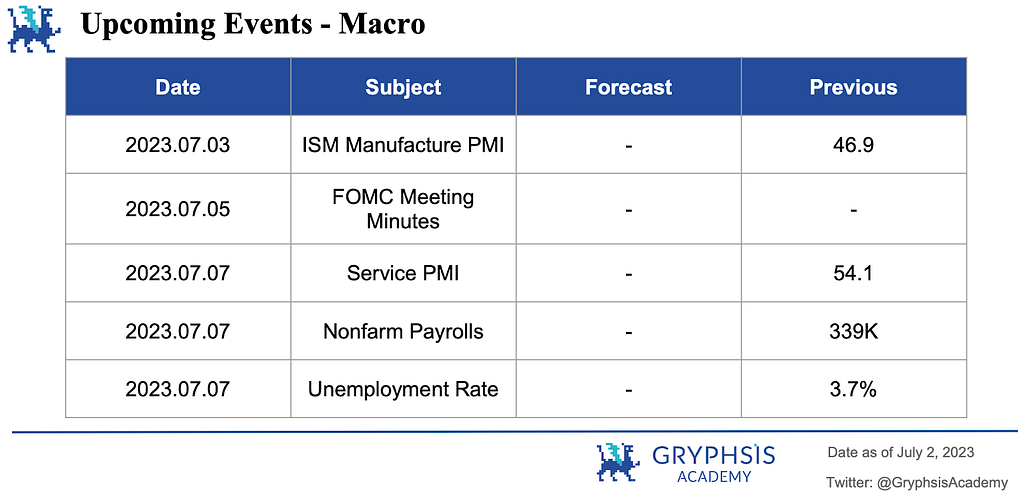
In the past week, the SPX and NASDAQ indices exhibited robust performance. Both closed notably higher than the previous week’s figures, with the SPX surpassing the closing price from two weeks ago, while NASDAQ ended slightly below its equivalent figure. This upward trend is worth watching as we head into a week with potential market-moving events on the horizon, including the release of the FOMC meeting minutes, the publication of nonfarm payrolls data, and an update on the unemployment rate.
Compared to last week’s robust activity, the crypto market has displayed relative stability this week. Both $BTC and $ETH have hovered near their opening prices for the week,and the BTC dominance has seen a minor decrease, now sitting around 51.2%. Contrarily, the NFT market has witnessed a significant sell-off, potentially triggered by the controversial launch of Azuki Elementals.
Story of the Week

The Fallen of Azuki? Controversy Around Azuki’s ‘Elementals’ Collection
Azuki, a blue-chip NFT brand under Chiru Labs, recently raised a notable $38 million in Ethereum with its swift sellout of the “Elementals” collection. Despite this success, the launch was mired in community backlash over the new collection’s artwork, which bore strong resemblance to the original Azuki collection with minor alterations. Further criticism centered on perceived flaws within the designs.
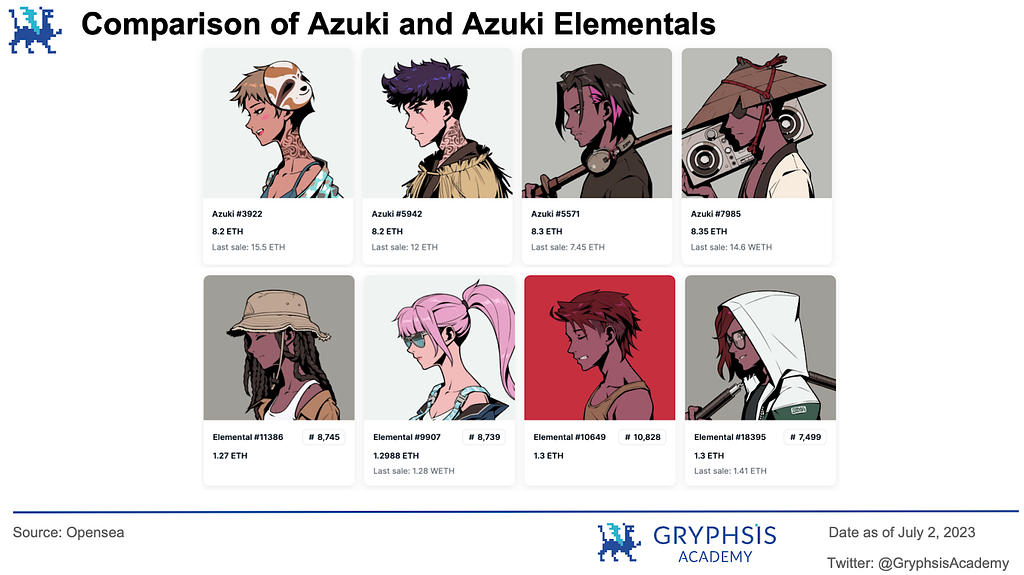
This discontent prompted a massive sell-off of Azuki NFTs, leading to a significant value dip for the original collection, which saw its floor price plummet by about 32% after the Elementals mint. In their response, Azuki said “technical glitch” was the cause of identical NFTs and assured the community that the metadata for these NFTs had since been corrected. In an effort to make amends, Azuki airdropped new “Green Beans” NFTs to select collectors.
Azuki’s Response:
Azuki on Twitter: "Azuki,It's always both challenging & exciting opening up the gate to the Garden. This time, we missed the mark.We hear you - the mint process was hectic, the PFPs feel similar and, even worse, dilutive to Azuki. / Twitter"
Azuki,It's always both challenging & exciting opening up the gate to the Garden. This time, we missed the mark.We hear you - the mint process was hectic, the PFPs feel similar and, even worse, dilutive to Azuki.
Our Take
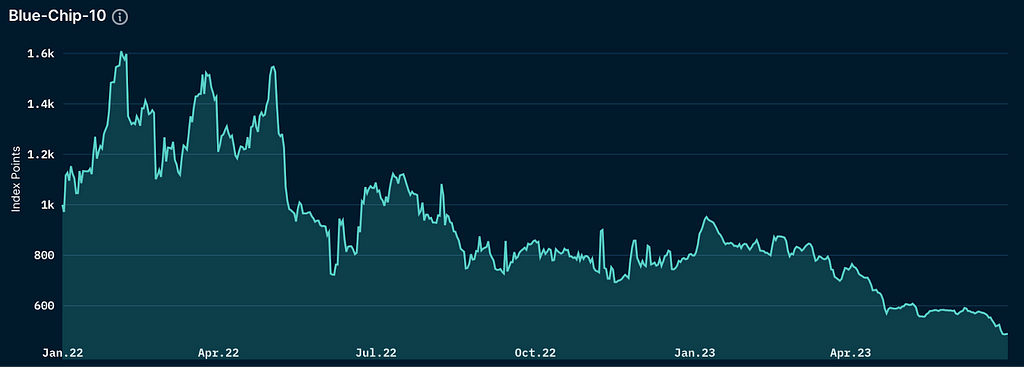
The fallout from the Azuki “Elementals” collection release has not only disappointed the Azuki community but has also cast a pall over the broader NFT market. Amidst a general downturn in the NFT space since its 2021 peak, Azuki had remained a bright spot, demonstrating resilience and even growth, largely due to its robust and active community.
Nansen NFT Blue-chip Index:
Source: Nansen
However, the Elementals launch has left a bitter taste in the mouths of long-time Azuki collectors. Critics argue that the team failed to deliver on quality and overlooked the rights and interests of original Azuki holders. With the Elementals collection bearing significant similarity to the original Azuki art, many feel that the value and uniqueness of the original collection are being eroded, causing distress among those who invested heavily in rare pieces.
The Elementals release was one of the most anticipated drops of the year, buoyed by positive sentiment around the project. But the disappointment caused by the team’s actions has left not only Azuki holders reeling but could also deter potential new entrants into the NFT space. This incident serves as a stark reminder that even highly-respected projects can stumble, and the impact can be deeply felt across the community.
Azuki Floor Price as of Writing:

Source: Opensea
In response to the backlash, the Azuki team has pledged to act in the best interests of all holders. However, the future of Azuki remains shrouded in uncertainty as the community and the broader market wait to see if the team can regain the trust and support of its base.
@ArcanicNFT’s Thread on Azuki Team’s Call:
Arcanic on Twitter: "The Azuki team held a call with the community in the discord today.Zagabond, Steamboy, and other core members came on to address the situation on Elementals, and give clarity on their next steps. Here is a mega-thread of everything that was discussed 🧵👇 pic.twitter.com/zQ80JJmmVw / Twitter"
The Azuki team held a call with the community in the discord today.Zagabond, Steamboy, and other core members came on to address the situation on Elementals, and give clarity on their next steps. Here is a mega-thread of everything that was discussed 🧵👇 pic.twitter.com/zQ80JJmmVw
Superstate: Blending DeFi and Traditional Finance

Compound’s CEO, Robert Leshner, has recently launched a new venture named Superstate, aiming to innovate in the world of government bonds by integrating traditional financial instruments with the Ethereum blockchain. This novel initiative, already raising $4 million from leading investors like ParaFi Capital and 1kx, sets out to offer a short-term government bond fund.
The fund, named Superstate Short-Term Government Bond Fund, plans to invest in short duration government securities, including US Treasury bonds and other government-backed instruments. As a standout feature, ownership of fund shares will be recorded both by a conventional Wall Street transfer agent and on the Ethereum blockchain, known as Secondary Blockchain Records. Regular reconciliation between these records aims to enable efficient peer-to-peer transfers. Initially, the fund doesn’t offer DeFi features and only serves for holding a share in the fund. Investors will have to be pre-approved and whitelisted to own the asset, and Superstate won’t whitelist smart contracts such as Uniswap or Compound, limiting the fund’s use by such applications.
Leshner believes that this innovation could cater to crypto-native firms seeking to diversify their portfolio without moving away from their blockchain infrastructure. With yields on US debt outperforming those in DeFi, this approach could attract considerable interest. Currently, Superstate is awaiting regulatory approval. If granted, this approach could significantly impact real-world assets tracked on a blockchain, especially with regulated exchanges trading multiple blockchain assets coming into play in the future.
Our Take
RWA has long been viewed as a game-changer in accelerating the adoption of digital assets. However, hurdles like regulatory constraints and laborious on/off-chain processing have limited RWA’s use cases. Noteworthy RWA sectors include RWA Lending, represented by Goldfinch and Centrifuge, and protocols like Ondo Finance and OpenEden, aiming to bring US Treasuries on-chain. With a TVL of $467M, the RWA ranks 14th among all DeFi categories, signifying its fledgling state while also revealing its growth potential.
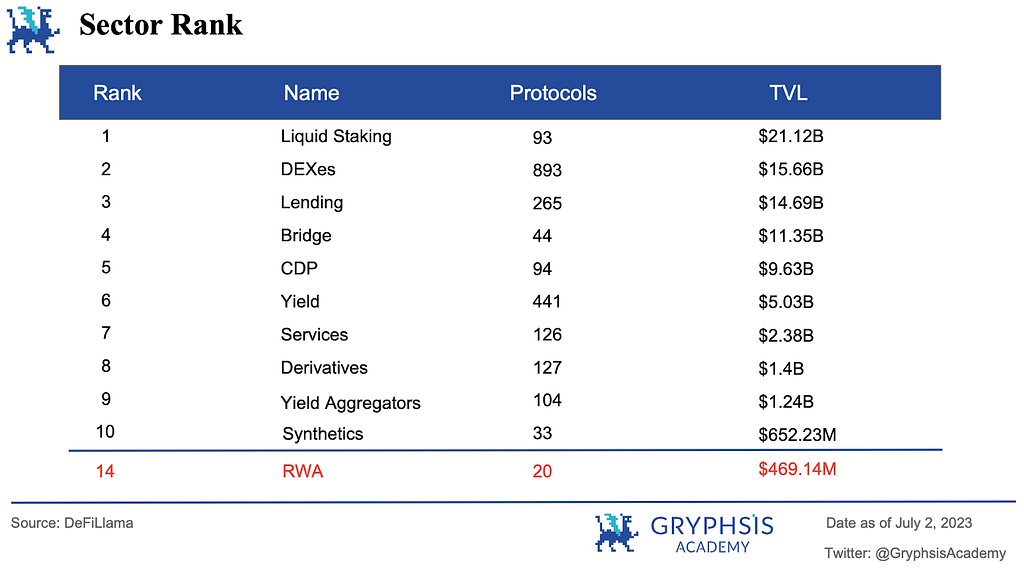
Superstate’s operation is still on hold pending regulatory approval. Yet, $COMP has already surged over 30% following the news. As it remains uncertain whether Superstate will issue its native token, the buying spree could be fuelled by speculation that $COMP might reap some benefits. Consequently, $COMP has outperformed the other two veteran DeFi blue-chips, $MKR and $AAVE, in recent weeks.
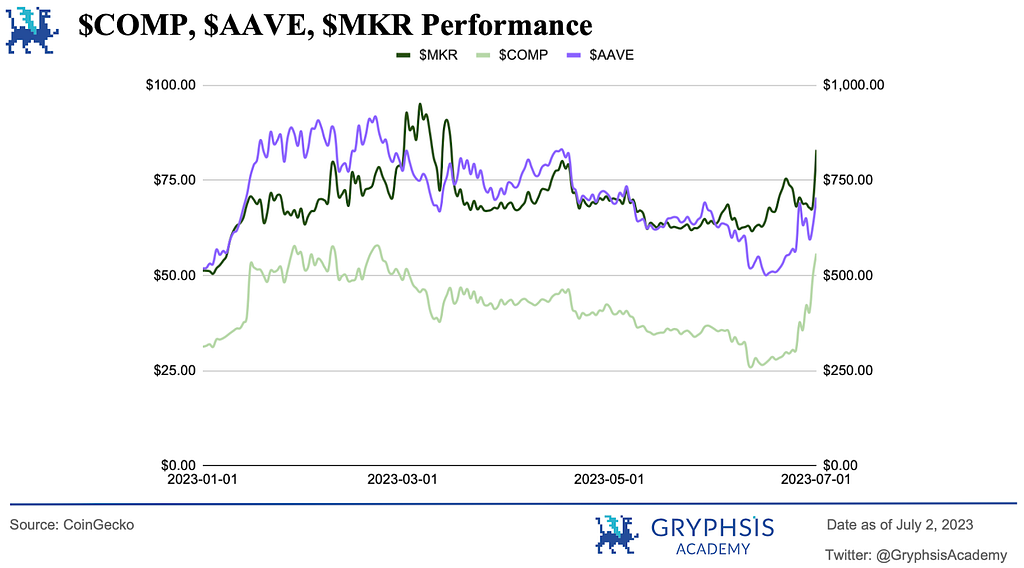
Although jumping on the bandwagon now could be rash, given the substantial rally in price and the challenge of determining an entry point with an acceptable risk-reward ratio, it remains beneficial to closely track Superstate’s regulatory progress. If approved, the positive sentiment could stimulate a favorable move among RWA-related coins. Therefore, vigilant monitoring is indispensable for identifying potential opportunities.
Weekly Protocol Pick
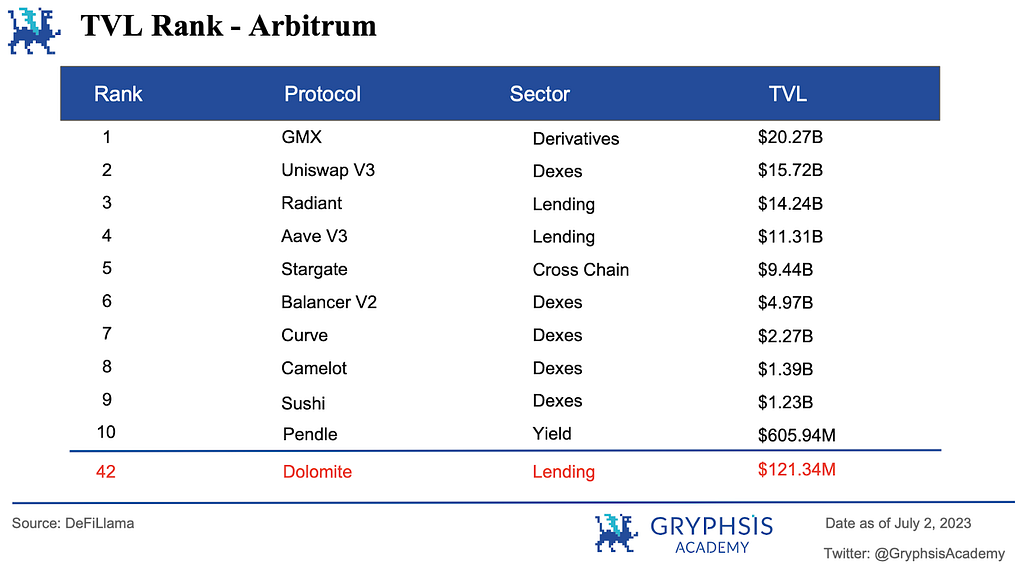
Welcome to our “Weekly Protocol Pick” — where we spotlight a protocol that’s making waves in the crypto space. This week, we’ve picked Dolomite, a money market and margin trading protocol on Arbitrum.

Dolomite is a decentralized money market protocol and DEX. The protocol combines the strengths of a DEX and a lending protocol, offering over-collateralized loans, margin trading, spot trading, and more. It aims to simplify hedging, leveraging, and unlocking dormant equity in portfolios through a non-rent seeking model for DeFi rewards to users.
Dolomite boasts a modular architecture composed of two layers: the core (immutable) and module (mutable) layers. This design reflects the spirit of DeFi, pairing an immutable base with a flexible layer that adapts to the ever-evolving trends and paradigms of the DeFi space. A key feature of Dolomite is its virtual liquidity system, which promotes capital efficiency by allowing liquidity to be recycled or reused for multiple sources of yield.
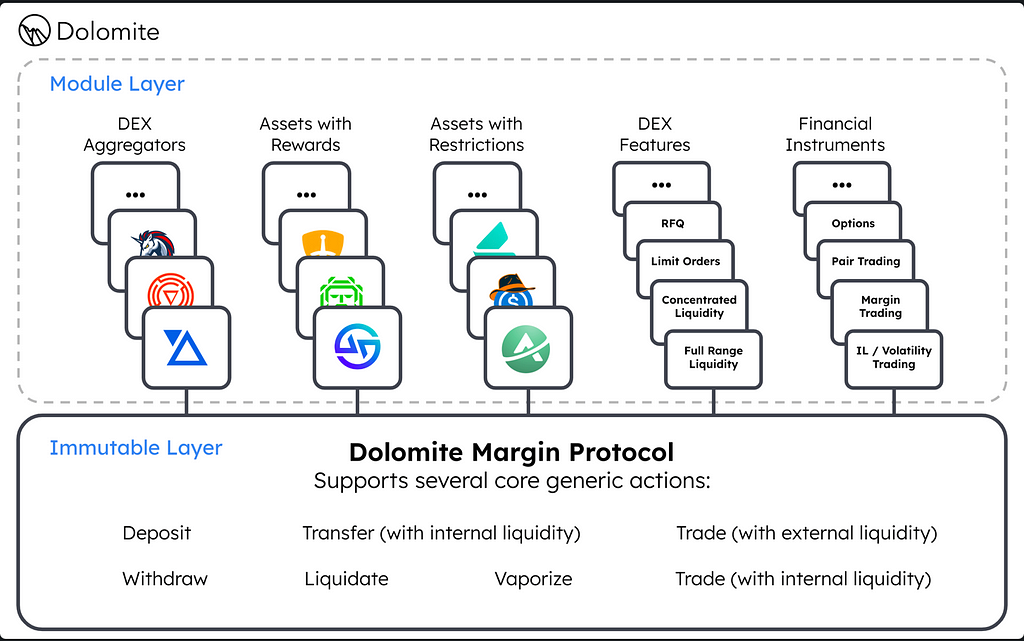
Source: Dolomite
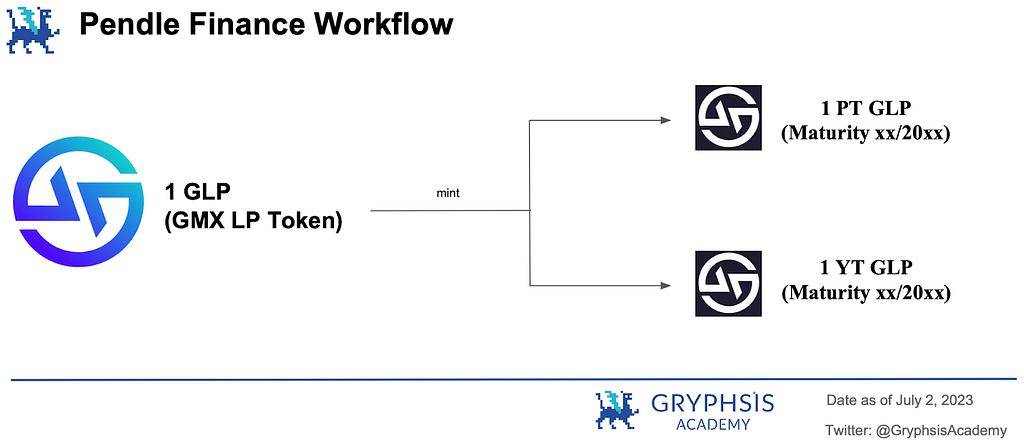
This week on June 28, Dolomite Announces Support for Pendle’s PT-GLP . Users of Dolomite and Pendle can now borrow against their PT-GLP on Dolomite’s platform while continuing to earn yield. PT-GLP serves as the principal portion of the GLP yield-bearing asset and is redeemable 1:1 for GLP at maturity. For instance, 42 PT-GLP can be redeemed for 42 GLP upon expiration in March 2024, which means users can lock in the implied yield on GLP by purchasing PT-GLP and holding it until maturity, allowing them to avoid the volatility of GLP’s interest rate while leveraging, hedging, or simply borrowing against it.
Our Insights
Dolomite’s inaugural use of PT-GLP as collateral marks the first instance of Pendle assets serving as collateral — a landmark for both protocols. Since 2023, Pendle Finance has seen considerable growth in TVL and token price — multiplying ten and eighteen times, respectively. This growth is largely due to Pendle’s unique product and the rise of the LSD narrative, unlocking new yield opportunities and illustrating true product-market fit. Simultaneously, Dolomite has seen a fivefold increase in TVL since 2023.
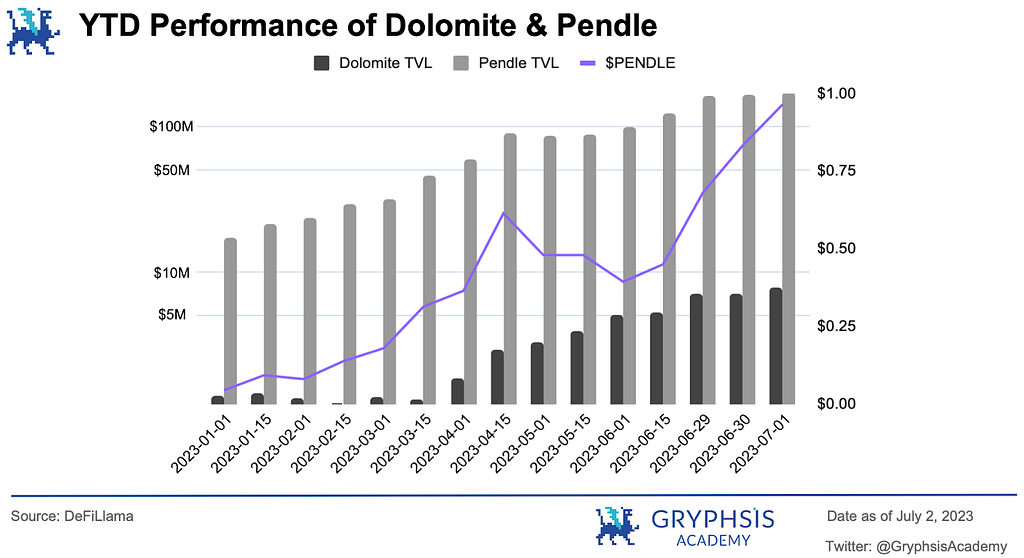
For Pendle, sustainable growth hinges on their PT/YT assets gaining wider market adoption. Dolomite’s integration could be the catalyst for another demand wave for PT/YT tokens. This move towards collateral opens up more yield opportunities, as demonstrated by the classic looping strategy. Based on @ThorHartvigsen’s calculation, the APY from this strategy could be 4x%, which, considering the current market, is impressively lucrative. As Dolomite is the only protocol enabling this strategy, it could see further TVL growth as users explore this yield opportunity. This move benefits both Dolomite and Pendle, suggesting that it’s worth monitoring the operation stats of both protocols for possible $PENDLE entry opportunities.
Thor⚡️Hartvigsen on Twitter: "Some quick napkin math on the new @pendle_fi ptGLP collateral strategy on @Dolomite_iotl;dr: 43% in fixed APY on $GLP 👀The minimum collateralization-ratio when borrowing against ptGLP on Dolomite is 120%.The example below therefore only borrows 70% -> keeping a CR of 143%.... pic.twitter.com/LTvs2MxOBq / Twitter"
Some quick napkin math on the new @pendle_fi ptGLP collateral strategy on @Dolomite_iotl;dr: 43% in fixed APY on $GLP 👀The minimum collateralization-ratio when borrowing against ptGLP on Dolomite is 120%.The example below therefore only borrows 70% -> keeping a CR of 143%.... pic.twitter.com/LTvs2MxOBq
Spotlight on Gryphsis Research — Radiant Capital
Welcome to this week’s ‘Spotlight on Gryphsis Research,’ where we share the latest insights from our team. Our dedicated research team constantly explores cutting-edge trends, developments, and breakthroughs across the crypto landscape. This week, we’re excited to share with you our research on Radiant Capital, designed to deepen your understanding and fuel your curiosity about the ever-evolving world of crypto.
Liquidity fragmentation has persistently troubled the crypto market, most notably within the DeFi sector, leading to considerable capital inefficiencies. Radiant Capital proposes a novel solution to this issue through its vision of omnichain lending and borrowing.
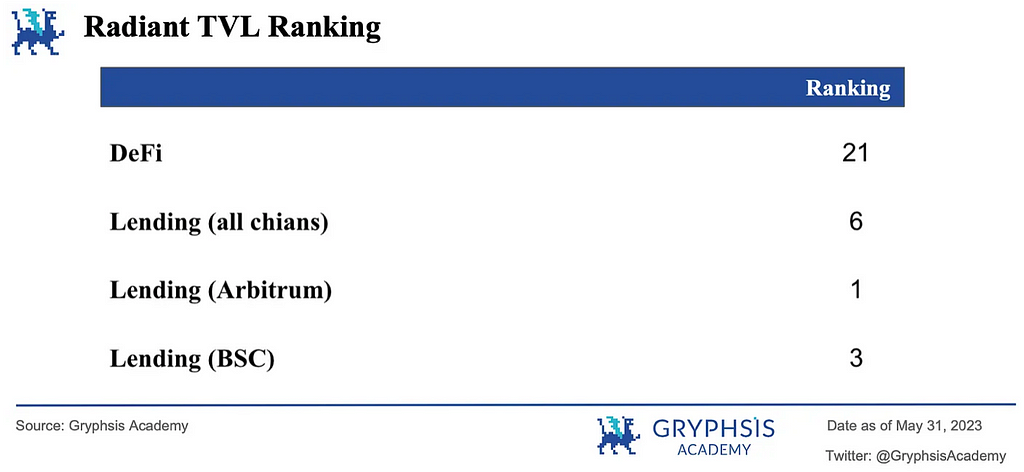
Radiant has witnessed extraordinary growth since its inception, boasting a TVL of $400 million. The protocol has emerged as a prominent player in the Arbitrum and BSC ecosystems, surpassing AAVE in terms of TVL on Arbitrum, and quickly rising to the third position in TVL on BSC since its launch in March 2023. Our conviction is that Radiant’s imminent V2 upgrade will trigger a flywheel effect, propelling its continued growth. This effect, coupled with Layer 2’s consistent expansion, positions Radiant on a trajectory of sustained, significant growth.
Being the first omni-chain lending & flash loan protocol built atop Layer Zero, Radiant leads the cross-chain lending space, a less competitive yet potentially profitable domain. Radiant’s ability to allow users to deposit collateral on one chain and borrow against it on another sets it apart. This is possible via Stargate’s cross-chain router, enabling asset deposits on Arbitrum and borrowing on any Stargate-supported EVM chain. This scalability enhances asset utilization and addresses the liquidity fragmentation issue prominent in other protocols like AAVE.
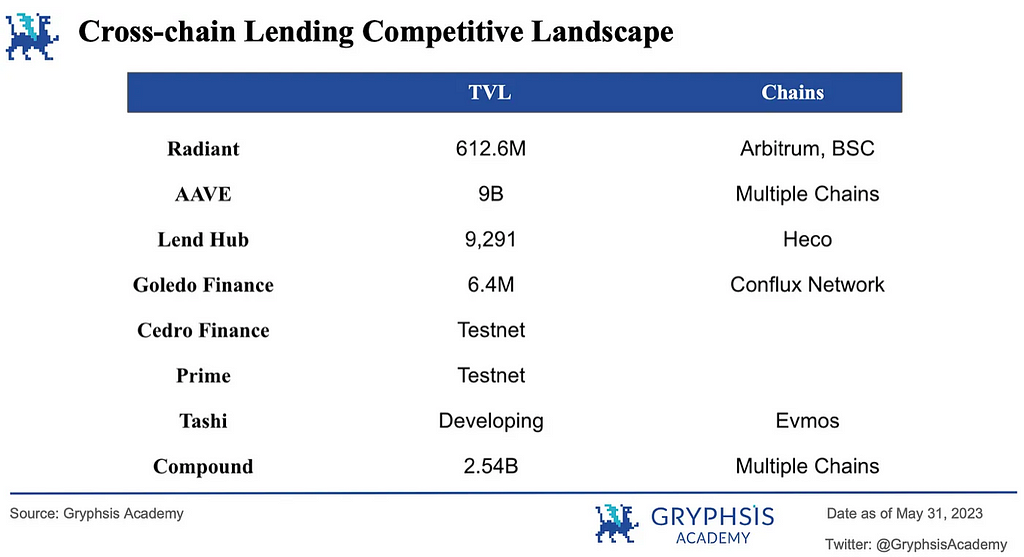
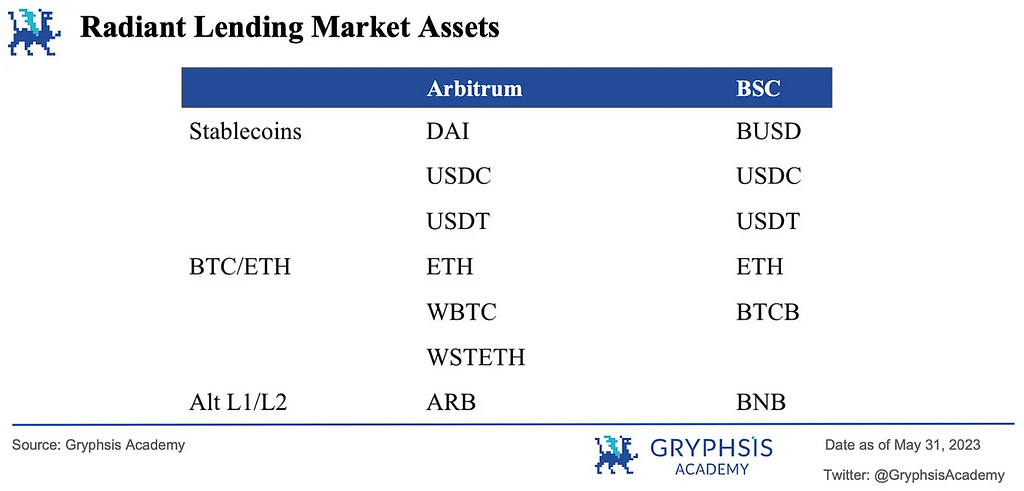
The Radiant Lending Market operates on both Arbitrum and BSC, supporting a broad range of assets including stablecoins (e.g., DAI, USDC, USDT) and popular crypto assets (ETH, WBTC, WSTETH, and ARB on Arbitrum; ETH, BTCB, and BNB on BSC).
This asset availability fuels borrowing, lending, and trading within the ecosystem. Radiant provides two rates: the red rate is the market APY for lending/borrowing underlying assets, and the purple APR refers to the native utility token $RDNT rewards for platform interaction and liquidity provision. High borrowing rates are currently offset by substantial $RDNT rewards, attracting a large user base.
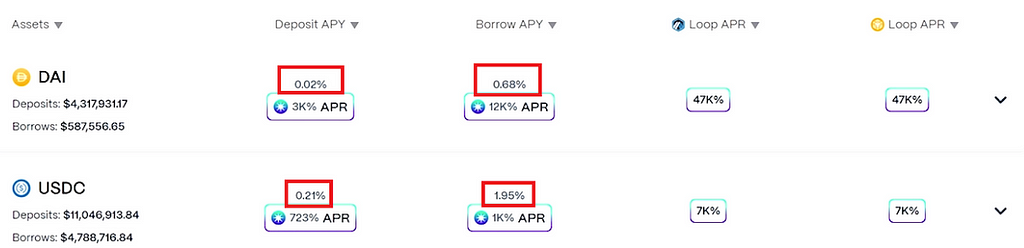
Source: Radiant Capital
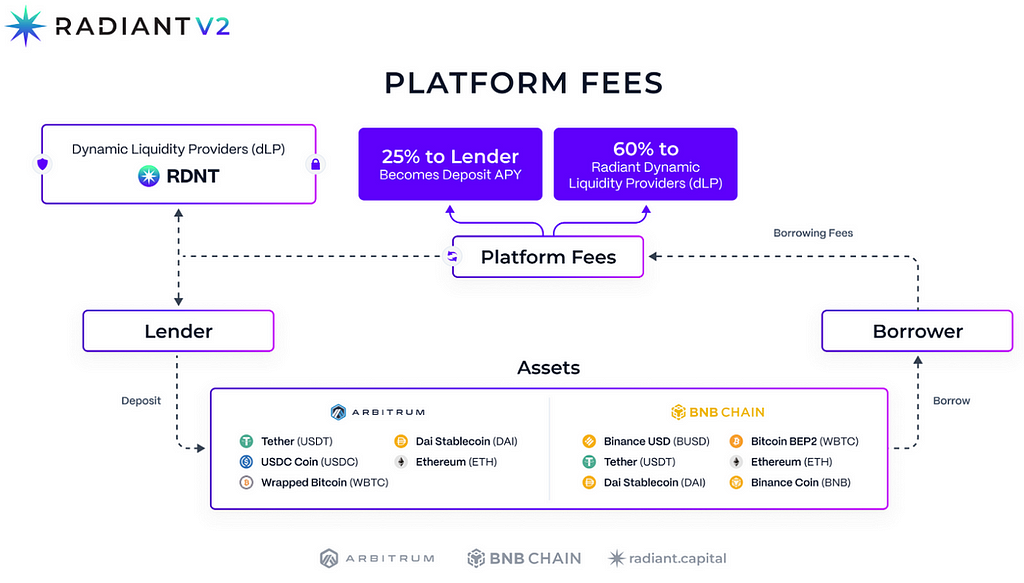
Radiant Capital’s ecosystem comprises three main sectors: Lending & Borrowing, Liquidity Mining, and a Cross-chain Bridge.
1. Lending & Borrowing: Users deposit into Radiant’s lending pool, earning interest plus additional $RDNT yield. Deposits double as collateral and can be withdrawn to specified chains. When users borrow, they pay loan fees and interest to Radiant DAO and liquidity providers. A health factor of <1 triggers liquidation, incurring a 15% penalty. Radiant’s Loop & Lock function allows users to multiply their collateral by automating the deposit and borrow cycle while maintaining a 5% dLP for $RDNT emission activation.
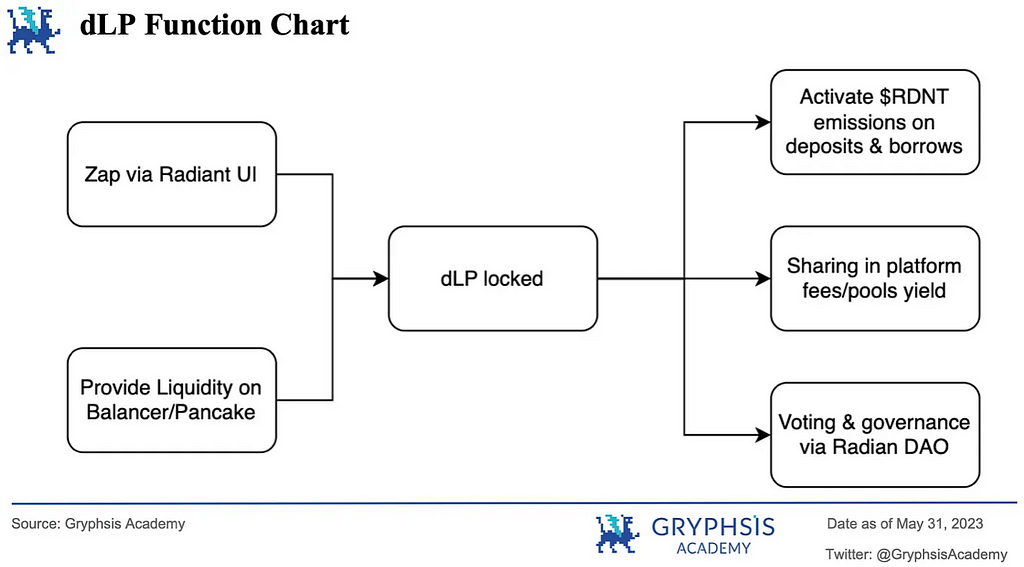
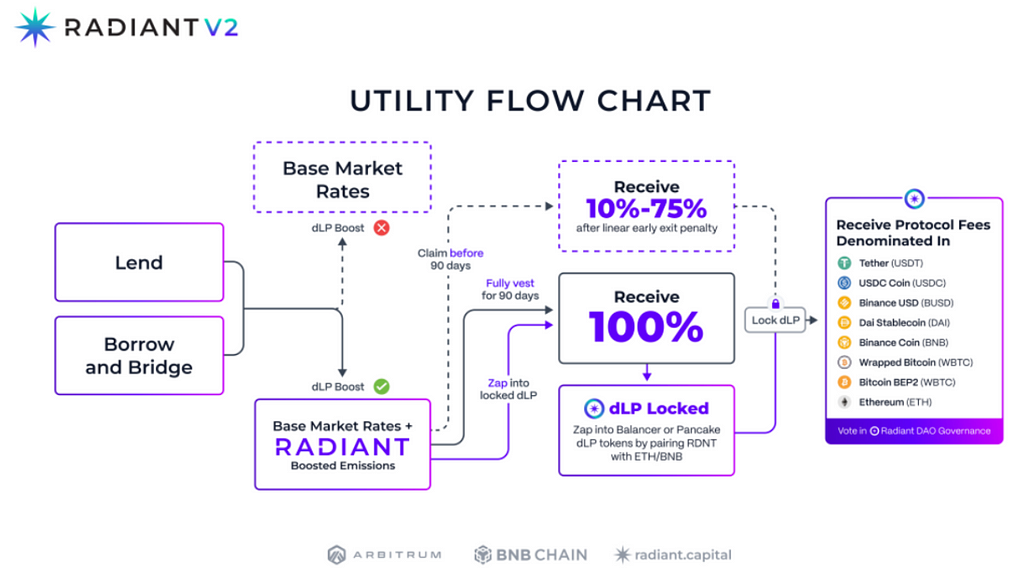
2. Liquidity Mining: Radiant investors can earn from locking and vesting $RDNT tokens. Dynamic Liquidity Providers (dLPs) are $RDNT liquidity-providing tokens. Pairs available are an 80/20 (RDNT/ETH) composition on Arbitrum and 50/50 (RDNT/BNB) on BSC. Users can withdraw locked dLPs or use them as collateral. They capture platform fees from borrowers, flash loans, and liquidation. A minimum of 5% $RDNT lock relative to USD deposit size qualifies users to earn $RDNT emission on borrows and deposits. An early exit fee applies to the vesting period (recently extended to 90 days).
3. Cross-chain Bridge: RDNT OFT Bridge facilitates native cross-chain token transfers via Layer Zero Labs’ Omnifungible token (OFT) solution. The Radiant-Stargate Bridge provides borrowing and bridging via Stargate router delivery. Radiant V1 and V2 support deposits on Arbitrum and BNB chains, and borrowing on any EVM chain supported by Stargate Finance. Full omnichain deposits and borrows are currently in developmental testing.
Radiant Capital captures value through dynamic borrow interest rates based on liquidity, liquidation fees, and penalties for early exits.
Source: Radiant Capital
The RDNT token usage includes a minimum of 5% deposit dLP to activate RDNT emissions for borrowers and lenders, providing additional value over base market rates. dLP lockers who lock in RDNT liquidity receive 60% of platform fees. Furthermore, RDNT holders participate in DAO governance, which allows the community to shape the platform’s direction.
Source: Radiant Capital
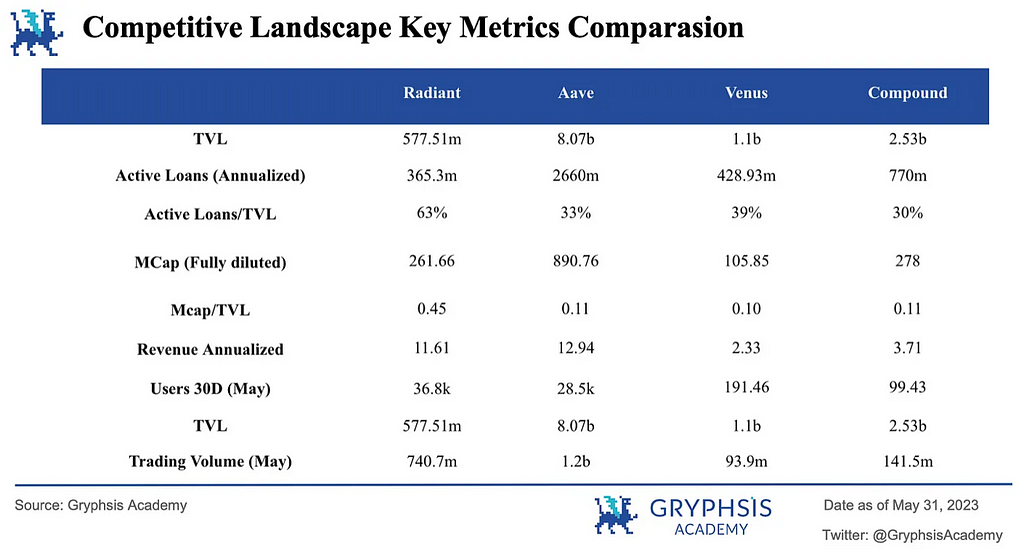
In terms of operation status and competitive landscape, Radiant also demonstrates strong performance.
TVL:
Radiant leads on the Arbitrum chain with a high TVL. The borrowing TVL is relatively higher than its peers, possibly due to the easy-to-use lock & loop feature and attractive incentives. However, its MCap/TVL ratios are higher than its peers, indicating a slightly higher valuation at present.
Users:
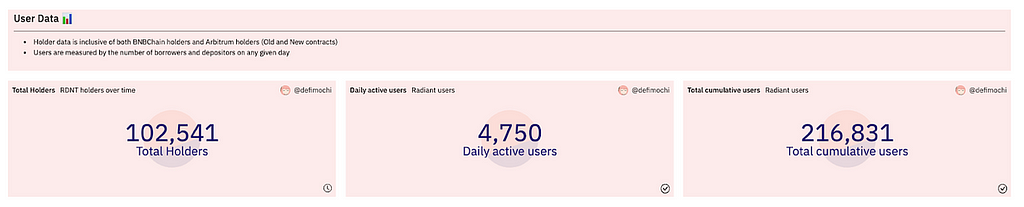
Since the launch of V1, Radiant saw two waves of user surges in Q3 2022 and January 2023, although user numbers didn’t significantly rise after the Radiant V2 launch. Currently, there are 216,831 cumulative users, with 4,750 daily active users.
Source: Dune Analytics (defimochi)
Volume:
$RDNT emissions have positively incentivized trading volume for borrowers and lenders, demonstrating the platform’s ability to drive engagement and activity. With a trading volume of $740.7 million in May, Radiant Capital has displayed robust trading activity, surpassing peers with similar market capitalization.
Utilization Rate:
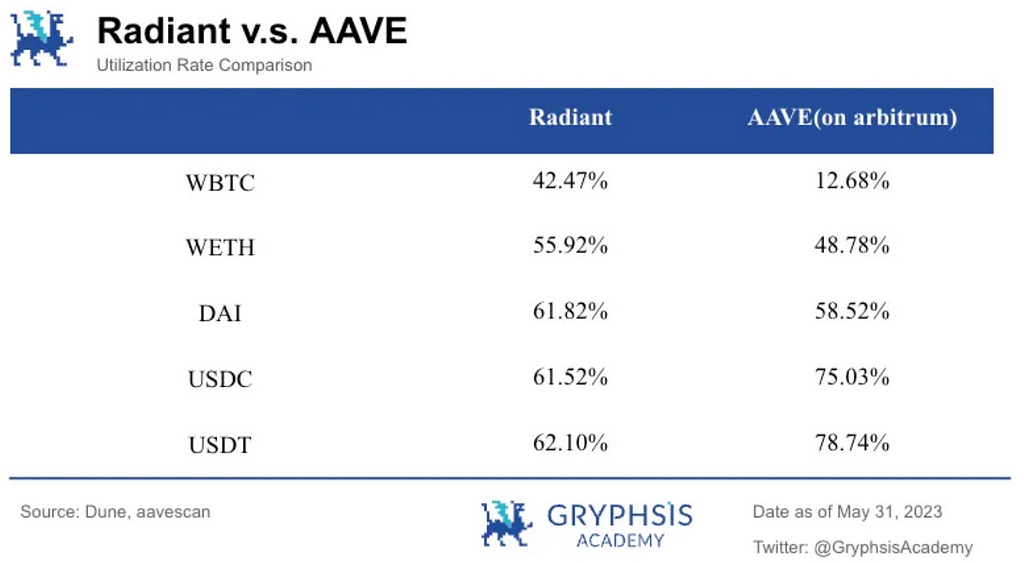
The overall utilization rate of around 60% is relatively higher than its peers, with $RDNT emission incentives and the easy-to-use loop & lock feature increasing the asset utilization rate. While Radiant’s utilization rate in stablecoins matches AAVE, it outperforms in utilization rates with WBTC and WETH.
Financial Statement:
Based on the financial report, RDNT has seen significant growth in both income and trade volume recently. Earnings increased by 886.90%, from $105.38k in January to $1.04m in May. RDNT’s trading volume also grew rapidly from $39.50m in January to $740.74m in May.
As of May 31, 2023, the platform had $377.39 million in active loans and $636.75 million in net deposits. These numbers indicate a strong demand for the platform’s services and a healthy liquidity status. Additionally, the solid borrowing-to-deposit ratio (377.39/636.75=0.59) suggests effective lending activity management.

Source: Token Terminal
Overall, RDNT is in a robust financial position, poised for further growth and service expansion in the decentralized lending market.
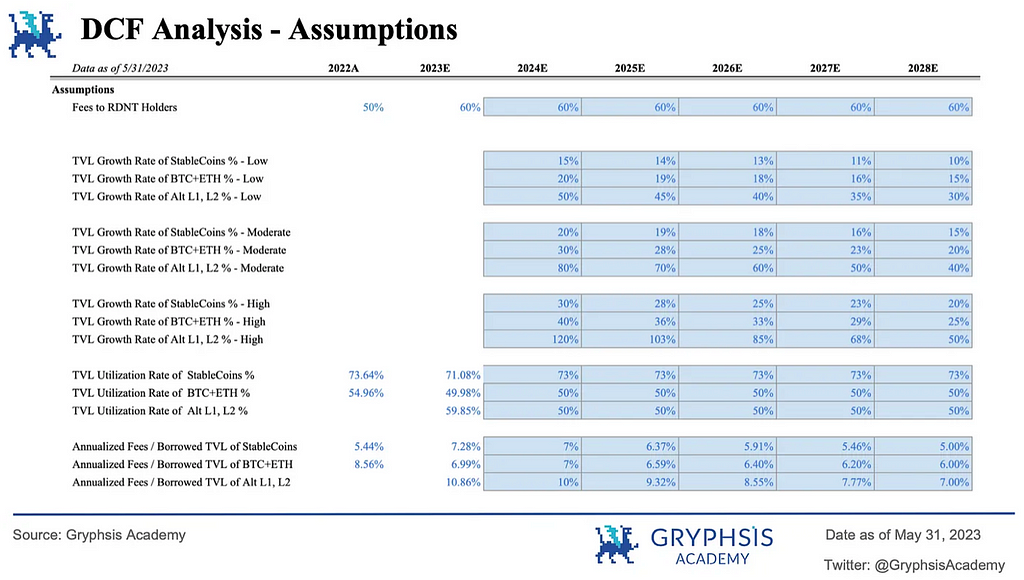
To evaluate the potential of $RDNT, we utilized both DCF analysis and comparable analysis to build a valuation model.
DCF Analysis:
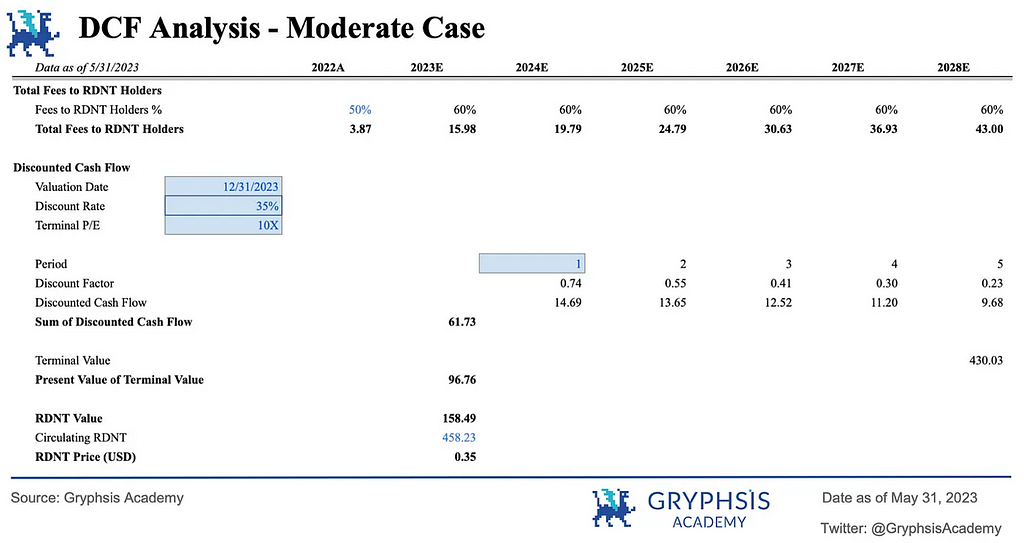
The moderate scenario of our DCF analysis predicts an RDNT price of $0.35 and a valuation of $158.49 million on Dec 31, 2023. Applying probability weights to our low, high, and moderate cases (25%, 25%, and 50%, respectively), we find a probability-weighted DCF valuation for the RDNT price at $0.37 and a protocol valuation of $168.14 million. Comparing this to the RDNT price on 31/05/2023 of $0.31, we forecast a potential upside of 17.26%.

Comparable Analysis:
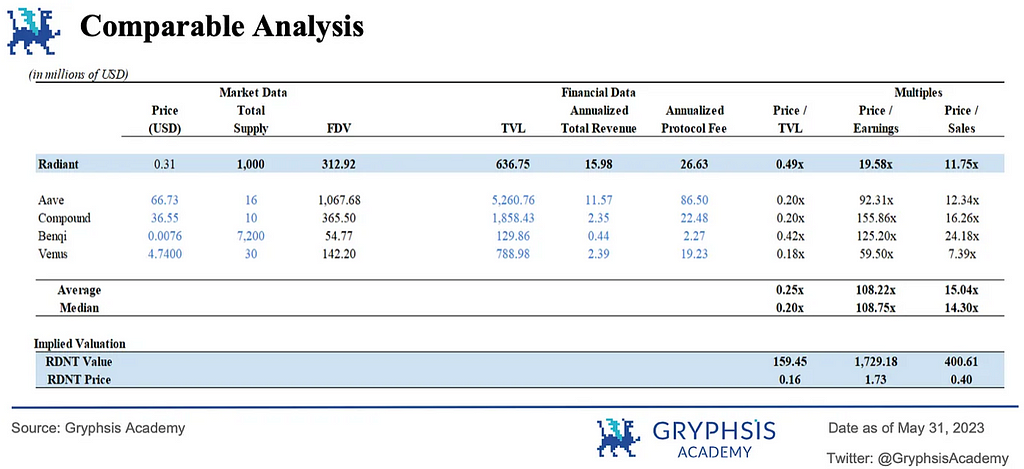
A comparative analysis places Radiant’s total value locked (TVL) at $636.75 million, positioning it between Benqi and Venus in terms of capital locked within the protocol. With a fully diluted valuation of $312.92 million, Radiant is smaller than Aave and Compound but larger than Benqi and Venus.
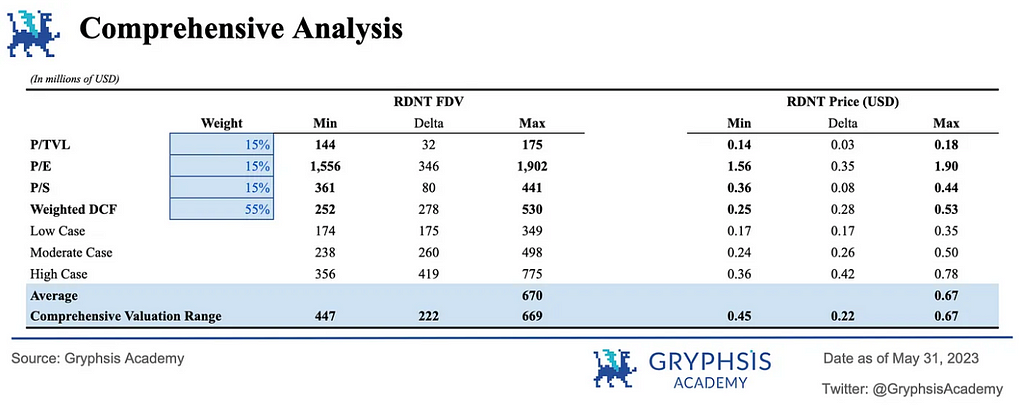
Despite Radiant’s relatively high Fully Diluted Valuation/TVL Ratio of 0.49x, which may indicate a market premium, the protocol’s robust annualized total revenue ($15.98 million) and protocol fee ($26.63 million) suggest strong revenue-generation. Furthermore, Radiant’s lower price-to-earnings (P/E) and price-to-sales (P/S) ratios relative to the average ratios for decentralized lending protocols suggest potential undervaluation. Based on these valuation multiples, Radiant’s implied valuation could drive potential prices of $0.16, $0.40, and $1.73, respectively.
Comprehensive Analysis:
We performed a sensitivity analysis to establish a range of valuation outcomes. Using P/TVL, P/E and P/S ratios, the comparative analysis produced three different values. We selected the minimum and maximum values from the sensitivity analysis with varying terminal P/E ratios and discount rates for the probability-weighted DCF valuation. Allocating weight for multiples at 15% each and 55% for the weighted DCF, our comprehensive analysis proposes a price range of $0.45 to $0.67 for $RDNT.To conclude, Radiant’s impressive performance in cross-chain lending is notable. Still, its heavy reliance on Stargate and LayerZero for cross-chain features could limit its growth. Even though challenges exit, its future appears bright. Radiant Capital can continue its evolution by implementing robust risk management frameworks, incorporating new assets, and partnering with other DeFi protocols.
This section offers a concise preview of our detailed research on Radiant Capital. We encourage readers to delve into the full report for a complete understanding and expert analysis of this promising protocol!
VC Highlights: Top Funded Crypto Protocols This Week
Welcome to our weekly Investment Spotlight, where we shine a light on the most significant venture capital moves in the crypto space. Each week, we’ll focus on protocols that have attracted the most funding.
One Trading
Bitpanda Pro, an arm of Austrian cryptocurrency firm Bitpanda, has successfully separated into its own entity, One Trading, and secured $33 million in a Series A funding round on June 28. The investment was led by Peter Thiel’s Valar Ventures and included MiddleGame Ventures, Speedinvest, Keyrock, and Wintermute Ventures. Joshua Barraclough, a former JPMorgan digital innovation head, leads the newly formed entity, while Bitpanda retains a minority stake.
One Trading aims to launch a fast and scalable digital asset exchange for institutional and professional traders, seeking to expand its crypto offerings across Europe. The platform, capable of processing orders in less than 250 microseconds, plans to use a membership model for large liquidity providers instead of the traditional pay-per-trade approach. In addition, One Trading is eyeing an expansion into derivatives and further product listings, catering to both retail and institutional investors.
Joshua Barraclough:

Protocol News
Ede Finance has been exploited again.
Autofarm shuts down.
Zksync introduces ZK Stack.
Chibi Finance rugged $1M.
PlutusDAO announced V2 tokenomics.
Cyberkonz introduces ERC-721X.
Yearn Finance’s proposal to active veYFI rewards.
Maverick Protocol announced details of its ecosystem.
Ankr introduces Appchains on Ethereum.
Industry Updates
HSBC to offer BTC and ETH ETFs to customers.
Binance reverses decision to delist privacy coins in Europe.
Fidelity is preparing to submit spot BTC ETF filing.
OKX suspending services to residents of Japan.
Ledger launches custodial trading network for institutions.
Saylor bought more BTC.
Kucoin requires KYC starting on July 15.
Coinbase’s response to SEC lawsuit.
Mastercard’s beta launch of blockchain app store.
Alpha Threads
Alpha is abundant on Crypto Twitter, but navigating thousands of threads in Twitter can be hard. Each week, we spend serveral hours researching, handpick threads packed with insights, and curate a list of weekly selection for you. Let’s dive in!
Emperor Osmo🧪 on Twitter: "Investors who bought $LVL early made a 2200% return this year.There's a protocol building a cross-margin Perp DEX with multi-asset collateral support offering the lowest trading fees in the industry.This could be your next big opportunity. 🧵👇 pic.twitter.com/zDUVDziqHJ / Twitter"
Investors who bought $LVL early made a 2200% return this year.There's a protocol building a cross-margin Perp DEX with multi-asset collateral support offering the lowest trading fees in the industry.This could be your next big opportunity. 🧵👇 pic.twitter.com/zDUVDziqHJ
Aylo on Twitter: "Using AI to Help You Trade Crypto (not an AI shitcoin) 🧵👇 pic.twitter.com/mfuNbhTwMs / Twitter"
Using AI to Help You Trade Crypto (not an AI shitcoin) 🧵👇 pic.twitter.com/mfuNbhTwMs
The DeFi Investor 🔎 on Twitter: "The latest developments in DeFi👇 pic.twitter.com/qHM362d9Tq / Twitter"
The latest developments in DeFi👇 pic.twitter.com/qHM362d9Tq
𝕋𝕖𝕞𝕞𝕪🦇🔊 on Twitter: "Are you familiar with reentrancy attacks? If not, you're not alone.These attacks have become increasingly rampant in Web3 and can cause people to lose their funds to scammers.Did you know that the popular CREAM FINANCE hack in 2021 was due to this attack? 🤔Read on👇: pic.twitter.com/fYHpiMTYLd / Twitter"
Are you familiar with reentrancy attacks? If not, you're not alone.These attacks have become increasingly rampant in Web3 and can cause people to lose their funds to scammers.Did you know that the popular CREAM FINANCE hack in 2021 was due to this attack? 🤔Read on👇: pic.twitter.com/fYHpiMTYLd
Edgy - The DeFi Edge 🗡️ on Twitter: "Go inside the 🧠 of a VC.I interviewed Ken Deeter, a general partner at Electric Capital.We covered:* How VCs think about bet sizing* Getting hired as a researcher* Electric's investment thesis* "Taking Profits" as a VC* Book recsHere are 12 alpha-packed insights: pic.twitter.com/C1frVca1LK / Twitter"
Go inside the 🧠 of a VC.I interviewed Ken Deeter, a general partner at Electric Capital.We covered:* How VCs think about bet sizing* Getting hired as a researcher* Electric's investment thesis* "Taking Profits" as a VC* Book recsHere are 12 alpha-packed insights: pic.twitter.com/C1frVca1LK
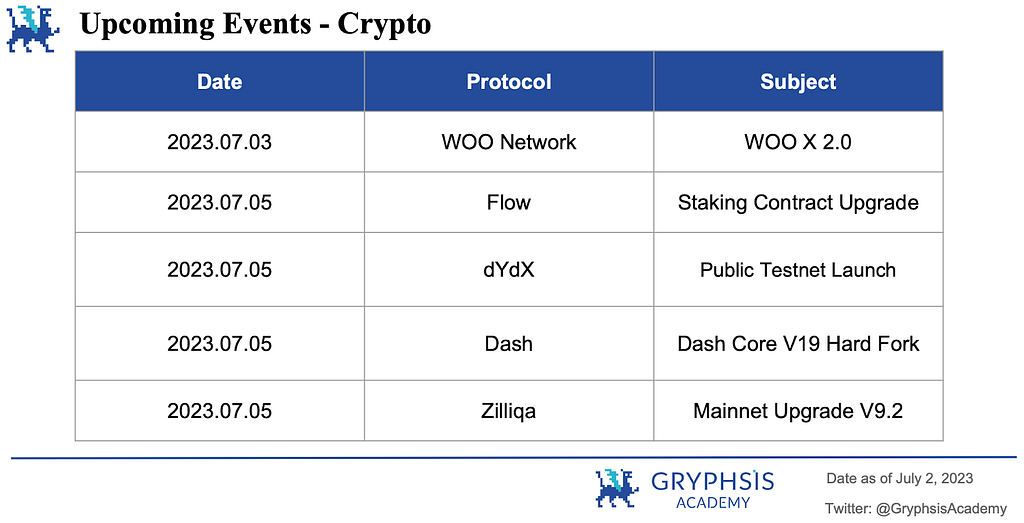
Upcoming Events



All Comments