

The information, opinions and judgments on markets, projects, currencies, etc. mentioned in this report are for reference only and do not constitute any investment advice.
Written by 0xBrooker
The structural forces in the crypto market, industry prospects and policies, US economic employment data (and the Fed's interest rate decision), capital supply, macro-financial trends and geopolitical conflicts have jointly influenced investor sentiment and determined the short-term, medium-term and long-term price trends of BTC. Among them, the factors that affect short-term prices are mainly capital supply and geopolitical conflicts.
This week's BTC price trend is a typical game between structural forces and geopolitical conflicts in the market.
Against the backdrop of neutral U.S. economic and employment data, internal structural forces and continued capital inflows pushed BTC above $110,000 again at the beginning of the week. After June 13, the sudden escalation of the Iran-Israel conflict pushed up global risk aversion, leading to a sudden drop in global stock markets and BTC prices. In the end, BTC fell slightly by 0.18% for the week, but the amplitude reached 7.47%, and the volume was reduced to close at a doji.
At present, the "soft landing" of the US economy and "lower-than-expected inflation and interest rate cuts in September" have been fully priced in, and the price of BTC has returned to the framework of "intensified geopolitical conflicts - increased risk aversion - falling prices of risky assets".
The short-term trend of BTC depends on the progress of "geopolitical conflict". If the conflict intensifies or even escalates, risk assets including BTC will remain volatile or even priced downward; if the conflict eases, equity assets may gradually recover their losses.
Policy, macro-finance and economic data
According to media reports, Iran's nuclear technology is at a breakthrough point. If the breakthrough is successful, it will be able to complete the production of nuclear weapons in a short period of time.
On June 12, the United Nations Nuclear Technical Committee passed a resolution that Iran has repeatedly failed to fulfill its nuclear non-proliferation obligations since 2019, including failing to provide full cooperation to the IAEA and the existence of undeclared nuclear materials and activities. This is seen as a criticism of Iran's nuclear program and provides a basis for Western countries to exert pressure.
On June 13, Israel launched a large-scale air strike against Iran, targeting nuclear facilities and senior military officials. In the end, Iran's nuclear facilities were significantly damaged, and more than 20 senior military officials and 6 nuclear scientists were killed.
On the night of June 13 and the morning of June 14, Iran launched a retaliatory attack, launching about 150-200 ballistic missiles in four waves against Israeli military targets, including the Kiryat military headquarters in Tel Aviv. The Iranian Revolutionary Guard claimed to have hit dozens of targets, including air bases.
At present, the United States is not directly involved in the conflict between the two sides. On the 15th, the presidents of the United States and Russia exchanged views in a telephone conference and believed that the conflict should end. However, the conflict is expected to continue for several weeks.
The escalation of the conflict between Iran and Israel has led to a sharp rise in crude oil prices, with Brent crude oil rising from $63 per barrel to $76.26 per barrel and now falling back to $73.58 per barrel. At the same time, gold prices have risen rapidly, approaching their historical highs.
The sharp rise in crude oil prices has increased market concerns that the final interest rate cut will be further delayed due to rising inflation in the United States, and has become the direct reason for the decline in US stocks.
In fact, apart from the current Iran-Israel conflict, the important economic and employment data released by the United States this week were slightly positive, enough to support a slight upward trend in U.S. stocks.
On Wednesday, the U.S. CPI data showed that the unadjusted CPI annual rate in May was 2.4%, lower than the expected 2.5%. On Thursday, the number of initial jobless claims for the week ended June 7 was 248,000, slightly higher than the expected 240,000, and the PPI annual rate was 2.6, in line with expectations. These data reinforced expectations of a rate cut. The initial one-year inflation rate forecast released on Friday was 5.1%, significantly lower than the expected 6.4%; the initial value of the University of Michigan Consumer Confidence Index in June was 60.5, significantly higher than the expected 53.5. These data show that market expectations for inflation are declining, which is good for the Fed to cut interest rates.
Because the pricing is relatively full, these data only slightly pushed up the US dollar index. The intensification of the Iran-Israel conflict has become the main trading point that dominates the market.
After the conflict broke out, oil and gold prices rose sharply, the three major U.S. stock indexes gave up their gains, and BTC fell sharply from $11,000 to around $10,000. Later, with the continued inflow of funds into the BTC Spot ETF channel, it rebounded to around $105,000 over the weekend, showing strong resilience.
The short-term trend of BTC depends on the development of "geopolitical conflicts". The medium- and long-term risks are relatively small.
Crypto Market
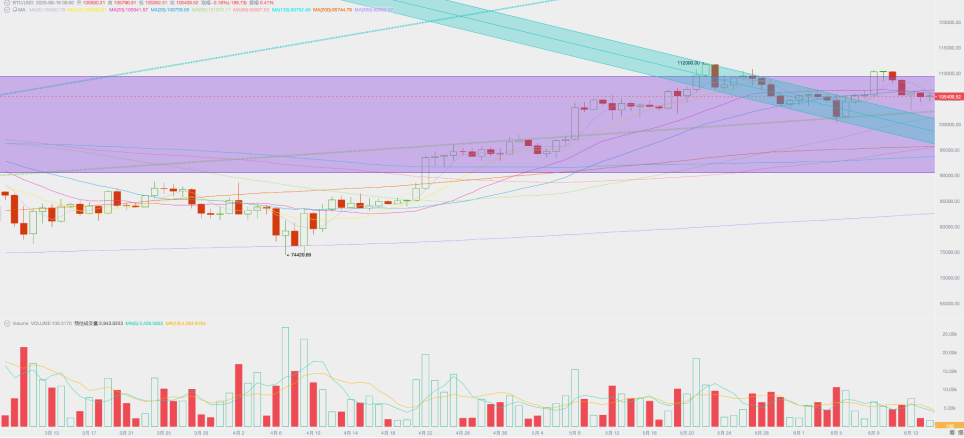
This week, BTC opened at 105784.41 and closed at 105599.25, with a slight drop of -0.18% for the whole week, an amplitude of 7.47%, and a shrinking trading volume.
On Monday, BTC surged 4.27% and once again attacked the $110,000 mark, then hovered near the mark for two days. After that, as the Iran-Israel conflict suddenly intensified, it fell to a low of $102,746.01 on Friday, and then rebounded to a narrow range around $105,000.
Judging from technical indicators, BTC is still running within the "Trump bottom", and it has again tested the support of the "bull market's first rising trend line" this Friday after last week. The trading volume has shrunk again.
The scale of contract opening continued to decline, having fallen below US$70 billion, and the on-site borrowing rates were also in a convergence state, both showing that trading parties lacked confidence when breaking through historical highs, and the scale of temporary withdrawal from transactions due to geopolitical conflicts was increasing.
Amid the sluggish trading market, more US companies are joining the game of hoarding BTC and other crypto assets. Well-known MEME stock GME announced the pricing of its private placement of zero-interest convertible senior notes and increased the fundraising scale from US$1.75 billion to US$2.25 billion. SharpLink Gaming announced on Friday that it had purchased 176,270.69 ETH ($463 million), becoming the second largest known holder after the Ethereum Foundation. However, after the announcement, the stock prices of both fell sharply.
Additionally, retail companies such as Walmart and Amazon are considering launching dollar-backed stablecoins to reduce payment friction, speed up settlement, and lower costs associated with traditional financial channels.
Next week, the U.S. Senate will hold a final vote on the GENIUS Act (stablecoin bill).
Selling pressure and selling
The long-short position structure is the basic support for the structural forces within the crypto market. Since the market adjustment in March, long positions have once again started to increase their holdings, and this week continued this trend, with about 32,000 BTC entering long positions.
Long-term investors increased their holdings, and short-term investors once again became the source of selling during geopolitical conflicts, with a total of 13,708 BTC sold this week. Overall, the amount of BTC transferred to exchanges is still declining, which shows that the current holding structure is more inclined to collect and hold chips for a long time, while the short-term investors with greater emotional fluctuations are still in a low floating profit (8%) as a whole, and are not under much pressure.
The structural forces of the crypto market remain stable and strong, becoming the fundamental force supporting BTC prices and trends.
Funds In and Out
In addition to internal structural forces, capital inflows have also become an external reason for BTC prices to remain relatively strong this week.
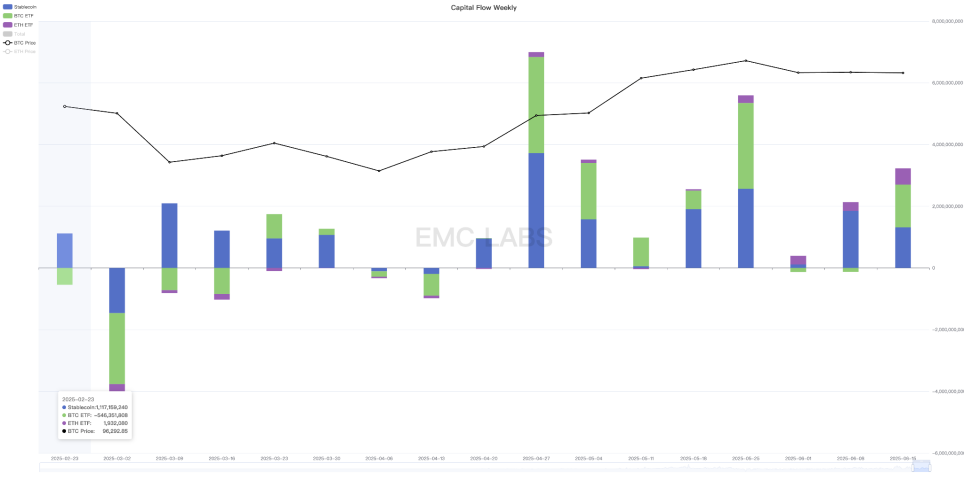
Stablecoin, BTC Spot ETH and ETH Spot ETH Inflow Statistics (Weekly)
According to eMerge Engine data, the crypto market had a total inflow of US$3.227 billion this week, including US$1.314 billion in stablecoins, US$1.384 billion in BTC Spot ETF, and US$530 million in ETH Spot ETF.
The BTC Spot ETF channel funds ended two weeks of slight outflow trend, while the ETH Spot ETF channel ushered in the largest single-week inflow so far this year.
Cycle Indicators
According to eMerge Engine, the EMC BTC Cycle Metrics indicator is 0.625 and is in an upward period.
EMC Labs was founded by crypto asset investors and data scientists in April 2023. It focuses on blockchain industry research and Crypto secondary market investment, takes industry foresight, insight and data mining as its core competitiveness, and is committed to participating in the booming blockchain industry through research and investment, and promoting blockchain and crypto assets to bring benefits to mankind.
For more information, please visit: https://www.emc.fund


All Comments